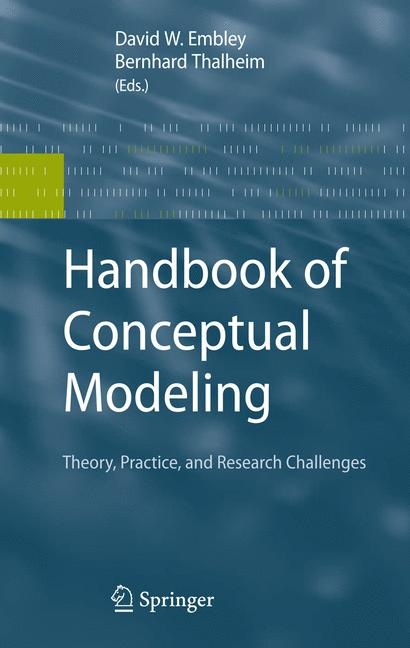
Handbook of Conceptual Modeling (eBook)
XIX, 589 Seiten
Springer Berlin (Verlag)
978-3-642-15865-0 (ISBN)
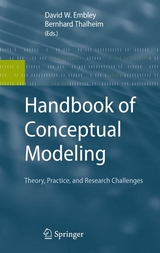
Conceptual modeling is about describing the semantics of software applications at a high level of abstraction in terms of structure, behavior, and user interaction.
Embley and Thalheim start with a manifesto stating that the dream of developing information systems strictly by conceptual modeling - as expressed in the phrase 'the model is the code' - is becoming reality. The subsequent contributions written by leading researchers in the field support the manifesto's assertions, showing not only how to abstractly model complex information systems but also how to formalize abstract specifications in ways that let developers complete programming tasks within the conceptual model itself. They are grouped into sections on programming with conceptual models, structure modeling, process modeling, user interface modeling, and special challenge areas such as conceptual geometric modeling, information integration, and biological conceptual modeling.
The Handbook of Conceptual Modeling collects in a single volume many of the best conceptual-modeling ideas, techniques, and practices as well as the challenges that drive research in the field. Thus it is much more than a traditional handbook for advanced professionals, as it also provides both a firm foundation for the field of conceptual modeling, and points researchers and graduate students towards interesting challenges and paths for how to contribute to this fundamental field of computer science.
Part I Programming with Conceptual Models 19
1 Conceptual-Model Programming: A Manifesto 20
David W. Embley, Stephen W. Liddle, and Óscar Pastor 20
1.1 Preamble 20
1.2 CMP Articles 21
1.3 Exposition 21
1.3.1 Executable Conceptual Models 21
1.3.2 Conceptual Modeling and CMP 27
Appendage 30
References 32
2 Model-Driven Software Development 34
Stephen W. Liddle 34
2.1 Introduction 34
2.2 Overview of Model-Driven Approaches 35
2.3 Modeling 38
2.4 Software Modeling 40
2.5 OSM: Making Conceptual Models Formal and Executable 42
2.6 Model-Driven Architecture (MDA) 46
2.6.1 MDA Overview 47
2.6.2 An MDA Manifesto 49
2.6.3 Executable UML 51
2.6.4 MDA Readings 53
2.7 OO-Method 54
2.8 Model-Driven Web Engineering (MDWE) 57
2.9 Agile MDD 60
2.10 Conclusions 62
References 64
Part II Structure Modelling 72
3 Entity-Relationship Model (Reprinted Historic Data) 73
Peter P.-S. Chen 73
3.1 Introduction 73
3.2 The Entity-Relationship Model 73
3.2.1 Multilevel Views of Data 74
3.2.2 Information Concerning Entities and Relationships (Level 1) 74
3.2.3 Information Structure (Level 2) 74
3.3 Entity-Relationship Diagram and Inclusion of Semantics in Data Description and Manipulation 74
3.3.1 System Analysis Using the Entity-Relationship Diagram 83
3.3.2 An Example of a Database Design and Description 83
3.3.3 Implications on Data Intergrity 83
3.3.4 Semantics and Set Operations of Information Retrieval Requests 83
3.3.5 Semantics and Rules for Insertion, Deletion, and Updating 83
3.4 Analysis of Other Data Models and Their Derivation from the Entity-Relationship Model 83
3.4.1 The Relational Model 89
3.4.2 The Network Model 89
3.4.3 The Entity Set Model 89
References 89
4 UML and OCL in Conceptual Modeling 101
Martin Gogolla 101
4.1 Introduction 101
4.2 Basic Conceptual Modeling Features in UML 102
4.2.1 Class and Object Diagrams 102
4.2.2 Object Constraint Language 105
4.3 Advanced Conceptual Schema Elements in UML 111
4.3.1 Class Diagram Features for Conceptual Schemas 112
4.3.2 Representation of Standard ER Modeling Concepts 118
4.4 Employing OCL for Conceptual Schemas 120
4.4.1 Standard ER Concepts Expressed with OCL 120
4.4.2 Constraints and Stereotypes 121
4.4.3 Queries 124
4.5 Describing Relational Schemas with UML 125
4.5.1 Relational Schemas 125
4.5.2 Constraints for Primary and Foreign Keys 126
4.6 Metamodeling Data Models with UML 127
4.6.1 Class Diagram 127
4.6.2 Object Diagrams 131
4.6.3 Constraints 132
4.7 Further Related Work 134
4.8 Conclusions 135
Appendix A: Original ER Diagram from Chen's Paper 136
References 137
5 Mapping Conceptual Models to Database Schemas 139
David W. Embley and Wai Yin Mok 139
5.1 Introduction 139
5.2 Entity-Relationship Model Mappings 140
5.2.1 Basic Mappings 140
5.2.2 Complex Key Attributes 145
5.2.3 Recursive Relationship Sets and Roles 147
5.2.4 Weak Entity Sets 149
5.3 Extended Entity-Relationship Model Mappings 151
5.3.1 ISA Mappings 151
5.3.2 Mappings for Complex Attributes 155
5.3.3 Mappings for Mandatory/Optional Participation 158
5.4 UML Mappings 161
5.5 Normal-Form Guarantees 165
5.5.1 Map – Then Normalize 167
5.5.2 Normalize – Then Map 168
5.6 Mappings for Object-Based and XML Databases 173
5.7 Additional Readings 178
References 179
6 The Enhanced Entity-Relationship Model 180
Bernhard Thalheim 180
6.1 Database Design 180
6.1.1 Database Design and Development 180
6.1.2 Implicit Assumptions and Inherent Constraints of Database Specification Languages 182
6.1.3 Storage and Representation Alternatives 183
6.1.4 The Higher-Order Entity-Relationship Model 185
6.2 Syntax of EER Models 186
6.2.1 Structuring Specification 186
6.2.2 Functionality Specification 197
6.2.3 Views in the Enhanced Entity-Relationship Models 203
6.2.4 Advanced Views and OLAP Cubes 205
6.3 Semantics of EER Models 208
6.3.1 Semantics of Structuring 208
6.3.2 Semantics of Functionality 216
6.4 Problems with Modelling and Constraint Specification 218
References 220
Part III Process Modelling 222
7 Object–Process Methodology for Structure–Behavior Codesign 223
Dov Dori 223
7.1 The Cognitive Assumptions and OPM's Design 223
7.1.1 Mayer's Three Cognitive Assumptions 224
7.1.2 Meeting the Verbal–Visual Challenge 225
7.1.3 Dual-Channel Processing and the Bimodality of OPM 225
7.1.4 Limited Capacity and the Refinement Mechanisms of OPM 228
7.1.5 Active Processing and the Animated Simulation of OPM 229
7.2 Function, Structure, and Behavior: The Three Major System Aspects 230
7.2.1 Function vs. Behavior 232
7.2.2 Ontology 233
7.3 The OPM Ontology 234
7.3.1 Entities: Objects, Processes, and Object States 235
7.4 Existence, Things, and Transformations 236
7.4.1 Physical and Informatical Objects 236
7.4.2 Object Defined 237
7.4.3 Process as a Transformation Metaphor 237
7.4.4 Process Defined 238
7.4.5 Cause and Effect 239
7.5 Syntax vs. Semantics 240
7.5.1 Objects to Semantics Is Like Nouns to Syntax 240
7.5.2 Syntactic vs. Semantic Sentence Analysis 241
7.6 The Process Test 241
7.6.1 The Preprocess Object Set and Object Involvement 242
7.6.2 The Postprocess Object Set and Object Transformation 242
7.6.3 Association with Time 243
7.6.4 Association with Verb 244
7.6.5 Boundary Cases of Objects and Processes 244
7.6.6 Thing Defined 246
7.6.7 States 247
7.6.8 Things and States Are Entities, Entities and Links are Elements 248
7.7 A Reflective Metamodel of OPM Elements 249
7.7.1 An Initial OPM Reflective Metamodel 249
7.7.2 The OPM Graphics–Text Equivalence Principle 250
7.7.3 The Five Basic Thing Attributes 250
7.8 OPM Links 252
7.8.1 Structural Links 252
7.8.2 Procedural Links 254
7.9 OPM Structure Modeling 254
7.9.1 Aggregation–Participation 256
7.9.2 Generalization–Specialization 257
7.9.3 Exhibition–Characterization 258
7.9.4 Classification–Instantiation 258
7.10 OPM Behavior Modeling 259
7.10.1 Enabling Links 259
7.10.2 Transforming Links 261
7.10.3 Control Links 263
7.11 Complexity Management 265
7.11.1 The Need for Complexity Management 266
7.11.2 Middle-Out as the De Facto Architecting Practice 267
7.11.3 The Completeness-Comprehension Dilemma 269
7.12 Applications and Standardization of OPM 269
References 270
8 Business Process Modeling and Workflow Design 273
Horst Pichler and Johann Eder 273
8.1 Introduction 273
8.1.1 Business Process Modeling and Workflow Design 274
8.1.2 Business Process Modeling Versus Workflow Design 274
8.1.3 Workflow Characteristics 275
8.2 An Overview of Process Modeling 276
8.2.1 Process Perspectives 276
8.2.2 Process Modeling Techniques 278
8.2.3 Standardization Efforts 279
8.3 Modeling Process Perspectives 280
8.3.1 Control Flow Perspective 280
8.3.2 Organizational Perspective 282
8.3.3 Data Perspective 285
8.4 Detection and Avoidance of Control Flow Errors 288
8.4.1 Control Flow Errors 288
8.4.2 Blocked Structures 289
8.4.3 Sound Processes 290
8.5 Process Views 292
8.5.1 Process Graph 293
8.5.2 Correctness of Process Views 293
8.5.3 Generation of Process Views by Activity Elimination 293
8.6 Timed Processes 294
8.6.1 Modeling the Temporal Perspective 295
8.6.2 Timed Graph 296
8.7 Conclusions 298
References 299
9 BPMN Core Modeling Concepts: Inheritance-Based Execution Semantics 301
Egon Börger, Ove Sörensen 301
9.1 Introduction 301
9.2 Structure of the Class Hierarchy of BPMN 2.0 303
9.2.1 Message Flow 303
9.2.2 Diagram Structure (Sequence Flow) 303
9.2.3 Flow Nodes 305
9.3 Gateways 306
9.3.1 Parallel Gateway (Fork and Join) 308
9.3.2 Exclusive Gateway (Data-Based Exclusive Decision) 308
9.3.3 Inclusive Gateway 309
9.3.4 Event-Based Gateway (Event-Based Exclusive Decision) 310
9.3.5 Complex Gateway 313
9.4 Activities 315
9.4.1 Tasks 317
9.4.2 Subprocesses 319
9.4.3 Call Activity 323
9.4.4 Iterated (Loop) Activities 323
9.5 Events 326
9.5.1 Start Events 327
9.5.2 End Events 328
9.5.3 Intermediate Events 330
9.5.4 Boundary Events 333
9.6 An Example 334
9.7 Conclusion 336
Appendix 337
9.7.1 Gateway Behavior 337
9.7.2 Activity Behavior 340
9.7.3 Event Behavior 343
References 346
Part IV User Interface Modelling 347
10 Conceptual Modelling of Interaction 348
Nathalie Aquino, Jean Vanderdonckt, José Ignacio Panach, and Óscar Pastor 348
10.1 Introduction 349
10.2 Related Work 351
10.3 The Presentation Model of OO-Method 354
10.3.1 Elementary Patterns 355
10.3.2 Interaction Units 356
10.3.3 Hierarchical Action Tree 359
10.4 Explicitly Distinguishing Abstract and Concrete Interaction Modeling in OO-Method 360
10.4.1 Abstract Interaction Modeling 360
10.4.2 Concrete Interaction Modeling: Transformation Templates 360
10.5 Conclusion 365
References 369
11 Conceptual Modelling of Application Stories 372
Antje Düsterhöft, Klaus-Dieter Schewe 372
11.1 Introduction 372
11.2 The Conceptual Model of Storyboarding 373
11.2.1 The Storyboard 374
11.2.2 Plots 378
11.3 Pragmatics of Storyboarding 380
11.3.1 Life Cases 380
11.3.2 User Modelling 382
11.3.3 Contexts 384
11.4 Analysis of Storyboards 385
11.4.1 Customisation with Respect to Preferences 385
11.4.2 Deontic Consistency 387
11.5 Bibliographic Remarks 388
References 389
Part V Special Challenge Area 391
12 Evolution and Migration of Information Systems 392
Meike Klettke, Bernhard Thalheim 392
12.1 Introduction 393
12.1.1 Information System Modernisation 393
12.1.2 Models for Information Systems 393
12.2 Overview of System Modernisations 395
12.2.1 Fundamental Terms 395
12.2.2 Migration, Evolution, and Legacy 396
12.2.3 Evolving Information Systems 397
12.3 Foundations of Evolution and Migration Transformations 399
12.3.1 Specification of Information System Models 399
12.3.2 Model Construction and Combination 402
12.3.3 Evolving Information Systems 404
12.3.4 Properties of Evolving Information Systems 406
12.4 Strategies for Migration 409
12.4.1 Big Bang 410
12.4.2 Chicken Little 413
12.4.3 Butterfly 416
12.5 Evolution 420
12.5.1 Evolution on a Small Scale 420
12.5.2 Wrapper-Based Evolution 423
12.5.3 Refinement of the Information System Model 426
12.6 Related Work 428
References 428
13 Conceptual Geometric Modelling 431
Hui Ma and Klaus-Dieter Schewe 431
13.1 Introduction 431
13.2 Spatial Data Models 434
13.3 Geometrically Enhanced ER Model (GERM) 436
13.3.1 Data Types and Nested Attributes 436
13.3.2 Entity and Relationship Types 437
13.3.3 Schemata and Instances 439
13.4 Geometric Types and Algebraic Varieties 439
13.4.1 Natural Modelling Algebra 441
13.4.2 Computing with Polyhedra and Surface Representations 442
13.4.3 The Choice of the Natural Modelling Function 444
13.5 Key Application Area GIS 444
13.6 Conclusion 448
References 449
14 Data Integration 451
Sonia Bergamaschi et al. 451
14.1 Outcomes and Challenges in Data Integration 451
14.1.1 Mediator-Based Systems 455
14.2 The MOMIS Integration Framework 466
14.2.1 The MOMIS Integration System 466
14.2.2 Global Schema Generation 467
14.2.3 Global Schema Refinement 470
14.2.4 Querying the MOMIS System 476
14.2.5 New Trends in the MOMIS System 481
14.3 Conclusions 482
References 482
15 Conceptual Modeling Foundations for a Web of Knowledge 487
David W. Embley, Stephen W. Liddle and Deryle W. Lonsdale 487
15.1 Introduction 487
15.2 WoK Conceptualization 489
15.3 WoK Formalization 494
15.4 WoK Construction 498
15.4.1 Construction via XML Reverse Engineering 499
15.4.2 Construction via Nested Table Interpretation 500
15.4.3 Construction via Semantic Integration 503
15.4.4 Construction via Form Filling 510
15.5 WoK Usage 512
15.5.1 Free-Form Query Processing 513
15.5.2 Grounded Reasoning Chains 515
15.5.3 Knowledge Bundles for Research Studies 518
15.6 Conclusion 521
References 523
16 A Conceptual Modeling Approach to Improve Human Genome Understanding 527
Óscar Pastor et al. 527
16.1 Introduction 527
16.2 Why a Conceptual Model for the Human Genome? 529
16.3 Models: Explaining the Domain 531
16.4 Existing Modeling/Ontology-Based Approaches 537
16.5 Results of Conceptual Modeling 540
16.6 Problem Statement and Conclusions 547
References 548
17 The Theory of Conceptual Models, the Theory of Conceptual Modelling and Foundations of Conceptual Modelling 552
Bernhard Thalheim 552
17.1 Towards a Theory of Conceptual Models and Conceptual Modelling 552
17.1.1 Artifacts, Concepts and Intentions 554
17.1.2 Dimensions of Models and Modelling 556
17.1.3 Postulates of Modelling 561
17.1.4 Artifacts and Models 563
17.2 The Theory of Conceptual Models 564
17.2.1 Conceptual Models and Languages 564
17.2.2 Concepts and Models 571
17.2.3 Information Exchange of Stakeholders Based on Models 573
17.2.4 Mappings Among Models and Originals 575
17.2.5 Development Phases That Use Models 579
17.2.6 Properties of the Models-Origin and the Models-Reflections Analogies 582
17.3 Conclusion 584
References 585
Index 587
| Erscheint lt. Verlag | 23.4.2012 |
|---|---|
| Zusatzinfo | XIX, 589 p. |
| Verlagsort | Berlin |
| Sprache | englisch |
| Themenwelt | Mathematik / Informatik ► Informatik |
| Schlagworte | conceptual modeling • Domain Engineering • ERM - Entity Relationship Model • model-driven software development • UML - Unified Modeling Language |
| ISBN-10 | 3-642-15865-X / 364215865X |
| ISBN-13 | 978-3-642-15865-0 / 9783642158650 |
| Informationen gemäß Produktsicherheitsverordnung (GPSR) | |
| Haben Sie eine Frage zum Produkt? |
 PDF (Wasserzeichen)
DRM: Digitales Wasserzeichen
Dieses eBook enthält ein digitales Wasserzeichen und ist damit für Sie personalisiert. Bei einer missbräuchlichen Weitergabe des eBooks an Dritte ist eine Rückverfolgung an die Quelle möglich.
Dateiformat: PDF (Portable Document Format)
Mit einem festen Seitenlayout eignet sich die PDF besonders für Fachbücher mit Spalten, Tabellen und Abbildungen. Eine PDF kann auf fast allen Geräten angezeigt werden, ist aber für kleine Displays (Smartphone, eReader) nur eingeschränkt geeignet.
Systemvoraussetzungen:
PC/Mac: Mit einem PC oder Mac können Sie dieses eBook lesen. Sie benötigen dafür einen PDF-Viewer - z.B. den Adobe Reader oder Adobe Digital Editions.
eReader: Dieses eBook kann mit (fast) allen eBook-Readern gelesen werden. Mit dem amazon-Kindle ist es aber nicht kompatibel.
Smartphone/Tablet: Egal ob Apple oder Android, dieses eBook können Sie lesen. Sie benötigen dafür einen PDF-Viewer - z.B. die kostenlose Adobe Digital Editions-App.
Buying eBooks from abroad
For tax law reasons we can sell eBooks just within Germany and Switzerland. Regrettably we cannot fulfill eBook-orders from other countries.
aus dem Bereich