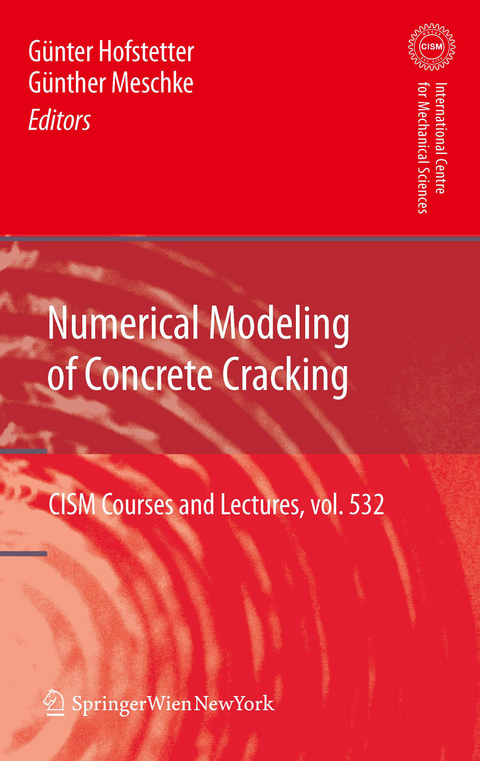
Numerical Modeling of Concrete Cracking (eBook)
VII, 327 Seiten
Springer Wien (Verlag)
978-3-7091-0897-0 (ISBN)
Title Page 4
Copyright Page 5
PREFACE 6
Table of Contents 7
Damage and Smeared Crack Models 8
1 Isotropic Damage Models 8
1.1 One-Dimensional DamageModel 8
1.2 DamageModels with Strain-Based Loading Functions 12
2 Smeared Crack Models 22
2.1 One-Dimensional Smeared Crack Model 23
2.2 Multi-Dimensional Smeared Crack Models 27
2.3 Fixed Crack Model 28
2.4 Rotating Crack Model 30
2.5 Rotating Crack Model with Transition to Scalar Damage 32
2.6 Examples of Failure Simulations 34
3 Strain Localization due to Softening 36
3.1 Strain Localization in One Dimension 36
3.2 Strain Localization in Multiple Dimensions 39
3.3 Mesh-Adjusted Softening Modulus (Crack Band Approach) 42
4 Regularized Softening Models 46
4.1 Integral-Type Nonlocal Models 46
4.2 Gradient-Enhanced Models 49
4.3 Examples of Failure Simulations 51
Acknowledgment 53
Bibliography 53
Cracking and Fracture of Concrete at Meso-levelusing Zero-thickness Interface Elements 57
1. Introduction 57
1.1. Historical Aspects, General Considerations 57
1.2. Meso-structural Geometries, Discretization 58
1.3. Fracture-based Interface Constitutive Law with Aging Effect 58
1.4. Aging Viscoelastic Model for the Matrix-phase 66
2. Original Results in 2D under Mechanical Loading 67
3. Extension to 3D 70
3.1. Geometry and Meshes 70
3.2. Extension of the Constitutive Model to 3D 72
3.3. Computational and Graphics Aspects 73
3.4. Results 73
4. Deterioration due to Diffusion-driven EnvironmentalPhenomena: Drying Shrinkage and External Sulphate Attack 79
4.1. Hygro-mechanical Modeling of Drying Shrinkage 79
4.2. Chemo-mechanical Analysis of External Sulfate Attack 88
Description of the chemo-transport model 89
Main results of the model 93
5. Concluding remarks and on-going developments 96
Acknowledgements 97
References 97
Crack Models with Embedded Discontinuities 104
1 Fracture Problem Approaches Based on ContinuumConstitutive Relations 104
1.1 Motivation: Idealization of the Fracture Process Zone (FPZ) in Quasi-Brittle Material 104
1.2 Stability and Uniqueness of the Mechanical Boundary Value Problem(BVP) 108
1.3 Example of a Material Model Subjected to Stability Loss and Bifurcation:Isotropic continuum damage model for concrete 111
2 Material Failure Analysis Using the Continuum-StrongDiscontinuity Approach (CSDA) 113
2.1 Motivation 113
2.2 The 1D Continuum-Strong Discontinuity Approach (CSDA) 118
2.3 The Continuum-Strong Discontinuity Approach in 3D Problems 123
3 Finite Elements with Embedded Discontinuities 125
3.1 Strong Discontinuities: The Local Form of the BVP Governing Equations 126
3.2 A Variational Consistent Formulation of the BVP with Strong Discontinuities 127
3.3 Finite Elements with Embedded Discontinuities 129
3.4 An Embedded Strong Discontinuity FE not Needing the Crack PathContinuity Enforcement 133
4 Algorithmic Aspects of the CSDA 136
4.1 A Global Tracking Algorithm 137
4.2 Factors Influencing the Stability and Accuracy of the Numerical Method 139
5 Applications of the CSDA Methodology to ConcreteFracture Problems 143
5.1 Modeling the Fracture Process Zone 144
5.1.1 The Three-Point Bending Test 145
5.1.2 Double Cantilever Beam (DCB Test) 148
5.2 Size Effect Analysis 149
5.2.1 The Brazilian Test 150
5.3 Dynamic Fracture Simulation 151
6 A Model for Reinforced Concrete Fracture via CSDA andMixture Theory 153
6.1 A Mixture Theory for Reinforced Concrete 154
6.2 Constitutive Model for the Composite: Regularization Procedure basedon the CSDA 155
6.3 Representative numerical simulations 157
Bibliography 162
Plasticity based crack models and applications 165
1 Introduction 165
2 Plasticity Based 2D Concrete Model with SmearedCracks 166
2.1 Formulation for plain concrete 166
2.2 Extension to reinforced concrete 174
2.3 Validation 178
2.4 Applications 182
3 Plasticity Based Crack Model with EmbeddedDiscontinuities 195
3.1 Strong Discontinuity Kinematics 195
3.2 Determination of the displacement jump and the stresses 200
3.3 Finite element discretization 204
3.4 Determination of the crack direction 206
3.5 Crack Tracking Algorithm 208
3.6 Validation 209
3.7 Application 216
Bibliography 219
Crack models based on the extended finiteelement method 224
1 Introduction 224
2 Background on discretization methods 225
2.1 Problem description and notations 225
2.3 The finite element method 226
2.4 Meshless methods 228
2.5 The partition of unity 230
3 Discontinuity modeling with the X-FEM and levelsets 231
3.1 A simple 1D problem 231
3.2 Extension to 2D and 3D 235
3.3 Cracks located by level sets 239
4 Technical and mathematical aspects 243
4.1 Integration of the element stiffness 243
4.2 Topological and geometrical enrichment strategies 243
4.3 Solver and condition number 246
4.4 Inf-sup condition for cracks under contact 248
5 Configurational analysis of the crack front 256
5.1 The Eshelby tensor 256
5.2 Energy integrals 259
5.3 Energetic information for cohesive cracks 260
Bibliography 264
Smeared Crack and X-FEM Modelsin the Context of Poromechanics 268
1 Elastoplastic-Damage Models for Concrete 268
1.1 Introductory Remarks 268
1.2 Evolution Equations 269
1.3 Damage and Yield Surfaces 272
1.4 Numerical Analysis of a Notched Concrete Beam 274
2 Hygro-mechanical Couplings in Concrete 276
2.1 Concrete Microstructure and Hygral Forces 276
2.2 Drying Creep 278
3 Fundamentals of Poromechanics 280
3.1 Concept of Volume Fractions 282
3.2 Kinematics 283
3.3 Balance of Momentum 283
3.4 Mass Balance Equations 284
3.5 Constitutive Equations 285
3.6 Transport of Water and Heat 286
4 Poroplastic-Damage Model for Concrete 286
4.1 State Equations 287
4.2 Coupling Coefficients 289
4.3 Effective stresses 290
4.4 Multisurface Poroplastic-Damage Model 292
4.5 Long-term Creep 293
4.6 Capillary-Pressure Relation 294
4.7 Moisture Transport 295
4.8 Finite Element Formulation 298
4.9 Application: Drying and Re-wetting of a Base-RestrainedConcrete Wall 300
5 Hygromechanical Extended Finite Element Modelfor Concrete 302
5.1 Introduction 302
5.2 X-FEM Resolution of Cracks 303
5.3 Weak Form of Balance of Momentum 304
5.4 Extension to Coupled Hygro-Mechanical Analyses 306
5.5 Finite Element Implementation 306
5.6 Crack Tracking Algorithm 307
5.7 Numerical Solution 307
5.8 Numerical Applications 312
Bibliography 323
| Erscheint lt. Verlag | 8.10.2011 |
|---|---|
| Reihe/Serie | CISM International Centre for Mechanical Sciences | CISM International Centre for Mechanical Sciences |
| Zusatzinfo | VII, 327 p. |
| Verlagsort | Vienna |
| Sprache | englisch |
| Themenwelt | Mathematik / Informatik ► Informatik |
| Technik ► Bauwesen | |
| Technik ► Maschinenbau | |
| Schlagworte | Discrete crack model • embedded discontinuity • extended finite element method • Poromechanics • smeared crack model |
| ISBN-10 | 3-7091-0897-7 / 3709108977 |
| ISBN-13 | 978-3-7091-0897-0 / 9783709108970 |
| Informationen gemäß Produktsicherheitsverordnung (GPSR) | |
| Haben Sie eine Frage zum Produkt? |
 PDF (Wasserzeichen)
DRM: Digitales Wasserzeichen
Dieses eBook enthält ein digitales Wasserzeichen und ist damit für Sie personalisiert. Bei einer missbräuchlichen Weitergabe des eBooks an Dritte ist eine Rückverfolgung an die Quelle möglich.
Dateiformat: PDF (Portable Document Format)
Mit einem festen Seitenlayout eignet sich die PDF besonders für Fachbücher mit Spalten, Tabellen und Abbildungen. Eine PDF kann auf fast allen Geräten angezeigt werden, ist aber für kleine Displays (Smartphone, eReader) nur eingeschränkt geeignet.
Systemvoraussetzungen:
PC/Mac: Mit einem PC oder Mac können Sie dieses eBook lesen. Sie benötigen dafür einen PDF-Viewer - z.B. den Adobe Reader oder Adobe Digital Editions.
eReader: Dieses eBook kann mit (fast) allen eBook-Readern gelesen werden. Mit dem amazon-Kindle ist es aber nicht kompatibel.
Smartphone/Tablet: Egal ob Apple oder Android, dieses eBook können Sie lesen. Sie benötigen dafür einen PDF-Viewer - z.B. die kostenlose Adobe Digital Editions-App.
Buying eBooks from abroad
For tax law reasons we can sell eBooks just within Germany and Switzerland. Regrettably we cannot fulfill eBook-orders from other countries.
aus dem Bereich