


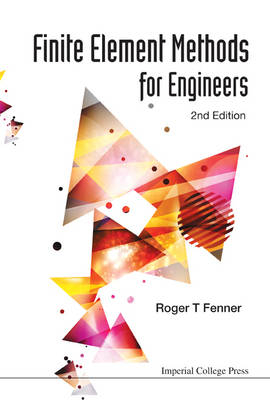
Finite Element Methods For Engineers (2nd Edition)
Seiten
2013
|
2nd Revised edition
Imperial College Press (Verlag)
9781848168862 (ISBN)
Imperial College Press (Verlag)
9781848168862 (ISBN)
Despite being somewhat unfashionable for general programming purposes, the FORTRAN language remains very widely used in engineering. The programs listed, which were originally developed for use on mainframe computers, have been thoroughly updated for use on desktops and laptops. This book is suitable for engineers, both students and professionals.
This book is intended as a textbook providing a deliberately simple introduction to finite element methods in a way that should be readily understandable to engineers, both students and practising professionals. Only the very simplest elements are considered, mainly two dimensional three-noded “constant strain triangles”, with simple linear variation of the relevant variables. Chapters of the book deal with structural problems (beams), classification of a broad range of engineering into harmonic and biharmonic types, finite element analysis of harmonic problems, and finite element analysis of biharmonic problems (plane stress and plane strain). Full FORTRAN programs are listed and explained in detail, and a range of practical problems solved in the text. Despite being somewhat unfashionable for general programming purposes, the FORTRAN language remains very widely used in engineering. The programs listed, which were originally developed for use on mainframe computers, have been thoroughly updated for use on desktops and laptops. Unlike the first edition, the new edition has problems (with solutions) at the end of each chapter.
This book is intended as a textbook providing a deliberately simple introduction to finite element methods in a way that should be readily understandable to engineers, both students and practising professionals. Only the very simplest elements are considered, mainly two dimensional three-noded “constant strain triangles”, with simple linear variation of the relevant variables. Chapters of the book deal with structural problems (beams), classification of a broad range of engineering into harmonic and biharmonic types, finite element analysis of harmonic problems, and finite element analysis of biharmonic problems (plane stress and plane strain). Full FORTRAN programs are listed and explained in detail, and a range of practical problems solved in the text. Despite being somewhat unfashionable for general programming purposes, the FORTRAN language remains very widely used in engineering. The programs listed, which were originally developed for use on mainframe computers, have been thoroughly updated for use on desktops and laptops. Unlike the first edition, the new edition has problems (with solutions) at the end of each chapter.
Introduction and Structural Analysis; Continuum Mechanics Problems; Finite Element Analysis of Harmonic Problems; Finite Element Meshes; Some Harmonic Problems; Finite Element Analysis of Biharmonic Problems; Some Biharmonic Problems; Further Applications.
| Erscheint lt. Verlag | 18.3.2013 |
|---|---|
| Verlagsort | London |
| Sprache | englisch |
| Themenwelt | Mathematik / Informatik ► Mathematik ► Angewandte Mathematik |
| Technik ► Maschinenbau | |
| ISBN-13 | 9781848168862 / 9781848168862 |
| Zustand | Neuware |
| Informationen gemäß Produktsicherheitsverordnung (GPSR) | |
| Haben Sie eine Frage zum Produkt? |
Mehr entdecken
aus dem Bereich

aus dem Bereich
für Ingenieure und Naturwissenschaftler
Buch | Softcover (2024)
Springer Vieweg (Verlag)
CHF 48,95
Buch | Softcover (2025)
Springer Vieweg (Verlag)
CHF 62,95
Buch | Softcover (2025)
Springer Fachmedien Wiesbaden (Verlag)
CHF 69,95


