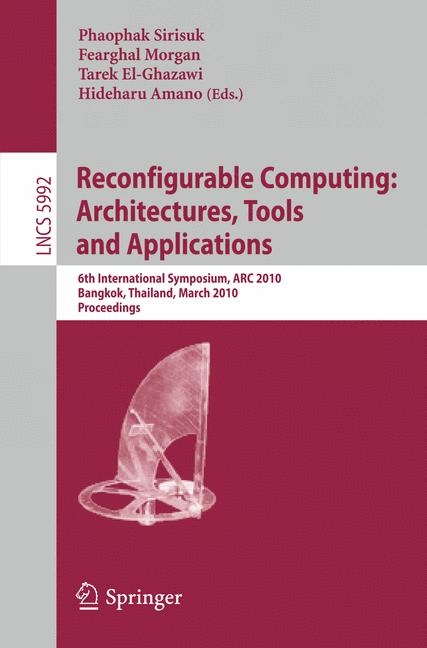
Reconfigurable Computing: Architectures, Tools and Applications (eBook)
XIV, 450 Seiten
Springer Berlin (Verlag)
978-3-642-12133-3 (ISBN)
Keynotes (Abstracts).- High-Performance Energy-Efficient Reconfigurable Accelerators/Co-processors for Tera-Scale Multi-core Microprocessors.- Process Variability and Degradation: New Frontier for Reconfigurable.- Towards Analytical Methods for FPGA Architecture Investigation.- Session 1: Architectures 1.- Generic Systolic Array for Run-Time Scalable Cores.- Virtualization within a Parallel Array of Homogeneous Processing Units.- Feasibility Study of a Self-healing Hardware Platform.- Session 2: Applications 1.- Application-Specific Signatures for Transactional Memory in Soft Processors.- Towards Rapid Dynamic Partial Reconfiguration in Video-Based Driver Assistance Systems.- Parametric Encryption Hardware Design.- A Reconfigurable Implementation of the Tate Pairing Computation over GF(2 m ).- Session 3: Architectures 2.- Application Specific FPGA Using Heterogeneous Logic Blocks.- Reconfigurable Communication Networks in a Parametric SIMD Parallel System on Chip.- A Dedicated Reconfigurable Architecture for Finite State Machines.- MEMS Dynamic Optically Reconfigurable Gate Array Usable under a Space Radiation Environment.- Session 4: Applications 2.- An FPGA Accelerator for Hash Tree Generation in the Merkle Signature Scheme.- A Fused Hybrid Floating-Point and Fixed-Point Dot-Product for FPGAs.- Optimising Memory Bandwidth Use for Matrix-Vector Multiplication in Iterative Methods.- Design of a Financial Application Driven Multivariate Gaussian Random Number Generator for an FPGA.- Session 5: Design Tools 1.- 3D Compaction: A Novel Blocking-Aware Algorithm for Online Hardware Task Scheduling and Placement on 2D Partially Reconfigurable Devices.- TROUTE: A Reconfigurability-Aware FPGA Router.- Space and Time Sharing of Reconfigurable Hardware for Accelerated Parallel Processing.- Routing-Aware Application Mapping Considering Steiner Points for Coarse-Grained Reconfigurable Architecture.- Session 6: Design Tools 2.- Design Automation for Reconfigurable Interconnection Networks.- A Framework for Enabling Fault Tolerance in Reconfigurable Architectures.- QUAD – A Memory Access Pattern Analyser.- Hierarchical Loop Partitioning for Rapid Generation of Runtime Configurations.- Session 7: Applications 3.- Reconfigurable Computing and Task Scheduling for Active Storage Service Processing.- A Reconfigurable Disparity Engine for Stereovision in Advanced Driver Assistance Systems.- A Modified Merging Approach for Datapath Configuration Time Reduction.- Posters.- Reconfigurable Computing Education in Computer Science.- Hardware Implementation of the Orbital Function for Quantum Chemistry Calculations.- Reconfigurable Polyphase Filter Bank Architecture for Spectrum Sensing.- Systolic Algorithm Mapping for Coarse Grained Reconfigurable Array Architectures.- A GMM-Based Speaker Identification System on FPGA.- An FPGA-Based Real-Time Event Sampler.- A Performance Evaluation of CUBE: One-Dimensional 512 FPGA Cluster.- An Analysis of Delay Based PUF Implementations on FPGA.- Comparison of Bit Serial Computation with Bit Parallel Computation for Reconfigurable Processor.- FPGA Implementation of QR Decomposition Using MGS Algorithm.- Memory-Centric Communication Architecture for Reconfigurable Computing.- Integrated Design Environment for Reconfigurable HPC.- Architecture-Aware Custom Instruction Generation for Reconfigurable Processors.- Cost and Performance Evaluation of a Noise Filter for Partitioning in Co-design Methodologies.- Towards a Tighter Integration of Generated and Custom-Made Hardware.- Pipelined Microprocessors Optimization and Debugging.
| Erscheint lt. Verlag | 10.3.2010 |
|---|---|
| Reihe/Serie | Lecture Notes in Computer Science | Theoretical Computer Science and General Issues |
| Verlagsort | Berlin |
| Sprache | englisch |
| Themenwelt | Mathematik / Informatik ► Informatik ► Netzwerke |
| Schlagworte | 3D graphics • algorithms • Arc • Debugging • Design • Router • Routing • Scheduling |
| ISBN-10 | 3-642-12133-0 / 3642121330 |
| ISBN-13 | 978-3-642-12133-3 / 9783642121333 |
| Informationen gemäß Produktsicherheitsverordnung (GPSR) | |
| Haben Sie eine Frage zum Produkt? |
 PDF (Adobe DRM)
Kopierschutz: Adobe-DRM
Adobe-DRM ist ein Kopierschutz, der das eBook vor Mißbrauch schützen soll. Dabei wird das eBook bereits beim Download auf Ihre persönliche Adobe-ID autorisiert. Lesen können Sie das eBook dann nur auf den Geräten, welche ebenfalls auf Ihre Adobe-ID registriert sind.
Details zum Adobe-DRM
Dateiformat: PDF (Portable Document Format)
Mit einem festen Seitenlayout eignet sich die PDF besonders für Fachbücher mit Spalten, Tabellen und Abbildungen. Eine PDF kann auf fast allen Geräten angezeigt werden, ist aber für kleine Displays (Smartphone, eReader) nur eingeschränkt geeignet.
Systemvoraussetzungen:
PC/Mac: Mit einem PC oder Mac können Sie dieses eBook lesen. Sie benötigen eine
eReader: Dieses eBook kann mit (fast) allen eBook-Readern gelesen werden. Mit dem amazon-Kindle ist es aber nicht kompatibel.
Smartphone/Tablet: Egal ob Apple oder Android, dieses eBook können Sie lesen. Sie benötigen eine
Geräteliste und zusätzliche Hinweise
Buying eBooks from abroad
For tax law reasons we can sell eBooks just within Germany and Switzerland. Regrettably we cannot fulfill eBook-orders from other countries.
aus dem Bereich