Precision Assembly Technologies and Systems (eBook)
XIV, 346 Seiten
Springer Berlin (Verlag)
978-3-642-11598-1 (ISBN)
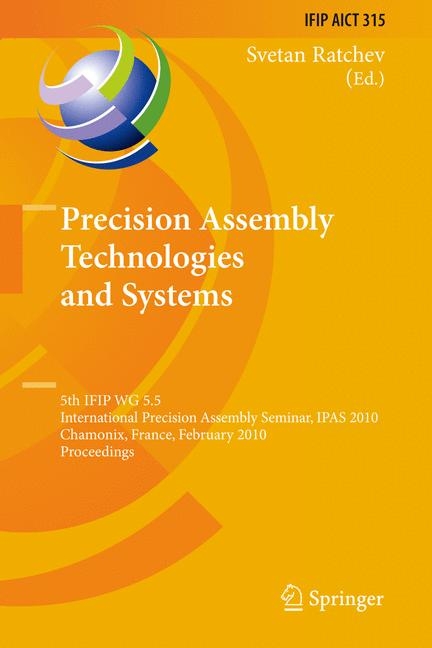
The development of new-generation micro-manufacturing technologies and systems has revolutionised the way products are designed and manufactured today with a s- nificant impact in a number of key industrial sectors. Micro-manufacturing techno- gies are often described as disruptive, enabling and interdisciplinary leading to the creation of whole new classes of products that were previously not feasible to ma- facture. While key processes for volume manufacture of micro-parts such as mach- ing and moulding are becoming mature technologies, micro-assembly remains a key challenge for the cost-effective manufacture of complex micro-products. The ability to manufacture customizable micro-products that can be delivered in variable volumes within relatively short timescales is very much dependent on the level of development of the micro-assembly processes, positioning, alignment and measurement techniques, gripping and feeding approaches and devices. Micro-assembly has developed rapidly over the last few years and all the pred- tions are that it will remain a critical technology for high-value products in a number of key sectors such as healthcare, communications, defence and aerospace. The key challenge is to match the significant technological developments with a new gene- tion of micro-products that will establish firmly micro-assembly as a mature manuf- turing process. th The book includes the set of papers presented at the 5 International Precision - sembly Seminar IPAS 2010 held in Chamonix, France from the 14th to the 17th February 2010.
Design of Micro Products.- Analysis of the Applicability of Design for Microassembly Theory to Biomedical Devices.- A Haptic Tele-operated System for Microassembly.- Neutral Interface for Assembly and Manufacturing Related Knowledge Exchange in Heterogeneous Design Environment.- Defining Tolerances in Assembly Process with the Aid of Simulation.- Assembly Analysis of Interference Fits in Elastic Materials.- How Form Errors Impact on 2D Precision Assembly with Clearance?.- Micro-assembly Processes.- Precision Assembling and Hybrid Bonding for Micro Fluidic Systems.- Feasibility of Laser Induced Plasma Micro-machining (LIP-MM).- Focused Ion Beam Micro Machining and Micro Assembly.- Hybrid Assembly for Ultra-Precise Manufacturing.- Development of the Roll Type Incremental Micro Pattern Imprint System for Large Area Pattern Replication.- Utilisation of FIB/SEM Technology in the Assembly of an Innovative Micro-CMM Probe.- Miniaturized Camera Systems for Microfactories.- Vision and Force Sensing to Decrease Assembly Uncertainty.- Modelling the Interaction Forces between an Ideal Measurement Surface and the Stylus Tip of a Novel Vibrating Micro-scale CMM Probe.- Gripping and Feeding Solutions for Micro-assembly.- Alignment Procedures for Micro-optics.- Pneumatic Driven Positioning and Alignment System for the Assembly of Hybrid Microsystems.- Flexure-Based 6-Axis Alignment Module for Automated Laser Assembly.- Approach for the 3D-Alignment in Micro- and Nano-scale Assembly Processes.- Guidelines for Implementing Augmented Reality Procedures in Assisting Assembly Operations.- Monodirectional Positioning Using Dielectric Elastomers.- Active Gripper for Hot Melt Joining of Micro Components.- Grasping and Interaction Force Feedback in Microassembly.- Low Voltage Thermo-mechanically Driven Monolithic Microgripper with Piezoresistive Feedback.- Improvement of Robotic Micromanipulations Using Chemical Functionalisations.- Positioning, Structuring and Controlling with Nanoprecision.- Challenges of Precision Assembly with a Miniaturized Robot.- Development of Micro-assembly Production Systems.- Application of a Reconfiguration Methodology for Multiple Assembly System Reconfigurations.- Multi-agent Architecture for Reconfiguration of Precision Modular Assembly Systems.- Reconfigurable Self-optimising Handling System.- Modular and Generic Control Software System for Scalable Automation.- Agile Multi-parallel Micro Manufacturing Using a Grid of Equiplets.- Development of a Reconfigurable Fixture for the Automated Assembly and Disassembly of High Pressure Rotors for Rolls-Royce Aero Engines.- Architectures and Interfaces for a Micro Factory Concept.- Desktop Micro Forming System for Micro Pattern on the Metal Substrate.- Miniaturization of Flexible Screwing Cell.- A Cooperation Model and Demand-Oriented ICT Infrastructure for SME Development and Production Networks in the Field of Microsystem Technology.- A Methodology for Evaluating the Technological Maturity of Micro and Nano Fabrication Processes.- Function and Length Scale Integration Study in Emerging MST-Based Products.
| Erscheint lt. Verlag | 6.2.2010 |
|---|---|
| Reihe/Serie | IFIP Advances in Information and Communication Technology |
| Verlagsort | Berlin |
| Sprache | englisch |
| Themenwelt | Mathematik / Informatik ► Informatik |
| Schlagworte | micro assembly • micro factory • micro handling • micromanipulations • micro manufacturing • micro robots • miniaturization • Model • nano devices • nano fabrication • nano robots • pneumatic systems • Robotics • Simulation • wafers |
| ISBN-10 | 3-642-11598-5 / 3642115985 |
| ISBN-13 | 978-3-642-11598-1 / 9783642115981 |
| Informationen gemäß Produktsicherheitsverordnung (GPSR) | |
| Haben Sie eine Frage zum Produkt? |
 PDF (Adobe DRM)
Kopierschutz: Adobe-DRM
Adobe-DRM ist ein Kopierschutz, der das eBook vor Mißbrauch schützen soll. Dabei wird das eBook bereits beim Download auf Ihre persönliche Adobe-ID autorisiert. Lesen können Sie das eBook dann nur auf den Geräten, welche ebenfalls auf Ihre Adobe-ID registriert sind.
Details zum Adobe-DRM
Dateiformat: PDF (Portable Document Format)
Mit einem festen Seitenlayout eignet sich die PDF besonders für Fachbücher mit Spalten, Tabellen und Abbildungen. Eine PDF kann auf fast allen Geräten angezeigt werden, ist aber für kleine Displays (Smartphone, eReader) nur eingeschränkt geeignet.
Systemvoraussetzungen:
PC/Mac: Mit einem PC oder Mac können Sie dieses eBook lesen. Sie benötigen eine
eReader: Dieses eBook kann mit (fast) allen eBook-Readern gelesen werden. Mit dem amazon-Kindle ist es aber nicht kompatibel.
Smartphone/Tablet: Egal ob Apple oder Android, dieses eBook können Sie lesen. Sie benötigen eine
Geräteliste und zusätzliche Hinweise
Buying eBooks from abroad
For tax law reasons we can sell eBooks just within Germany and Switzerland. Regrettably we cannot fulfill eBook-orders from other countries.
aus dem Bereich