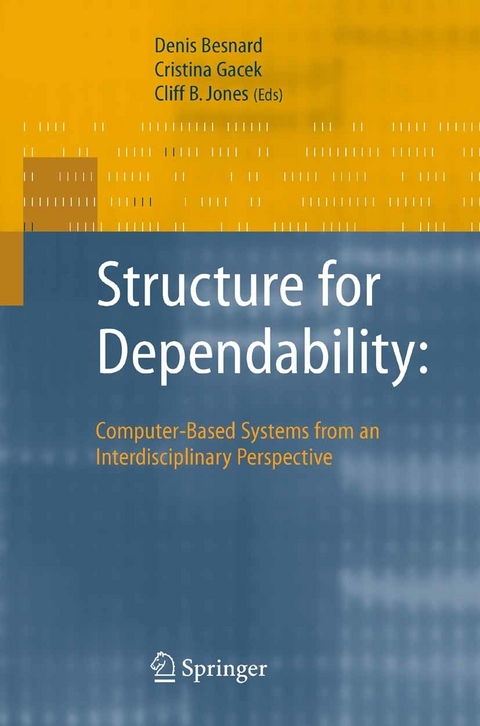
Structure for Dependability: Computer-Based Systems from an Interdisciplinary Perspective (eBook)
XII, 306 Seiten
Springer London (Verlag)
978-1-84628-111-2 (ISBN)
System developers, stakeholders, decision makers, policymakers and academics will find this book a one-stop resource highlighting the core issues for all those involved in dependability in a complex computer-based environment.
Computer-based systems are now essential to everyday life. They involve both tech- cal (hardware/software) components and human beings as active participants. Wh- ever we ?y aboard an aircraft or withdraw money from a cash point, a combination of humans, machines and software is supporting the delivery of the service. These systems and many others bene?t from the miniaturisation and cost reduction of the hardware which has made it possible for computers to be embedded everywhere. An equally remarkable development is the software involved: today, systems are built which were literally unthinkable twenty or thirty years ago. Measured in terms of their function, the productivity of their creation has also advanced enormously (largely - cause of the software infrastructure). Even the dependability of the best of todays so- ware is praiseworthy when one considers the complexity of the functionality provided. Solid engineering and the increasing adoption of methods based on ?rmly established theory are to be thanked here. However, in large and complex systems, there remain major challenges to achieving dependability when complex interactions exist between technical and human components. Large and complex things are understood as assemblages of simpler components: the way these components ?t together is the structure of the system. Structure can be real and physical, or a subjective mental tool for analysis.
Preface 5
Contents 9
Contributors 11
Introduction 13
Chapter 1 The role of structure: a dependability perspective 15
Chapter 2 The role of structure: a software engineering perspective 28
System Properties 59
Chapter 3 Structuring evolution: on the evolution of socio-technical systems 61
Chapter 4 Time bands in systems structure 86
Human Components 102
Chapter 5 Procedures, programs and their impact on dependability 103
Chapter 6 Cognitive conflicts in dynamic systems 119
Systems Descriptions 138
Chapter 7 Architectural description of dependable software systems 139
Chapter 8 Computational diagrammatics: diagrams and structure 155
Chapter 9 Ethnography and the social structure of work 181
Chapter 10 Faults, errors and failures in communications: a systems theory perspective on organisational structure 201
Guaranteeing Dependability 227
Chapter 12 The structure of software development thought 240
Chapter 13 On the useof diverse arguments to increase confidence in dependability claims 266
Chapter 14 Qualitative analysis of dependability argument structure 281
Index 303
| Erscheint lt. Verlag | 28.4.2006 |
|---|---|
| Zusatzinfo | XII, 306 p. 50 illus. |
| Verlagsort | London |
| Sprache | englisch |
| Themenwelt | Mathematik / Informatik ► Informatik ► Software Entwicklung |
| Mathematik / Informatik ► Informatik ► Theorie / Studium | |
| Mathematik / Informatik ► Informatik ► Web / Internet | |
| Schlagworte | Architecture • Computer • Design • Development • ethnography • Human-Computer Interaction (HCI) • organization • security • Software • software development • Software engineering • Time |
| ISBN-10 | 1-84628-111-3 / 1846281113 |
| ISBN-13 | 978-1-84628-111-2 / 9781846281112 |
| Informationen gemäß Produktsicherheitsverordnung (GPSR) | |
| Haben Sie eine Frage zum Produkt? |
 PDF (Wasserzeichen)
DRM: Digitales Wasserzeichen
Dieses eBook enthält ein digitales Wasserzeichen und ist damit für Sie personalisiert. Bei einer missbräuchlichen Weitergabe des eBooks an Dritte ist eine Rückverfolgung an die Quelle möglich.
Dateiformat: PDF (Portable Document Format)
Mit einem festen Seitenlayout eignet sich die PDF besonders für Fachbücher mit Spalten, Tabellen und Abbildungen. Eine PDF kann auf fast allen Geräten angezeigt werden, ist aber für kleine Displays (Smartphone, eReader) nur eingeschränkt geeignet.
Systemvoraussetzungen:
PC/Mac: Mit einem PC oder Mac können Sie dieses eBook lesen. Sie benötigen dafür einen PDF-Viewer - z.B. den Adobe Reader oder Adobe Digital Editions.
eReader: Dieses eBook kann mit (fast) allen eBook-Readern gelesen werden. Mit dem amazon-Kindle ist es aber nicht kompatibel.
Smartphone/Tablet: Egal ob Apple oder Android, dieses eBook können Sie lesen. Sie benötigen dafür einen PDF-Viewer - z.B. die kostenlose Adobe Digital Editions-App.
Buying eBooks from abroad
For tax law reasons we can sell eBooks just within Germany and Switzerland. Regrettably we cannot fulfill eBook-orders from other countries.
aus dem Bereich