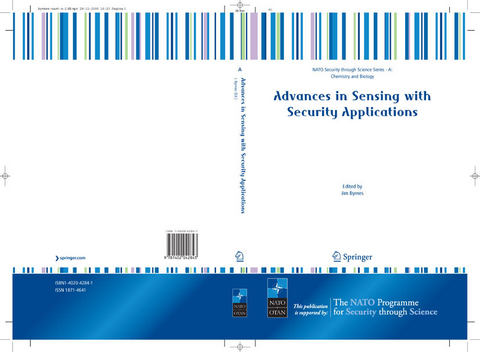
Advances in Sensing with Security Applications (eBook)
XIII, 388 Seiten
Springer Netherlands (Verlag)
978-1-4020-4295-9 (ISBN)
- The increasing need for fast and accurate sensing – what is the threat; The scientific underpinnings of the ongoing revolution in sensing; Specific sensing algorithms and techniques.
The chapters in this volume were presented at the July 2005NATO Advanced Study Institute on Advances in Sensing with Security App- cations. The conference was held at the beautiful Il Ciocco resort near Lucca, in the glorious Tuscany region of northern Italy. Once again we gathered at this idyllic spot to explore and extend the reciprocity between mathematics and engineering. The dynamic interaction - tween world-renowned scientists from the usually disparate communities of pure mathematicians and applied scientists which occurred at our six previous ASI's continued at this meeting. The fusion of basic ideas in mathematics, biology, and chemistry with ongoing improvements in hardware and computation o?ers the promise of much more sophisticated and accurate sensing capabilities than c- rently exist. Coupled with the dramatic rise in the need for surveillance in innumerable aspects of our daily lives, brought about by hostile acts deemed unimaginable only a few short years ago, the time was right for scientists in the diverse areas of sensing and security to join together in a concerted e?ort to combat the new brands of terrorism. This ASI was one important initial step. To encompass the diverse nature of the s- ject and the varied backgrounds of the anticipated participants, the ASI was divided into three broadly de?ned but interrelated areas: the - creasing need for fast and accurate sensing, the scienti?c underpinnings of the ongoing revolution in sensing, and speci?c sensing algorithms and techniques. The ASI brought together world leaders from academia, government, andindustry,withextensivemultidisciplinarybackgroundsevidencedby theirresearchandparticipationinnumerousworkshopsandconferences.
Preface. Acknowledgments.Bistatic and multistatic radar sensors for homeland security; G.J. Baker and H.D. Griffiths. 1. Introduction .- 2 Definitions .-3. Bistatic essentials .- 4. Passive Coherent Location (PCL).- 5. Multistatic radar .-6. Conclusions.- 7. Acknowlegments .-References.The Terrorist Threat and Its Implications for Sensor Technologies; J. L. Brower.1. Introduction.- 2. What is Terrorism?.- 3. General Trends in Terrorism.- 4.Significant Domestic Threats.- 5. State Sponsored Terrorism.- 6. Future Threats.- 7. Preventions Efforts The Role of Sensors.- 8. Improving Sensors.- 9. Conclusions.- References. Advances in sensors; the lessons from Neurosciences; M. Costa.-1. Energies that affect earth living organisms survival.- 2. The emergence of a nervous system. 3. Neurons as excitable cells.- 4. Sensory neurons.- 5. Sensory transduction.- 6. Molecules of sensory transduction.- 7. Hearing system and mechanosensation.- 8. Temperature receptors.- 9. Pain receptors.- 10. Olfaction.- 11. Vision .-12. General view of the sensory systems.- References. Chemical sensors and chemical sensor systems; A. Orsini, A. D ‘Amico. 1. Introduction—Parameters.- 2. Fundamentals Devices; 3. Thermopiles.- 4. Kelvin Probe.- 5. Bulk Acoustic Waves.- 6. Surface Acoustic Waves.- 7. Natural and Artificial Olfaction.- 8. Optical Fibre Sensor .- 9. Surface Plasmon Resonance.- 10. Conclusions.- References. Wireless Sensor Networks for Security: Issues and Challenges; T. Onel, et al. 1. Introduction.- 2. Neyman-Pearson Detection.- 3. Breach Probability Analysis [30].-
4. Data Processing Architecture for Target Tracking.- 5. Maximum Mutual Information Based Sensor Selection Algorithm.- 6. Simulation Results.- 7. Conclusion.-References. Internet-Scale Chemical Sensing ; D. Diamond. 1. Introduction.- 2. Chemical Sensing and Biosensing.- 3. Miniaturised Analytical Instruments — Lab on a Chip Devices.- 4. Analytical Device Hierarchy.-5. Networking Options.-
6. Integrating Chemical Sensors and Biosensors with Wireless Networks.- 7. Scale-up Issues for Densely Distributed Analytical Devices.- 8. Chemo- & Bio-warfare Agents.- 9. Sensor communities and group behaviour.- 10. pHealth.- 11. Conclusions.- References. Data analysis for chemical sensor arrays; .C. Di Natale et al.1. Feature extraction.-2. Data Pre—processing: Scaling .- 3. Normalization.-
4.- Multivariate data exploration.- 5. Principal Component Analysis.- 6. Supervised Classification .- 7. Linear Discrimination.- 8. Application to the investigation of Chemical Sensors properties.-
9. Conclusions.- References. Fundamentals of Tomography and Radar; H.D. Griffiths and C.J. Baker. 1. Introduction.-2. Imaging and Resolution.- 3. Tomographic Imaging.- 4. The Projection Slice Theorem .- 5. Tomography of Moving Targets.- 6. Applications.- 7. Automatic Target Recognition.- 8. Bandwidth Extrapolation.- 9. Target-matched Illumination.- 10. Conclusion.-11. Acknowledgements.- References. Remote Sensing using Space Based Radar; B. Himed, et al. 1. Introduction .- 2. Geometry.- 3. Range Foldover and Earth’s Rotation.- 4. Application of STAP for SBR .-5. Orthogonal Pulsing Scheme.- References. Continuous wave radars—monostatic, multistatic and network ; K. Kulpa. 1.Introduction.- 2. Radar fundamentals.- 3. Linear Frequency Modulated Continuous Wave Radar.- 4. Noise Radar.- 5. Noise radar range equation .- 6. Bi-static and multi-static continuous wave radars.- 7. Target identification in continuous wave radars.-References.
Terahertz Imaging, Millimeter-Wave Radar; R. W. McMillan.1. Introduction .- 2. Atmospheric Limitations.- 3. Millimeter-Wave and Terahertz Sources of Radiation.-4. Millimeter-Wave and Terahertz Detectors and Receivers.- 5. Millimeter-Wave and Terahertz Optics.-6. Millimeter-Wave and Terahertz Systems.- 7. Summary.- References. Sensor Management for Radar: A Tutorial;
B. Moran et al. 1. Introduction .- 2. Radar Fundamentals.- 3. Sensor Management Overview.- 4. Theory of Waveform Libraries.-5. Sensor scheduling simulations and results.- References. Waveform Design, Range CFAR and Target Recognition; H. Rohling.1. Introduction.- 2. Combination of LFMCW and FSK modulation principles for automotive radar systems.- Automotive Radar Network Based On 77GHz FMCW Sensors.- 4. Range CFAR Techniques.- 5. Conclusion.-References. Tomography of Moving Targets (TMT) for Security and Surveillance; M. C. Wicks et al. 1.Introduction.- 2. Tomography Concept and Framework .-3. Bistatic Geometry and Observables .-4. Matched Filter Processing (MFP).- 5. TMT Netted Radar System.-6. TMT MFP Simulation.-
7. Detection Perfomance.-8. Summary.- 9. Acknowledgements.- References. Near Infrared Imaging and Spectroscopy for Brain Activity Monitoring; Il- Young Son, B. Yazici.1. Introduction.- 2. NIR Imaging and Spectroscopy Systems .- 3. Hemodynamic Response.- 4. Neuronal Response.- 5. Human Subject Studies.- 6. Concluding Remarks and Future Directions.-References.
Topic Index
| Erscheint lt. Verlag | 18.8.2006 |
|---|---|
| Sprache | englisch |
| Themenwelt | Informatik ► Theorie / Studium ► Künstliche Intelligenz / Robotik |
| Mathematik / Informatik ► Mathematik ► Analysis | |
| Mathematik / Informatik ► Mathematik ► Angewandte Mathematik | |
| Naturwissenschaften ► Chemie ► Analytische Chemie | |
| Naturwissenschaften ► Geowissenschaften ► Geografie / Kartografie | |
| Naturwissenschaften ► Geowissenschaften ► Geologie | |
| Technik ► Maschinenbau | |
| Schlagworte | algorithms • Analysis • Architecture • augmented reality • Cells • classification • Computer-Aided Design (CAD) • Data Analysis • Hardware • linear optimization • proving • Remote Sensing • Simulation |
| ISBN-10 | 1-4020-4295-7 / 1402042957 |
| ISBN-13 | 978-1-4020-4295-9 / 9781402042959 |
| Informationen gemäß Produktsicherheitsverordnung (GPSR) | |
| Haben Sie eine Frage zum Produkt? |
 PDF (Wasserzeichen)
Größe: 64,3 MB
DRM: Digitales Wasserzeichen
Dieses eBook enthält ein digitales Wasserzeichen und ist damit für Sie personalisiert. Bei einer missbräuchlichen Weitergabe des eBooks an Dritte ist eine Rückverfolgung an die Quelle möglich.
Dateiformat: PDF (Portable Document Format)
Mit einem festen Seitenlayout eignet sich die PDF besonders für Fachbücher mit Spalten, Tabellen und Abbildungen. Eine PDF kann auf fast allen Geräten angezeigt werden, ist aber für kleine Displays (Smartphone, eReader) nur eingeschränkt geeignet.
Systemvoraussetzungen:
PC/Mac: Mit einem PC oder Mac können Sie dieses eBook lesen. Sie benötigen dafür einen PDF-Viewer - z.B. den Adobe Reader oder Adobe Digital Editions.
eReader: Dieses eBook kann mit (fast) allen eBook-Readern gelesen werden. Mit dem amazon-Kindle ist es aber nicht kompatibel.
Smartphone/Tablet: Egal ob Apple oder Android, dieses eBook können Sie lesen. Sie benötigen dafür einen PDF-Viewer - z.B. die kostenlose Adobe Digital Editions-App.
Zusätzliches Feature: Online Lesen
Dieses eBook können Sie zusätzlich zum Download auch online im Webbrowser lesen.
Buying eBooks from abroad
For tax law reasons we can sell eBooks just within Germany and Switzerland. Regrettably we cannot fulfill eBook-orders from other countries.
PDF (Adobe DRM)Kopierschutz: Adobe-DRM
Adobe-DRM ist ein Kopierschutz, der das eBook vor Mißbrauch schützen soll. Dabei wird das eBook bereits beim Download auf Ihre persönliche Adobe-ID autorisiert. Lesen können Sie das eBook dann nur auf den Geräten, welche ebenfalls auf Ihre Adobe-ID registriert sind.
Details zum Adobe-DRM
Dateiformat: PDF (Portable Document Format)
Mit einem festen Seitenlayout eignet sich die PDF besonders für Fachbücher mit Spalten, Tabellen und Abbildungen. Eine PDF kann auf fast allen Geräten angezeigt werden, ist aber für kleine Displays (Smartphone, eReader) nur eingeschränkt geeignet.
Systemvoraussetzungen:
PC/Mac: Mit einem PC oder Mac können Sie dieses eBook lesen. Sie benötigen eine
eReader: Dieses eBook kann mit (fast) allen eBook-Readern gelesen werden. Mit dem amazon-Kindle ist es aber nicht kompatibel.
Smartphone/Tablet: Egal ob Apple oder Android, dieses eBook können Sie lesen. Sie benötigen eine
Geräteliste und zusätzliche Hinweise
Buying eBooks from abroad
For tax law reasons we can sell eBooks just within Germany and Switzerland. Regrettably we cannot fulfill eBook-orders from other countries.
aus dem Bereich