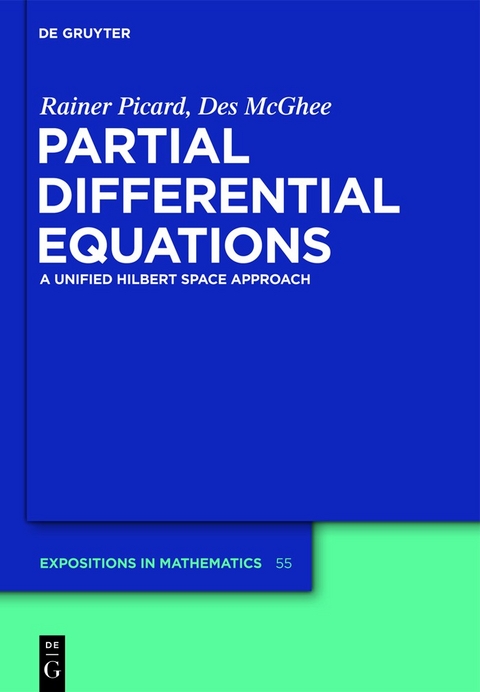
Partial Differential Equations (eBook)
487 Seiten
De Gruyter (Verlag)
978-3-11-025027-5 (ISBN)

This book presents a systematic approach to a solution theory for linear partial differential equations developed in a Hilbert space setting based on a Sobolev Lattice structure, a simple extension of the well established notion of a chain (or scale) of Hilbert spaces. Thefocus on a Hilbert space setting is a highly adaptable and suitable approach providing a more transparent framework for presenting the main issues in the development of a solution theory for partial differential equations.This global point of view is takenby focussing on the issues involved in determining the appropriate functional analytic setting in which a solution theory can naturally be developed. Applications to many areas of mathematical physics are presented.
The book aims to be a largely self-contained. Full proofs to all but the most straightforward results are provided. It is therefore highly suitable as a resource for graduate courses and for researchers, who will find new results for particular evolutionary system from mathematical physics.
Rainer Picard, Dresden University of Technology, Germany; Des McGhee, University of Strathclyde, Glasgow, Scotland, UK.
lt;P>Rainer Picard, Dresden University of Technology, Germany; Des McGhee, University of Strathclyde, Glasgow, Scotland, UK.
Preface 8
Contents 12
Nomenclature 16
1 Elements of Hilbert Space Theory 20
1.1 Hilber tSpace 20
1.2 Some Construction Principles of Hilbert Spaces 21
1.2.1 Direct Sums of Hilbert Spaces 22
1.2.2 Dual Spaces 34
1.2.3 Tensor Products of Hilbert Spaces 38
2 Sobolev Lattices 49
2.1 Sobolev Chains 49
2.2 Sobolev Lattices 75
2.3 Sobolev Lattices from Tensor Products of Sobolev Chains 84
3 Linear Partial Differential Equations with Constant Coefficients in Rn+1, n e N 91
3.1 Partial Differential Equations in H-8(dv +e) 91
3.1.1 First Steps Towards a Solution Theory 91
3.1.2 The Tarski–Seidenberg Theorem and some Consequences 95
3.1.3 Regularity Loss (0,....,0) 108
3.1.4 Classification of Partial Differential Equations 109
3.1.5 The Classical Classification of Partial Differential Equations 113
3.1.6 Elliptic, Parabolic, Hyperbolic? 123
3.1.7 Evolutionary Expressions in Canonical Form 126
3.1.8 Functions of dv and Convolutions 133
3.1.9 Systems and Scalar Equations 140
3.1.10 Causality 144
3.1.11 Initial Value Problems 161
3.1.12 Some Applications to Linear Partial Differential Equations of Mathematical Physics 175
3.1.12.1 Transport Equation 175
3.1.12.2 Acoustics 179
3.1.12.3 Thermodynamics 189
3.1.12.4 Electrodynamics 190
3.1.12.5 Elastodynamics 200
3.1.12.6 Fluid Dynamics 214
3.1.12.7 Quantum Mechanics 217
3.2 Partial Differential Equations in H-8(Dv) 224
3.2.1 Extension of the Solution Theory to H-8(Dv) 224
3.2.2 Some Applications to Linear Partial Differential Equations of Mathematical Physics 242
3.2.2.1 Helmholtz Equation in R3 242
3.2.2.2 Helmholtz Equation in R2 245
3.2.2.3 Cauchy–Riemann Operator 248
3.2.2.4 Wave Equation in R2 (Method of Descent) 248
3.2.2.5 Plane Waves 251
3.2.2.6 Linearized Navier–Stokes Equations 252
3.2.2.7 Electro- and Magnetostatics 254
3.2.2.8 Force-free Magnetic Fields 255
3.2.2.9 Beltrami Field Expansions 257
3.2.3 Convolutions in H-8(Dv)H, v Rn+1 262
3.2.4 Integral Representations of Convolutions with Fundamental Solutions 267
3.2.4.1 An Integral Representation of the Solution of the Transport Equation 267
3.2.4.2 Potentials, Single and Double Layers in R3 268
3.2.4.3 Electro- and Magnetostatics (Biot–Savart’s Law) 294
3.2.4.4 Potential Theory in R2 297
3.2.4.5 Cauchy’s Integral Formula 300
3.2.4.6 Integral Representations of Solutions of the Helmholtz Equation in R3 304
3.2.4.7 Retarded Potentials 315
3.2.4.8 Integral Representations of Solutions of the Time-Harmonic Maxwell Equations 316
4 Linear Evolution Equations 322
4.1 Linear Operator Equations in Sobolev Lattices 322
4.1.1 Polynomials of Commuting Operators 322
4.1.2 Polynomials of Commuting, Selfadjoint Operators 323
4.2 Evolution Equations with Polynomials of Operators as Coefficients 324
4.2.1 Classification of Operator Polynomials with Time Differentiation 324
4.2.2 Causality of Evolutionary Problems 327
4.2.3 Abstract Initial Value Problems 335
4.2.4 Systems and Scalar Equations 348
4.2.5 First-Order-in-Time Evolution Equations in Sobolev Lattices 353
5 Some Evolution Equations of Mathematical Physics 357
5.1 Schrödinger Type Equations 357
5.1.1 The Selfadjoint Laplace Operator 357
5.1.2 SomePerturbations 361
5.1.2.1 Bounded Perturbations 361
5.1.2.2 Relatively Bounded Perturbations (the Coulomb Potential) 365
5.2 Heat Equation 368
5.2.1 TheSelfadjointOperatorCase 369
5.2.1.1 Prescribed Dirichlet and Neumann Boundary Data 376
5.2.1.2 Transmission Initial Boundary Value Problem 385
5.2.2 Stefan Boundary Condition 388
5.2.3 LowerOrderPerturbations 390
5.3 Acoustics 391
5.3.1 Dirichlet and Neumann Boundary Condition 393
5.3.2 Wave Equation 396
5.3.3 ReversibleHeatTransport 401
5.4 Electrodynamics 404
5.4.1 The Electric Boundary Condition 406
5.4.2 Some Decomposition Results 410
5.4.3 TheExtendedMaxwellSystem 413
5.4.4 The Vectorial Wave Equation for the Electromagnetic Field 419
5.5 Elastodynamics 426
5.5.1 The Rigid Boundary Condition 428
5.5.2 Free Boundary Condition 431
5.5.3 Shear andPressureWaves 432
5.6 Plate Dynamics 434
5.7 Thermo-Elasticity 439
6 A "Royal Road" to Initial Boundary Value Problems 445
6.1 A Class of Evolutionary Material Laws 446
6.2 Evolutionary Dynamics and Material Laws 450
6.2.1 The Shape of Evolutionary Problems with Material Laws 450
6.2.2 Some Special Cases 456
6.2.3 Material Laws via Differential Equations 459
6.2.4 CoupledSystems 460
6.2.5 Initial Value Problems 462
6.2.6 MemoryProblems 466
6.3 Some Applications 472
6.3.1 ReversibleHeatTransfer 473
6.3.2 Models of Thermoelasticity 474
6.3.3 Thermo-Piezo-Electro-Magnetism 476
Conclusion 478
Bibliography 480
Index 484
| Erscheint lt. Verlag | 30.6.2011 |
|---|---|
| Reihe/Serie | De Gruyter Expositions in Mathematics |
| De Gruyter Expositions in Mathematics | |
| ISSN | ISSN |
| Verlagsort | Berlin/Boston |
| Sprache | englisch |
| Themenwelt | Mathematik / Informatik ► Mathematik ► Analysis |
| Technik | |
| Schlagworte | evolution equation • hilbert space • Mathematics • Partial differential equations • Sobolev |
| ISBN-10 | 3-11-025027-6 / 3110250276 |
| ISBN-13 | 978-3-11-025027-5 / 9783110250275 |
| Informationen gemäß Produktsicherheitsverordnung (GPSR) | |
| Haben Sie eine Frage zum Produkt? |
 PDF (Wasserzeichen)
Größe: 4,1 MB
DRM: Digitales Wasserzeichen
Dieses eBook enthält ein digitales Wasserzeichen und ist damit für Sie personalisiert. Bei einer missbräuchlichen Weitergabe des eBooks an Dritte ist eine Rückverfolgung an die Quelle möglich.
Dateiformat: PDF (Portable Document Format)
Mit einem festen Seitenlayout eignet sich die PDF besonders für Fachbücher mit Spalten, Tabellen und Abbildungen. Eine PDF kann auf fast allen Geräten angezeigt werden, ist aber für kleine Displays (Smartphone, eReader) nur eingeschränkt geeignet.
Systemvoraussetzungen:
PC/Mac: Mit einem PC oder Mac können Sie dieses eBook lesen. Sie benötigen dafür einen PDF-Viewer - z.B. den Adobe Reader oder Adobe Digital Editions.
eReader: Dieses eBook kann mit (fast) allen eBook-Readern gelesen werden. Mit dem amazon-Kindle ist es aber nicht kompatibel.
Smartphone/Tablet: Egal ob Apple oder Android, dieses eBook können Sie lesen. Sie benötigen dafür einen PDF-Viewer - z.B. die kostenlose Adobe Digital Editions-App.
Buying eBooks from abroad
For tax law reasons we can sell eBooks just within Germany and Switzerland. Regrettably we cannot fulfill eBook-orders from other countries.
aus dem Bereich