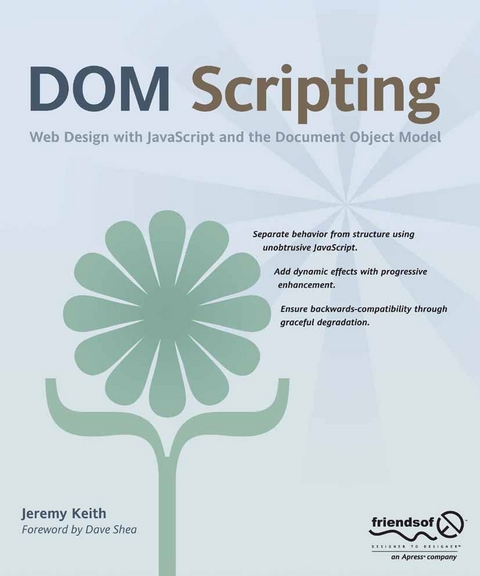
DOM Scripting (eBook)
XXII, 368 Seiten
Apress (Verlag)
978-1-4302-0062-8 (ISBN)
* Shows readers how to build several real world projects.
* All examples are fiercely standards compliant and up-to-date.
Jeremy Keith is a web developer living and working in Brighton, England. Working with the web consultancy firm Clearleft (Clearleft.com), he enjoys building accessible, elegant websites using the troika of web standards: XHTML, CSS, and the DOM. His online home is Adactio.com. Jeremy is also a member of the WebStandards.org, where he serves as joint leader of the DOM Scripting Task Force. When he's not building websites, Jeremy plays bouzouki in the alt.country band Salter Cane (SalterCane.com). He is also the creator and curator of one of the web's largest online communities dedicated to Irish traditional music, TheSession.org.
We know from the success of titles such as Web Standards Solutions, Cascading Style Sheets: Separating Content from Presentation, and The Web Designer's Reference that web designers are increasingly concerned with making sites that don't just look pretty, but are also built using current best practices.There are three main technologies married together to create usable, standards-compliant web designs: XHTML for data structure, Cascading Style Sheets for styling your data, and JavaScript for adding dynamic effects and manipulating structure on the fly using the Document Object Model.This book is about the latter of the three. DOM Scripting: Web Design with JavaScript and the Document Object Model gives you everything you need to start using JavaScript and the Document Object Model to enhance your web pages with client-side dynamic effects. Jeremy Keith starts off by giving you a basic crash course in JavaScript and the DOM, then moves on to provide you with several real-world examples built up from scratch, including dynamic image galleries and dynamic menus. Then, he shows you how to manipulate web page style using the CSS DOM, and create markup on the fly.
Jeremy Keith is a web developer living and working in Brighton, England. Working with the web consultancy firm Clearleft (Clearleft.com), he enjoys building accessible, elegant websites using the troika of web standards: XHTML, CSS, and the DOM. His online home is Adactio.com. Jeremy is also a member of the WebStandards.org, where he serves as joint leader of the DOM Scripting Task Force. When he's not building websites, Jeremy plays bouzouki in the alt.country band Salter Cane (SalterCane.com). He is also the creator and curator of one of the web's largest online communities dedicated to Irish traditional music, TheSession.org.
A table of contents is not available for this title.
| Erscheint lt. Verlag | 7.11.2006 |
|---|---|
| Zusatzinfo | XXII, 368 p. |
| Verlagsort | Berkeley |
| Sprache | englisch |
| Themenwelt | Mathematik / Informatik ► Informatik ► Web / Internet |
| Schlagworte | CSS • data structure • Design • Document Object Model (DOM) • HTML • JavaScript • Standards • XHTML |
| ISBN-10 | 1-4302-0062-6 / 1430200626 |
| ISBN-13 | 978-1-4302-0062-8 / 9781430200628 |
| Informationen gemäß Produktsicherheitsverordnung (GPSR) | |
| Haben Sie eine Frage zum Produkt? |
 PDF (Wasserzeichen)
DRM: Digitales Wasserzeichen
Dieses eBook enthält ein digitales Wasserzeichen und ist damit für Sie personalisiert. Bei einer missbräuchlichen Weitergabe des eBooks an Dritte ist eine Rückverfolgung an die Quelle möglich.
Dateiformat: PDF (Portable Document Format)
Mit einem festen Seitenlayout eignet sich die PDF besonders für Fachbücher mit Spalten, Tabellen und Abbildungen. Eine PDF kann auf fast allen Geräten angezeigt werden, ist aber für kleine Displays (Smartphone, eReader) nur eingeschränkt geeignet.
Systemvoraussetzungen:
PC/Mac: Mit einem PC oder Mac können Sie dieses eBook lesen. Sie benötigen dafür einen PDF-Viewer - z.B. den Adobe Reader oder Adobe Digital Editions.
eReader: Dieses eBook kann mit (fast) allen eBook-Readern gelesen werden. Mit dem amazon-Kindle ist es aber nicht kompatibel.
Smartphone/Tablet: Egal ob Apple oder Android, dieses eBook können Sie lesen. Sie benötigen dafür einen PDF-Viewer - z.B. die kostenlose Adobe Digital Editions-App.
Buying eBooks from abroad
For tax law reasons we can sell eBooks just within Germany and Switzerland. Regrettably we cannot fulfill eBook-orders from other countries.
aus dem Bereich