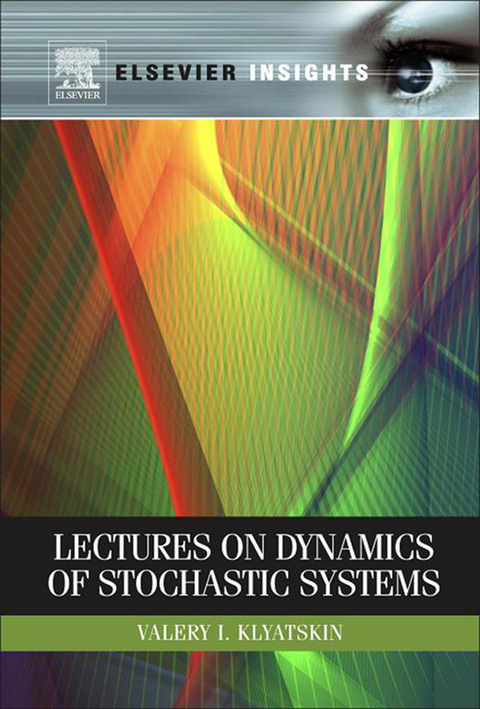
Lectures on Dynamics of Stochastic Systems (eBook)
410 Seiten
Elsevier Science (Verlag)
9780123849670 (ISBN)
Born in 1940 in Moscow, USSR, Valery I. Klyatskin received his secondary education at school in Tbilisi, Georgia, finishing in 1957. Seven years later he graduated from Moscow Institute of Physics and Technology (FIZTEX), whereupon he took up postgraduate studies at the Institute of Atmospheric Physics USSR Academy of Sciences, Moscow gaining the degree of Candidate of Physical and Mathematical Sciences (Ph.D) in 1968. He then continued at the Institute as a researcher, until 1978, when he was appointed as Head of the Wave Process Department at the Pacific Oceanological Institute of the USSR Academy of Sciences, based in Vladivostok. In 1992 Valery I. Klyatskin returned to Institute of Atmospheric Physics Russian Academy of Sciences, Moscow when he was appointed to his present position as Chief Scientist. At the same time he is Chief Scientific Consultant of Pacific Oceanological Institute Russian Academy of Sciences, Vladivostok. In 1977 he obtained a doctorate in Physical and Mathematical Sciences and in 1988 became Research Professor of Theoretical and Mathematical Physics, Russian Academy of Science.
Fluctuating parameters appear in a variety of physical systems and phenomena. They typically come either as random forces/sources, or advecting velocities, or media (material) parameters, like refraction index, conductivity, diffusivity, etc. Models naturally render to statistical description, where random processes and fields express the input parameters and solutions. The fundamental problem of stochastic dynamics is to identify the essential characteristics of the system (its state and evolution), and relate those to the input parameters of the system and initial data. This book is a revised and more comprehensive version of Dynamics of Stochastic Systems. Part I provides an introduction to the topic. Part II is devoted to the general theory of statistical analysis of dynamic systems with fluctuating parameters described by differential and integral equations. Part III deals with the analysis of specific physical problems associated with coherent phenomena. - A comprehensive update of Dynamics of Stochastic Systems- Develops mathematical tools of stochastic analysis and applies them to a wide range of physical models of particles, fluids and waves- Includes problems for the reader to solve
Front cover 1
Lectures on Dynamics of Stochastic Systems 4
Copyright page 5
Table of contents 6
Preface 10
Introduction 12
Part I: Dynamical Description of Stochastic Systems 16
Lecture 1. Examples, Basic Problems, Peculiar Features of Solutions 18
1.1. Ordinary Differential Equations: Initial-Value Problems 18
1.2. Boundary-Value Problems for Linear Ordinary Differential Equations (Plane Waves in Layered Media) 35
1.3. Partial Differential Equations 39
Problem 65
Lecture 2. Solution Dependence on Problem Type, Medium Parameters, and Initial Data 68
2.1. Functional Representation of Problem Solution 68
2.2. Solution Dependence on Problem's Parameters 75
Problems 80
Lecture 3. Indicator Function and Liouville Equation 84
3.1. Ordinary Differential Equations 84
3.2. First-Order Partial Differential Equations 87
3.3. Higher-Order Partial Differential Equations 95
Problems 100
Part II: Statistical Description of Stochastic Systems 102
Lecture 4. Random Quantities, Processes, and Fields 104
4.1. Random Quantities and their Characteristics 104
4.2. Random Processes, Fields, and their Characteristics 110
4.3. Markovian Processes 130
Problems 134
Lecture 5. Correlation Splitting 138
5.1. General Remarks 138
5.2. Gaussian Process 140
5.3. Poisson's Process 142
5.4. Telegrapher's Random Process 143
5.5. Delta-Correlated Random Processes 145
Problems 150
Lecture 6. General Approaches to Analyzing Stochastic Systems 156
6.1. Ordinary Differential Equations 156
6.2. Completely Solvable Stochastic Dynamic Systems 159
6.3. Delta-Correlated Fields and Processes 175
Problems 181
Lecture 7. Stochastic Equations with the Markovian Fluctuations of Parameters 198
7.1. Telegrapher's Processes 199
7.2. Gaussian Markovian Processes 202
Problems 203
Lecture 8. Approximations of Gaussian Random Field Delta-Correlated in Time 206
8.1. The Fokker–Planck Equation 206
8.2. Transition Probability Distributions 209
8.3. The Simplest Markovian Random Processes 211
8.4. Applicability Range of the Fokker–Planck Equation 226
8.5. Causal Integral Equations 230
8.6. Diffusion Approximation 233
Problems 235
Lecture 9. Methods for Solving and Analyzing the Fokker–Planck Equation 244
9.1. Integral Transformations 244
9.2. Steady-State Solutions of the Fokker–Planck Equation 245
9.3. Boundary-Value Problems for the Fokker–Planck Equation (Hopping Phenomenon) 257
9.4. Method of Fast Oscillation Averaging 260
Problems 262
Lecture 10. Some Other Approximate Approaches to the Problems of Statistical Hydrodynamics 268
10.1. Quasi-Elastic Properties of Isotropic and Stationary Noncompressible Turbulent Media 269
10.2. Sound Radiation by Vortex Motions 273
Part III: Examples of Coherent Phenomena in
284
Lecture 11. Passive Tracer Clustering and Diffusion in Random Hydrodynamic and
286
11.1. General Remarks 286
11.2. Particle Diffusion in Random Velocity Field 291
11.3. Probabilistic Description of Density Field in Random Velocity Field 299
11.4. Probabilistic Description of Magnetic Field and Magnetic Energy in Random Velocity Field 306
11.5. Integral One-Point Statistical Characteristics of Passive Vector Fields 313
Problems 334
Lecture 12. Wave Localization in Randomly Layered Media 340
12.1. General Remarks 340
12.2. Statistics of Scattered Field at Layer Boundaries 345
12.3. Statistical Theory of Radiative Transfer 354
12.4. Numerical Simulation 365
Problems 367
Lecture 13. Caustic Structure of Wavefield in Random Media 370
13.1. Input Stochastic Equations and Their Implications 370
13.2. Wavefield Amplitude–Phase Fluctuations. Rytov's Smooth Perturbation Method 376
13.3. Method of Path Integral 382
13.4 Elements of Statistical Topography of Random Intensity Field 396
Problems 403
References 408
| Erscheint lt. Verlag | 9.9.2010 |
|---|---|
| Sprache | englisch |
| Themenwelt | Mathematik / Informatik ► Mathematik ► Angewandte Mathematik |
| Naturwissenschaften ► Physik / Astronomie | |
| Technik | |
| ISBN-13 | 9780123849670 / 9780123849670 |
| Informationen gemäß Produktsicherheitsverordnung (GPSR) | |
| Haben Sie eine Frage zum Produkt? |
 EPUB (Adobe DRM)
Kopierschutz: Adobe-DRM
Adobe-DRM ist ein Kopierschutz, der das eBook vor Mißbrauch schützen soll. Dabei wird das eBook bereits beim Download auf Ihre persönliche Adobe-ID autorisiert. Lesen können Sie das eBook dann nur auf den Geräten, welche ebenfalls auf Ihre Adobe-ID registriert sind.
Details zum Adobe-DRM
Dateiformat: EPUB (Electronic Publication)
EPUB ist ein offener Standard für eBooks und eignet sich besonders zur Darstellung von Belletristik und Sachbüchern. Der Fließtext wird dynamisch an die Display- und Schriftgröße angepasst. Auch für mobile Lesegeräte ist EPUB daher gut geeignet.
Systemvoraussetzungen:
PC/Mac: Mit einem PC oder Mac können Sie dieses eBook lesen. Sie benötigen eine
eReader: Dieses eBook kann mit (fast) allen eBook-Readern gelesen werden. Mit dem amazon-Kindle ist es aber nicht kompatibel.
Smartphone/Tablet: Egal ob Apple oder Android, dieses eBook können Sie lesen. Sie benötigen eine
Geräteliste und zusätzliche Hinweise
Buying eBooks from abroad
For tax law reasons we can sell eBooks just within Germany and Switzerland. Regrettably we cannot fulfill eBook-orders from other countries.
aus dem Bereich