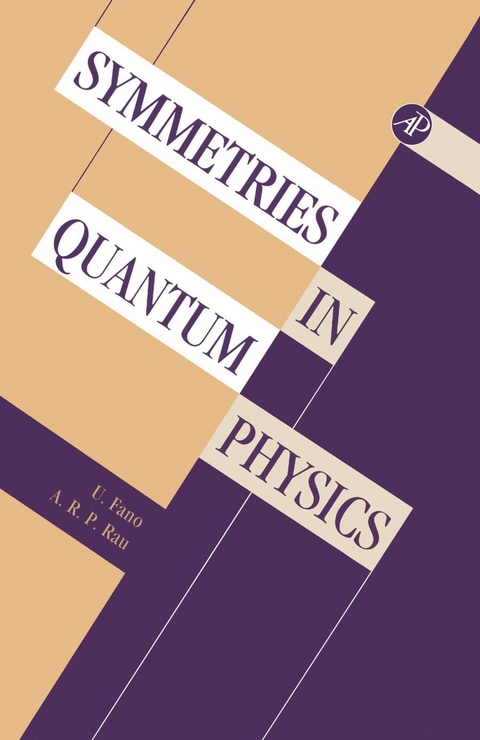
Symmetries in Quantum Physics (eBook)
333 Seiten
Elsevier Science (Verlag)
978-0-08-054217-1 (ISBN)
This book is an updated replacement for the text Irreducible Tensorial Sets (Academic Press, 1959). Parts A and B of the present book grew out of occasional lectures in the intervening decades at the University of Chicago, where it became neccessary to update or elaborate upon certain points. Part C has been built more recently to deal with innovations and new information in the field of mathematical physics. The book as a whole develops the subject of symmetry from a physical point of view, allowing students and researchers to gain new insight on their subject. This book can be used both as a text and as a reference by students and scientists in the field.
Adapts and extends the earlier Irreducible Tensor Sets (Academic Press, 1959) to classroom use
Extends to multi-particle systems and relativity
Includes problems in each chapter for homework assignments
Embraces the latest research on non-invariance groups
This text focuses on the physics of symmetries, developing symmetries and transformations through concrete physical examples and contexts rather than presenting the information axiomatically, mathematically, and abstractly. Readers are introduced gradually to advanced mathematical procedures, including the Wigner and Racah algebras and their applications to various symmetry groups. The book also includes some of the latest research on the use of non-invariance and non-compact groups in the consideration of relativistic and many-particle problems of atoms and nuclei.This book is an updated replacement for the text Irreducible Tensorial Sets (Academic Press, 1959). Parts A and B of the present book grew out of occasional lectures in the intervening decades at the University of Chicago, where it became neccessary to update or elaborate upon certain points. Part C has been built more recently to deal with innovations and new information in the field of mathematical physics. The book as a whole develops the subject of symmetry from a physical point of view, allowing students and researchers to gain new insight on their subject. This book can be used both as a text and as a reference by students and scientists in the field.Adapts and extends the earlier Irreducible Tensor Sets (Academic Press, 1959) to classroom useExtends to multi-particle systems and relativityIncludes problems in each chapter for homework assignmentsEmbraces the latest research on non-invariance groups
Front Cover 1
Symmetries in Quantum Physics 4
Copyright Page 5
Contents 6
Preface 14
Chapter 1. Introduction 16
Transformation Theories: Klein's and Dirac's 18
1.1 Symmetry and the Selection of Variables 20
1.2 Algebraic Elements 26
1.3 Reduction Procedure and Irreducible Tensorial Sets 32
1.4 Further Aspects of Reduction 35
1.5 Structure of the Book 41
1.6 Quaternions 43
Problems 44
PART A : STATE REPRESENTATIVES AND r-TRANSFORMATIONS: THEIR CONSTRUCTION AND PROPERTIES 46
Chapter 2. Infinitesimal Rotations and Angular Momentum 48
2.1 Basic Relations 49
2.2 Analytical Example: Infinitesimal Transformation of Cartesian Coordinates 53
2.3 The Angular Momentum Matrices of Quantum Mechanics 56
2.4 The Fundamental Representation 60
Problems 64
Chapter 3. Frame Reversal and Complex Conjugation 66
3.1 Analytical Representation and Implications of Frame Reversal 69
3.2 Contragredience and the Construction of Invariants 77
3.3 Cartesian Base for Integer j > = 1
Problems 89
Chapter 4. Standard r-Transformation Matrices and Their Applications 90
4.1 Explicit Form and Properties 91
4.2 Macroscopic Applications 100
4.3 Applications to Quantum Physics 103
4.4 Coordinate Inversion and Parity Eigenfunctions 108
Problems 112
Chapter 5. Reduction of Direct Products (Addition of Angular Momenta) 114
5.1 Structure and Properties of the Reducing Matrix 115
5.2 Reduction of r-Transformation Products 125
5.3 Irreducible Product Sets 127
5.4 Symmetrization of Wigner Coefficients: 134
Problems 138
PART B: TENSORIAL ASPECTS OF QUANTUM PHYSICS 140
Chapter 6. Tensorial Sets of Quantum Operators 142
6.1 The Liouville Representation of Quantum Mechanics 143
6.2 Quantum Mechanics of Particles with Spin 1/2 145
6.3 Two-Level Systems 150
6.4 Particles with Spin j > 1/2: Wigner-Eckart Theorem
6.5 Systems with 2j + 1 Levels 161
6.6 Transfer of Angular Momentum 163
6.7 Calculation of Matrix Elements 165
Problems 169
Chapter 7. Recoupling Transformations: 6-j and 9-j Coefficients 172
7.1 Transformation Matrices and Their Analysis 175
7.2 Symmetrized Recoupling: 6-j and 9-j Coefficients 183
7.3 Products of Operators 191
7.4 Combining Operators of Different Systems 198
7.5 Illustrations 201
Problems 210
Chapter 8. Partially Filled Shells of Atoms or Nuclei 214
8.1 Qualitative Discussion 215
8.2 Shell-wide Treatment 223
8.3 Algebra of Triple Tensors and Its Applications 229
PART C: SYMMETRIES OF HIGHER DIMENSIONS 240
Chapter 9. Discrete Transformations of Coordinates 244
9.1 Point Symmetry Operations and Their Groups 245
9.2 Characters of Group Representations and Their Applications 250
9.3 Symmetries of Molecules and Crystals 258
Problems 265
Chapter 10. Rotation Groups in Higher Dimensions: Multiparticle Problems 266
10.1 Four-Dimensional Rotations: The Coulomb-Kepler Problem 267
10.2 Orthogonal Groups in Higher Dimensions 278
10.3 Further Developments 287
Chapter 11. Lorentz Transformations and the Lorentz and Poincaré Groups 294
11.1 Lorentz Transformations 296
11.2 Generators and Representations of the Lorentz Group 298
11.3 The Inhomogeneous Lorentz (Poincaré) Group 310
11.4 Field Representations 312
Chapter 12. Symmetries of the Scattering Continuum 316
12.1 Symmetries of Radial Eigenfunctions 317
12.2 The Full Noninvariance Group of Hydrogen 320
12.3 Dynamics and Symmetry Transformations 325
Bibliography 328
Index 332
| Erscheint lt. Verlag | 17.6.1996 |
|---|---|
| Sprache | englisch |
| Themenwelt | Mathematik / Informatik ► Mathematik ► Angewandte Mathematik |
| Naturwissenschaften ► Physik / Astronomie ► Hochenergiephysik / Teilchenphysik | |
| Naturwissenschaften ► Physik / Astronomie ► Quantenphysik | |
| Technik | |
| ISBN-10 | 0-08-054217-4 / 0080542174 |
| ISBN-13 | 978-0-08-054217-1 / 9780080542171 |
| Informationen gemäß Produktsicherheitsverordnung (GPSR) | |
| Haben Sie eine Frage zum Produkt? |
 PDF (Adobe DRM)
Kopierschutz: Adobe-DRM
Adobe-DRM ist ein Kopierschutz, der das eBook vor Mißbrauch schützen soll. Dabei wird das eBook bereits beim Download auf Ihre persönliche Adobe-ID autorisiert. Lesen können Sie das eBook dann nur auf den Geräten, welche ebenfalls auf Ihre Adobe-ID registriert sind.
Details zum Adobe-DRM
Dateiformat: PDF (Portable Document Format)
Mit einem festen Seitenlayout eignet sich die PDF besonders für Fachbücher mit Spalten, Tabellen und Abbildungen. Eine PDF kann auf fast allen Geräten angezeigt werden, ist aber für kleine Displays (Smartphone, eReader) nur eingeschränkt geeignet.
Systemvoraussetzungen:
PC/Mac: Mit einem PC oder Mac können Sie dieses eBook lesen. Sie benötigen eine
eReader: Dieses eBook kann mit (fast) allen eBook-Readern gelesen werden. Mit dem amazon-Kindle ist es aber nicht kompatibel.
Smartphone/Tablet: Egal ob Apple oder Android, dieses eBook können Sie lesen. Sie benötigen eine
Geräteliste und zusätzliche Hinweise
Buying eBooks from abroad
For tax law reasons we can sell eBooks just within Germany and Switzerland. Regrettably we cannot fulfill eBook-orders from other countries.
aus dem Bereich