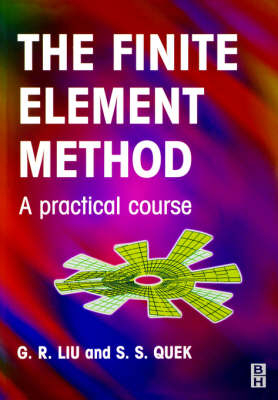
Finite Element Method (eBook)
384 Seiten
Elsevier Science (Verlag)
9780080472768 (ISBN)
Fundamental theories are introduced in a straightforward way, and state-of-the-art techniques for designing and analyzing engineering systems, including microstructural systems are explained in detail. Case studies are used to demonstrate these theories, methods, techniques and practical applications, and numerous diagrams and tables are used throughout.
The case studies and examples use the commercial software package ABAQUS, but the techniques explained are equally applicable for readers using other applications including NASTRAN, ANSYS, MARC, etc.
Full sets of PowerPoint slides developed by the authors for their course on FEM are available as a free download from a companion website.
* A practical and accessible guide to this complex, yet important subject
* Covers modeling techniques that predict how components will operate and tolerate loads, stresses and strains in reality
* Full set of PowerPoint presentation slides which illustrate and support the book are available on a companion website.
The Finite Element Method (FEM) has become an indispensable technology for the modelling and simulation of engineering systems. Written for engineers and students alike, the aim of the book is to provide the necessary theories and techniques of the FEM for readers to be able to use a commercial FEM package to solve primarily linear problems in mechanical and civil engineering with the main focus on structural mechanics and heat transfer.Fundamental theories are introduced in a straightforward way, and state-of-the-art techniques for designing and analyzing engineering systems, including microstructural systems are explained in detail. Case studies are used to demonstrate these theories, methods, techniques and practical applications, and numerous diagrams and tables are used throughout.The case studies and examples use the commercial software package ABAQUS, but the techniques explained are equally applicable for readers using other applications including NASTRAN, ANSYS, MARC, etc. - A practical and accessible guide to this complex, yet important subject- Covers modeling techniques that predict how components will operate and tolerate loads, stresses and strains in reality
Cover 1
CONTENTS 1
BIOGRAPHICAL INFORMATION 1
Preface 1
1. COMPUTATIONAL MODELLING 1
1.1 INTRODUCTION 1
1.2 PHYSICAL PROBLEMS IN ENGINEERING 1
1.3 COMPUTATIONAL MODELLING USING THE FEM 1
1.3.1 Modelling of the Geometry 1
1.3.2 Meshing 1
1.3.3 Property of Material or Medium 1
1.3.4 Boundary, Initial and Loading Conditions 1
1.4 SIMULATION 1
1.4.1 Discrete System Equations 1
1.4.2 Equation Solvers 1
1.5 VISUALIZATION 1
2. INTRODUCTION TO MECHANICS FOR SOLIDS AND STRUCTURES 1
2.1 INTRODUCTION 1
2.2 EQUATIONS FOR THREE-DIMENSIONAL SOLIDS 1
2.2.1 Stress and Strain 1
2.2.2 Constitutive Equations 1
2.2.3 Dynamic Equilibrium Equation 1
2.2.4 Boundary Conditions 1
2.3 EQUATIONS FOR TWO-DIMENSIONAL SOLIDS 1
2.3.1 Stress and Strain 1
2.3.2 Constitutive Equations 1
2.3.3 Dynamic Equilibrium Equations 1
2.4 EQUATIONS FOR TRUSS MEMBERS 1
2.4.1 Stress and Strain 1
2.4.2 Constitutive Equations 1
2.4.3 Dynamic Equilibrium Equations 1
2.5 EQUATIONS FOR BEAMS 1
2.5.1 Stress and Strain 1
2.5.2 Constitutive Equations 1
2.5.3 Moments and Shear Forces 1
2.5.4 Dynamic Equilibrium Equations 1
2.6 EQUATIONS FOR PLATES 1
2.6.1 Stress and Strain 1
2.6.2 Constitutive Equations 1
2.6.3 Moments and Shear Forces 1
2.6.4 Dynamic Equilibrium Equations 1
2.6.5 Reissner–Mindlin Plate (Reissner, 1945 Mindlin, 1951)
2.7 REMARKS 1
3. FUNDAMENTALS FOR FINITE ELEMENT METHOD 1
3.1 INTRODUCTION 1
3.2 STRONG AND WEAK FORMS 1
3.3 HAMILTON’S PRINCIPLE 1
3.4 FEM PROCEDURE 1
3.4.1 Domain Discretization 1
3.4.2 Displacement Interpolation 1
3.4.3 Standard Procedure for Constructing Shape Functions 1
3.4.4 Properties of the Shape Functions1 1
3.4.5 Formation of FE Equations in Local Coordinate System 1
3.4.6 Coordinate transformation 1
3.4.7 Assembly of Global FE Equation 1
3.4.8 Imposition of Displacement Constraints 1
3.4.9 Solving the Global FE Equation 1
3.5 STATIC ANALYSIS 1
3.6 ANALYSIS OF FREE VIBRATION (EIGENVALUE ANALYSIS) 1
3.7 TRANSIENT RESPONSE 1
3.7.1 Central Difference Algorithm 1
3.7.2 Newmark’s Method (Newmark, 1959) 1
3.8 REMARKS 1
3.8.1 Summary of Shape Function Properties 1
3.8.2 Sufficient Requirements for FEM Shape Functions 1
3.8.3 Recap of FEM Procedure 1
3.9 REVIEW QUESTIONS 1
4. FEM FOR TRUSSES 1
4.1 INTRODUCTION 1
4.2 FEM EQUATIONS 1
4.2.1 Shape Function Construction 1
4.2.2 Strain Matrix 1
4.2.3 Element Matrices in the Local Coordinate System 1
4.2.4 Element Matrices in the Global Coordinate System 1
4.2.5 Boundary Conditions 1
4.2.6 Recovering Stress and Strain 1
4.3 WORKED EXAMPLES 1
Example 4.1: A uniform bar subjected to an axial force 1
4.3.1 Properties of the FEM 1
Example 4.2: A triangular truss structure subjected to a vertical force 1
4.4 HIGH ORDER ONE-DIMENSIONAL ELEMENTS 1
4.5 REVIEW QUESTIONS 1
5. FEM FOR BEAMS 1
5.1 INTRODUCTION 1
5.2 FEM EQUATIONS 1
5.2.1 Shape Function Construction 1
5.2.2 Strain Matrix 1
5.2.3 Element Matrices 1
5.3 REMARKS 1
5.4 WORKED EXAMPLES 1
Example 5.1: A uniform cantilever beam subjected to a downward force 1
5.5 CASE STUDY: RESONANT FREQUENCIES OF MICRO RESONANT TRANSDUCER 1
5.5.1 Modelling 1
5.5.2 ABAQUS Input File 1
5.5.3 Solution Process 1
5.5.4 Result and Discussion 1
5.6 REVIEW QUESTIONS 1
6. FEM FOR FRAMES 1
6.1 INTRODUCTION 1
6.2 FEM EQUATIONS FOR PLANAR FRAMES 1
6.2.1 Equations in Local Coordinate System 1
6.2.2 Equations in Global Coordinate System 1
6.3 FEM EQUATIONS FOR SPACE FRAMES 1
6.3.1 Equations in Local Coordinate System 1
6.3.2 Equations in Global Coordinate System 1
6.4 REMARKS 1
6.5 CASE STUDY: FINITE ELEMENT ANALYSIS OF A BICYCLE FRAME 1
6.5.1 Modelling 1
6.5.2 Abaqus Input File 1
6.5.3 Solution Processes 1
6.5.4 Results and Discussion 1
6.6 REVIEW QUESTIONS 1
7. FEM FOR TWO-DIMENSIONAL SOLIDS 1
7.1 INTRODUCTION 1
7.2 LINEAR TRIANGULAR ELEMENTS 1
7.2.1 Field Variable Interpolation 1
7.2.2 Shape Function Construction 1
7.2.3 Area Coordinates 1
7.2.4 Strain Matrix 1
7.2.5 Element Matrices 1
7.3 LINEAR RECTANGULAR ELEMENTS 1
7.3.1 Shape Function Construction 1
7.3.2 Strain Matrix 1
7.3.3 Element Matrices 1
7.3.4 Gauss Integration 1
7.4 LINEAR QUADRILATERAL ELEMENTS 1
7.4.1 Coordinate Mapping 1
7.4.2 Strain Matrix 1
7.4.3 Element Matrices 1
7.4.4 Remarks 1
7.5 HIGHER ORDER ELEMENTS 1
7.5.1 Triangular Element Family 1
7.5.2 Rectangular Elements 1
7.6 ELEMENTS WITH CURVED EDGES 1
7.7 COMMENTS ON GAUSS INTEGRATION 1
7.8 CASE STUDY: SIDE DRIVE MICRO-MOTOR 1
7.8.1 Modelling 1
7.8.2 ABAQUS Input File 1
7.8.3 Solution Process 1
7.8.4 Results and Discussion 1
7.9 REVIEW QUESTIONS (PETYT, 1990) 1
8. FEM FOR PLATES AND SHELLS 1
8.1 INTRODUCTION 1
8.2 PLATE ELEMENTS 1
8.2.1 Shape Functions 1
8.2.2 Element Matrices 1
8.2.3 Higher Order Elements 1
8.3 SHELL ELEMENTS 1
8.3.1 Elements in Local Coordinate Systems 1
8.3.2 Elements in Global Coordinate System 1
8.4 REMARKS 1
8.5 CASE STUDY: NATURAL FREQUENCIES OF MICRO-MOTOR 1
8.5.1 Modelling 1
8.5.2 ABAQUS Input File 1
8.5.3 Solution Process 1
8.5.4 Result and Discussion 1
8.6 CASE STUDY: TRANSIENT ANALYSIS OF A MICRO-MOTOR 1
8.6.1 Modelling 1
8.6.2 ABAQUS Input File 1
8.6.3 Solution Process 1
8.6.4 Result and Discussion 1
8.7 REVIEW QUESTIONS 1
9. FEM FOR 3D SOLIDS 1
9.1 INTRODUCTION 1
9.2 TETRAHEDRON ELEMENT 1
9.2.1 Strain Matrix 1
9.2.2 Element Matrices 1
9.3 HEXAHEDRON ELEMENT 1
9.3.1 Strain Matrix 1
9.3.2 Element Matrices 1
9.3.3 Using Tetrahedrons to form Hexahedrons 1
9.4 HIGHER ORDER ELEMENTS 1
9.4.1 Tetrahedron Elements 1
9.4.2 Brick Elements 1
9.5 ELEMENTS WITH CURVED SURFACES 1
9.6 CASE STUDY: STRESS AND STRAIN ANALYSIS OF A QUANTUM DOT HETEROSTRUCTURE 1
9.6.1 Modelling 1
9.6.2 ABAQUS Input File 1
9.6.3 Solution Process 1
9.6.4 Result and Discussion 1
9.7 REVIEW QUESTIONS 1
10. SPECIAL PURPOSE ELEMENTS 1
10.1 INTRODUCTION 1
10.2 CRACK TIP ELEMENTS 1
10.3 METHODS FOR INFINITE DOMAINS 1
10.3.1 Infinite Element Formulated by Mapping (Bettess, 1992) 1
10.3.2 Gradual Damping Elements 1
10.3.3 Coupling of FEM and BEM 1
10.3.4 Coupling of FEM and SEM 1
10.4 FINITE STRIP ELEMENTS 1
10.5 STRIP ELEMENT METHOD (SEM) 1
11. MODELLING TECHNIQUES 1
11.1 INTRODUCTION 1
11.2 CPU TIME ESTIMATION 1
11.3 GEOMETRY MODELLING 1
11.4 MESHING 1
11.4.1 Mesh Density 1
11.4.2 Element Distortion 1
11.5 MESH COMPATIBILITY 1
11.5.1 Different Order of Elements 1
11.5.2 Straddling Elements 1
11.6 USE OF SYMMETRY 1
11.6.1 Mirror Symmetry or Plane Symmetry 1
11.6.2 Axial Symmetry 1
11.6.3 Cyclic Symmetry 1
11.6.4 Repetitive Symmetry 1
11.7 MODELLING OF OFFSETS 1
11.7.1 Methods for Modelling Offsets 1
11.7.2 Creation of MPC Equations for Offsets 1
11.8 MODELLING OF SUPPORTS 1
11.9 MODELLING OF JOINTS 1
11.10 OTHER APPLICATIONS OF MPC EQUATIONS 1
11.10.1 Modelling of Symmetric Boundary Conditions 1
11.10.2 Enforcement of Mesh Compatibility 1
11.10.3 Modelling of Constraints by Rigid Body Attachment 1
11.11 IMPLEMENTATION OF MPC EQUATIONS 1
11.11.1 Lagrange Multiplier Method 1
11.11.2 Penalty Method 1
11.12 REVIEW QUESTIONS 1
12. FEM FOR HEAT TRANSFER PROBLEMS 1
12.1 FIELD PROBLEMS 1
12.1.1 Heat Transfer in a Two-Dimensional Fin 1
12.1.2 Heat Transfer in a Long Two-Dimensional Body 1
12.1.3 Heat Transfer in a One-Dimensional Fin 1
12.1.4 Heat Transfer Across a CompositeWall 1
12.1.5 Torsional Deformation of a Bar 1
12.1.6 Ideal Irrotational Fluid Flow 1
12.1.7 Acoustic Problems 1
12.2 WEIGHTED RESIDUAL APPROACH FOR FEM 1
12.3 1D HEAT TRANSFER PROBLEM 1
12.3.1 One-Dimensional Fin 1
12.3.2 Direct Assembly Procedure 1
12.3.3 Worked Example 1
12.3.4 Remarks 1
12.3.5 CompositeWall 1
12.3.6 Worked Example 1
12.4 2D HEAT TRANSFER PROBLEM 1
12.4.1 Element Equations 1
12.4.2 Triangular Elements 1
12.4.3 Rectangular Elements 1
12.4.4 Boundary Conditions and Vector b( 1
12.4.5 Point Heat Source or Sink 1
12.5 SUMMARY 1
12.6 CASE STUDY: TEMPERATURE DISTRIBUTION OF HEATED ROAD SURFACE 1
12.6.1 Modelling 1
12.6.2 ABAQUS Input File 1
12.6.3 Result and Discussion 1
12.7 REVIEW QUESTIONS 1
13. USING ABAQUS 1
13.1 INTRODUCTION 1
13.2 BASIC BUILDING BLOCK: KEYWORDS AND DATA LINES 1
13.3 USING SETS 1
13.4 ABAQUS INPUT SYNTAX RULES 1
13.4.1 Keyword Lines 1
13.4.2 Data Lines 1
13.4.3 Labels 1
13.5 DEFINING A FINITE ELEMENT MODEL IN ABAQUS 1
13.5.1 Model Data 1
13.5.2 History Data 1
13.5.3 Example of Cantilever Beam Problem 1
13.6 GENERAL PROCEDURES 1
REFERENCES 1
INDEX 1
| Erscheint lt. Verlag | 21.2.2003 |
|---|---|
| Sprache | englisch |
| Themenwelt | Informatik ► Grafik / Design ► Digitale Bildverarbeitung |
| Mathematik / Informatik ► Informatik ► Theorie / Studium | |
| Mathematik / Informatik ► Mathematik ► Algebra | |
| Mathematik / Informatik ► Mathematik ► Analysis | |
| Mathematik / Informatik ► Mathematik ► Angewandte Mathematik | |
| Naturwissenschaften ► Physik / Astronomie | |
| Technik ► Bauwesen | |
| Technik ► Maschinenbau | |
| ISBN-13 | 9780080472768 / 9780080472768 |
| Informationen gemäß Produktsicherheitsverordnung (GPSR) | |
| Haben Sie eine Frage zum Produkt? |
 PDF (Adobe DRM)
Kopierschutz: Adobe-DRM
Adobe-DRM ist ein Kopierschutz, der das eBook vor Mißbrauch schützen soll. Dabei wird das eBook bereits beim Download auf Ihre persönliche Adobe-ID autorisiert. Lesen können Sie das eBook dann nur auf den Geräten, welche ebenfalls auf Ihre Adobe-ID registriert sind.
Details zum Adobe-DRM
Dateiformat: PDF (Portable Document Format)
Mit einem festen Seitenlayout eignet sich die PDF besonders für Fachbücher mit Spalten, Tabellen und Abbildungen. Eine PDF kann auf fast allen Geräten angezeigt werden, ist aber für kleine Displays (Smartphone, eReader) nur eingeschränkt geeignet.
Systemvoraussetzungen:
PC/Mac: Mit einem PC oder Mac können Sie dieses eBook lesen. Sie benötigen eine
eReader: Dieses eBook kann mit (fast) allen eBook-Readern gelesen werden. Mit dem amazon-Kindle ist es aber nicht kompatibel.
Smartphone/Tablet: Egal ob Apple oder Android, dieses eBook können Sie lesen. Sie benötigen eine
Geräteliste und zusätzliche Hinweise
Buying eBooks from abroad
For tax law reasons we can sell eBooks just within Germany and Switzerland. Regrettably we cannot fulfill eBook-orders from other countries.
aus dem Bereich