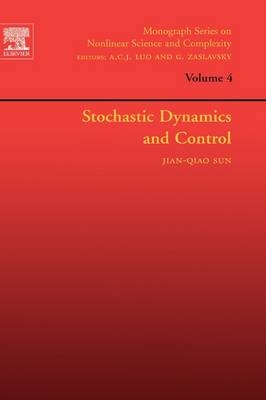
Stochastic Dynamics and Control (eBook)
426 Seiten
Elsevier Science (Verlag)
978-0-08-046398-8 (ISBN)
? Comprehensive review of probability theory, and stochastic processes
? Random vibrations
? Structural reliability and fatigue, Non-Gaussian fatigue
? Monte Carlo methods
? Stochastic calculus and engineering applications
? Stochastic feedback controls and optimal controls
? Stochastic sliding mode controls
? Feedback control of stochastic time-delayed systems
? Probability density tracking control
This book is a result of many years of author's research and teaching on random vibration and control. It was used as lecture notes for a graduate course. It provides a systematic review of theory of probability, stochastic processes, and stochastic calculus. The feedback control is also reviewed in the book. Random vibration analyses of SDOF, MDOF and continuous structural systems are presented in a pedagogical order. The application of the random vibration theory to reliability and fatigue analysis is also discussed. Recent research results on fatigue analysis of non-Gaussian stress processes are also presented. Classical feedback control, active damping, covariance control, optimal control, sliding control of stochastic systems, feedback control of stochastic time-delayed systems, and probability density tracking control are studied. Many control results are new in the literature and included in this book for the first time. The book serves as a reference to the engineers who design and maintain structures subject to harsh random excitations including earthquakes, sea waves, wind gusts, and aerodynamic forces, and would like to reduce the damages of structural systems due to random excitations.* Comprehensive review of probability theory, and stochastic processes* Random vibrations* Structural reliability and fatigue, Non-Gaussian fatigue* Monte Carlo methods* Stochastic calculus and engineering applications* Stochastic feedback controls and optimal controls* Stochastic sliding mode controls* Feedback control of stochastic time-delayed systems* Probability density tracking control
Front cover 1
Table of contents 6
Preface 16
Chapter 1. Introduction 18
1.1. Stochastic dynamics 18
1.2. Stochastic control 19
Chapter 2. Probability Theory 26
2.1. Probability of random events 26
2.2. Random variables 27
2.3. Probability distributions 28
2.4. Expectations of random variables 28
2.5. Common probability distributions 30
2.6. Two-dimensional random variables 35
2.7. n-Dimensional random variables 37
2.8. Functions of random variables 39
2.9 Conditional probability 46
Exercises 47
Chapter 3. Stochastic Processes 50
3.1. Definitions 50
3.2. Expectations 51
3.3. Vector process 52
3.4 Gaussian process 53
3.5. Harmonic process 54
3.6. Stationary process 55
3.7. Ergodic process 57
3.8. Poisson process 62
3.9. Markov process 65
Exercises 66
Chapter 4. Spectral Analysis of Stochastic Processes 68
4.1 Power spectral density function 68
4.2. Spectral moments and bandwidth 71
4.3. Process with rational spectral density function 76
4.4. Finite time spectral analysis 78
Exercises 79
Chapter 5. Stochastic Calculus 82
5.1. Modes of convergence 82
5.2. Stochastic differentiation 84
5.3. Stochastic integration 91
5.4. Ito calculus 98
Exercises 107
Chapter 6. Fokker-Planck-Kolmogorov Equation 110
6.1. Chapman-Kolmogorov-Smoluchowski equation 110
6.2. Derivation of the FPK equation 111
6.3. Solutions of FPK equations for linear systems 116
6.4. Short-time solution 118
6.5. Path integral solution 119
6.6. Exact stationary solutions 121
Exercises 135
Chapter 7. Kolmogorov Backward Equation 138
7.1. Derivation of the backward equation 138
7.2. Reliability formulation 141
7.3. First-passage time probability 142
7.4. Pontryagin-Vitt equations 143
Exercises 144
Capter 8. Random Vibration of SDOF Systems 146
8.1. Solutions in the mean square sense 146
8.2. Solutions with Ito calculus 152
Exercises 156
Chapter 9. Random Vibration of MDOF Discrete Systems 160
9.1. Lagrange's equation 160
9.2. Modal solutions of MDOF systems 163
9.3. Response statistics 168
9.4. State space representation and Ito calculus 171
9.5. Filtered white noise excitation 176
Exercises 178
Chapter 10. Random Vibration of Continuous Structures 180
10.1. Distributed random excitations 180
10.2. One-dimensional structures 181
10.3. Two-dimensional structures 196
Exercises 203
Chapter 11. Structural Reliability 204
11.1. Modes of failure 204
11.2. Level crossing 204
11.3. Vector process 217
11.4. First-passage reliability based on level crossing 219
11.5. First-passage time probability - general approach 221
11.6. Structural fatigue 226
11.7. Dirlik's formula for fatigue prediction 231
11.8. Extended Dirlik's formula for non-Gaussian stress 232
Exercises 241
Chapter 12. Monte Carlo Simulation 244
12.1. Random numbers 244
12.2. Random processes 246
12.3. Stochastic differential equations 252
12.4. Simulation of non-Gaussian processes 256
Exercises 259
Chapter 13. Elements of Feedback Controls 260
13.1. Transfer function of linear dynamical systems 260
13.2. Concepts of stability 262
13.3. Effects of poles and zeros 265
13.4. Time domain specifications 266
13.5. PID controls 267
13.6. Routh's stability criterion 269
13.7. Root locus design 271
Exercises 272
Chapter 14. Feedback Control of Stochastic Systems 274
14.1. Response moment control of SDOF systems 274
14.2. Covariance control 277
14.3. Generalized covariance control 278
14.4. Covariance control with maximum entropy principle 287
Exercises 294
Chapter 15. Concepts of Optimal Controls 296
15.1. Optimal control of deterministic systems 297
15.2. Optimal control of stochastic systems 306
15.3. Linear Quadratic Gaussian (LQG) control 310
15.4. Sufficient conditions 316
Exercises 316
Chapter 16. Stochastic Optimal Control with the GCM Method 318
16.1. Bellman's principle of optimality 318
16.2. The cell mapping solution approach 319
16.3. Control of one-dimensional nonlinear system 323
16.4. Control of a linear oscillator 329
16.5. Control of a Van der Pol oscillator 333
16.6. Control of a dry friction damped oscillator 336
16.7. Systems with non-polynomial nonlinearities 341
16.8. Control of an impact nonlinear oscillator 347
16.9. A note on the GCM method 351
Exercises 353
Chapter 17. Sliding Mode Control 354
17.1. Variable structure control 354
17.2. Concept of sliding mode 357
17.3. Stochastic sliding mode control 365
17.4. Adaptive stochastic sliding mode control 373
Exercises 375
Chapter 18. Control of Stochastic Systems with Time Delay 378
18.1. Method of semi-discretization 379
18.2. Stability and performance analysis 381
18.3. An example 383
18.4. A note on the methodology 387
Exercises 388
Chapter 19. Probability Density Function Control 390
19.1. A motivating example 391
19.2. PDF tracking control 392
19.3. General formulation of PDF control 394
19.4. Numerical examples 396
Exercises 397
Appendix A. Matrix Computation 400
A.1. Types of matrices 400
A.2. Blocked matrix inversion 401
A.3. Matrix decomposition 402
A.4. Solution of linear algebraic equations and generalized inverse 404
Appendix B. Laplace Transformation 408
B.1. Definition and basic properties 408
B.2. Laplace transform of common functions 410
Bibliography 412
Subject Index 424
| Erscheint lt. Verlag | 10.8.2006 |
|---|---|
| Sprache | englisch |
| Themenwelt | Mathematik / Informatik ► Mathematik ► Algebra |
| Mathematik / Informatik ► Mathematik ► Analysis | |
| Mathematik / Informatik ► Mathematik ► Angewandte Mathematik | |
| Mathematik / Informatik ► Mathematik ► Wahrscheinlichkeit / Kombinatorik | |
| Naturwissenschaften ► Physik / Astronomie ► Thermodynamik | |
| Technik ► Bauwesen | |
| Technik ► Maschinenbau | |
| ISBN-10 | 0-08-046398-3 / 0080463983 |
| ISBN-13 | 978-0-08-046398-8 / 9780080463988 |
| Informationen gemäß Produktsicherheitsverordnung (GPSR) | |
| Haben Sie eine Frage zum Produkt? |
 PDF (Adobe DRM)
Kopierschutz: Adobe-DRM
Adobe-DRM ist ein Kopierschutz, der das eBook vor Mißbrauch schützen soll. Dabei wird das eBook bereits beim Download auf Ihre persönliche Adobe-ID autorisiert. Lesen können Sie das eBook dann nur auf den Geräten, welche ebenfalls auf Ihre Adobe-ID registriert sind.
Details zum Adobe-DRM
Dateiformat: PDF (Portable Document Format)
Mit einem festen Seitenlayout eignet sich die PDF besonders für Fachbücher mit Spalten, Tabellen und Abbildungen. Eine PDF kann auf fast allen Geräten angezeigt werden, ist aber für kleine Displays (Smartphone, eReader) nur eingeschränkt geeignet.
Systemvoraussetzungen:
PC/Mac: Mit einem PC oder Mac können Sie dieses eBook lesen. Sie benötigen eine
eReader: Dieses eBook kann mit (fast) allen eBook-Readern gelesen werden. Mit dem amazon-Kindle ist es aber nicht kompatibel.
Smartphone/Tablet: Egal ob Apple oder Android, dieses eBook können Sie lesen. Sie benötigen eine
Geräteliste und zusätzliche Hinweise
Buying eBooks from abroad
For tax law reasons we can sell eBooks just within Germany and Switzerland. Regrettably we cannot fulfill eBook-orders from other countries.
aus dem Bereich