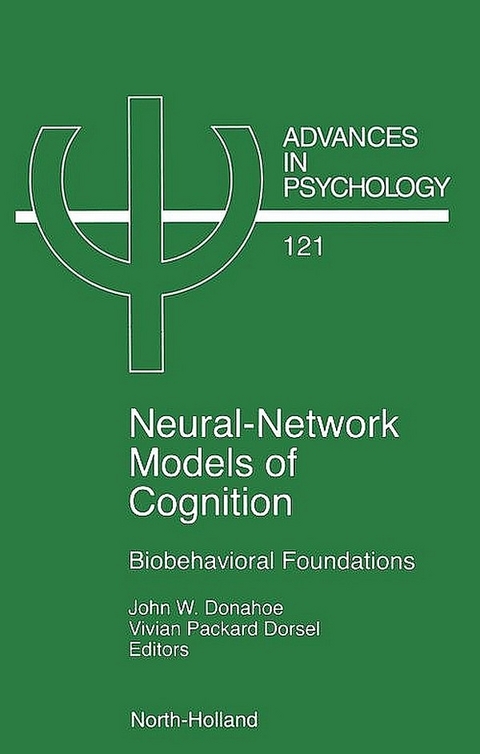
Neural Network Models of Cognition (eBook)
585 Seiten
Elsevier Science (Verlag)
978-0-08-053736-8 (ISBN)
This internationally authored volume presents major findings, concepts, and methods of behavioral neuroscience coordinated with their simulation via neural networks. A central theme is that biobehaviorally constrained simulations provide a rigorous means to explore the implications of relatively simple processes for the understanding of cognition (complex behavior). Neural networks are held to serve the same function for behavioral neuroscience as population genetics for evolutionary science. The volume is divided into six sections, each of which includes both experimental and simulation research: (1) neurodevelopment and genetic algorithms, (2) synaptic plasticity (LTP), (3) sensory/hippocampal systems, (4) motor systems, (5) plasticity in large neural systems (reinforcement learning), and (6) neural imaging and language. The volume also includes an integrated reference section and a comprehensive index.
Front Cover 1
Neural-Network Models of Cognition: Biobehavioral Foundations 4
Copyright Page 5
List of Contents 8
Acknowledgments 6
List of Contributors 12
Chapter 1. The necessity of neural networks 16
Part One: Network Architecture and Neuroanatomy 35
Chapter 2. Progenitor cells of the mammalian forebrain: Their types and distribution 37
Chapter 3. A statistical framework for presenting developmental neuroanatomy 52
Chapter 4. Evolving artificial neural networks in Pavlovian environments 73
Part Two: Neural Plasticity 95
Chapter 5. Principles of neurotransmission and implications for network modeling 97
Chapter 6. Cellular mechanisms of long-term potentiation: Late maintenance 120
Chapter 7. Temporal information processing: A computational role for paired-pulse facilitation and slow inhibition 144
Part Three: Perceiving 155
Chapter 8. Development and plasticity of neocortical processing architectures 157
Chapter 9. Inferotemporal cortex and object recognition 175
Color Plates 200
Chapter 10. Sparse coding of faces in a neuronal model: Interpreting cell population response in object recognition 204
Chapter 11. Structure and binding in object perception 218
Chapter 12. A neural-network approach to adaptive similarity and stimulus representations in cortico-hippocampal function 235
Part Four: Behaving 257
Chapter 13. Motor cortex: Neural and computational studies 259
Chapter 14. Selectionist constraints on neural networks 278
Chapter 15. Analysis of reaching for stationary and moving objects in the human infant 298
Chapter 16. Reinforcement learning of complex behavior through shaping 317
Part Five: Reinforcement Learning 330
Chapter 17. Adaptive dopaminergic neurons report the appetitive value of environmental stimuli 332
Chapter 18. Selection networks: Simulation of plasticity through reinforcement learning 351
Chapter 19. Reinforcement learning in artificial intelligence 373
Chapter 20. The T-D model of classical conditioning: Response topography and brain implementation 402
Chapter 21. Biological substrates of predictive mechanisms in learning and action choice 421
Chapter 22. The role of training in reinforcement learning 437
Part Six: Complex Behavior--Language 451
Chapter 23. Functional brain imaging and verbal behavior 453
Chapter 24. Neural modeling of learning in verbal response-selection tasks 470
Chapter 25. Serial order: A parallel distributed processing approach 486
Chapter 26. Connectionist models of arbitrarily applicable relational responding: A possible role for the hippocampal system 511
Chapter 27. A recurrent-network account of reading, spelling, and dyslexia 537
References 554
Index 597
| Erscheint lt. Verlag | 26.9.1997 |
|---|---|
| Sprache | englisch |
| Themenwelt | Geisteswissenschaften ► Psychologie ► Allgemeine Psychologie |
| Geisteswissenschaften ► Psychologie ► Biopsychologie / Neurowissenschaften | |
| Geisteswissenschaften ► Psychologie ► Verhaltenstherapie | |
| Informatik ► Theorie / Studium ► Künstliche Intelligenz / Robotik | |
| Naturwissenschaften ► Biologie ► Humanbiologie | |
| Naturwissenschaften ► Biologie ► Zoologie | |
| ISBN-10 | 0-08-053736-7 / 0080537367 |
| ISBN-13 | 978-0-08-053736-8 / 9780080537368 |
| Informationen gemäß Produktsicherheitsverordnung (GPSR) | |
| Haben Sie eine Frage zum Produkt? |
 PDF (Adobe DRM)
Kopierschutz: Adobe-DRM
Adobe-DRM ist ein Kopierschutz, der das eBook vor Mißbrauch schützen soll. Dabei wird das eBook bereits beim Download auf Ihre persönliche Adobe-ID autorisiert. Lesen können Sie das eBook dann nur auf den Geräten, welche ebenfalls auf Ihre Adobe-ID registriert sind.
Details zum Adobe-DRM
Dateiformat: PDF (Portable Document Format)
Mit einem festen Seitenlayout eignet sich die PDF besonders für Fachbücher mit Spalten, Tabellen und Abbildungen. Eine PDF kann auf fast allen Geräten angezeigt werden, ist aber für kleine Displays (Smartphone, eReader) nur eingeschränkt geeignet.
Systemvoraussetzungen:
PC/Mac: Mit einem PC oder Mac können Sie dieses eBook lesen. Sie benötigen eine
eReader: Dieses eBook kann mit (fast) allen eBook-Readern gelesen werden. Mit dem amazon-Kindle ist es aber nicht kompatibel.
Smartphone/Tablet: Egal ob Apple oder Android, dieses eBook können Sie lesen. Sie benötigen eine
Geräteliste und zusätzliche Hinweise
Buying eBooks from abroad
For tax law reasons we can sell eBooks just within Germany and Switzerland. Regrettably we cannot fulfill eBook-orders from other countries.
aus dem Bereich