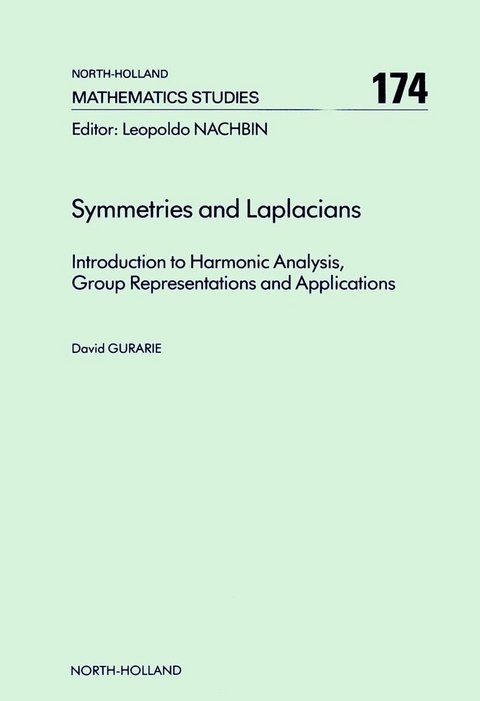
Symmetries and Laplacians (eBook)
452 Seiten
Elsevier Science (Verlag)
978-0-08-087285-8 (ISBN)
this book covers a wide range of topics rather than delving deeply into any
particular one. In the words of H. Weyl
...it is primarily meant for.
the humble, who want to learn as new the things set forth therein, rather than
for the proud and learned who are already familiar with the subject and merely
look for quick and exact information...
The main objective is to
introduce the reader to concepts, ideas, results and techniques that evolve
around symmetry-groups, representations and Laplacians. More
specifically, the main interest concerns geometrical objects and structures
{X}, discrete or continuous, that possess sufficiently large symmetry
group G, such as regular graphs (Platonic solids), lattices, and
symmetric Riemannian manifolds. All such objects have a natural Laplacian
&Dgr,, a linear operator on functions over X, invariant under
the group action. There are many problems associated with Laplacians on
X, such as continuous or discrete-time evolutions, on X,
random walks, diffusion processes, and wave-propagation. This book contains
sufficient material for a 1 or 2-semester course.
Designed as an introduction to harmonic analysis and group representations,this book covers a wide range of topics rather than delving deeply into anyparticular one. In the words of H. Weyl ...it is primarily meant forthe humble, who want to learn as new the things set forth therein, rather thanfor the proud and learned who are already familiar with the subject and merelylook for quick and exact information....The main objective is tointroduce the reader to concepts, ideas, results and techniques that evolvearound symmetry-groups, representations and Laplacians. Morespecifically, the main interest concerns geometrical objects and structures{X}, discrete or continuous, that possess sufficiently large symmetrygroup G, such as regular graphs (Platonic solids), lattices, andsymmetric Riemannian manifolds. All such objects have a natural Laplacian&Dgr;, a linear operator on functions over X, invariant underthe group action. There are many problems associated with Laplacians onX, such as continuous or discrete-time evolutions, on X,random walks, diffusion processes, and wave-propagation. This book containssufficient material for a 1 or 2-semester course.
Front Cover 1
Symmetries and Laplacians: Introduction to Harmonic Analysis, Group Representations and Applications 4
Copyright Page 5
Table of Contents 8
Introduction 10
Chapter 1. Basics of representation theory 22
1.1. Groups and group actions 22
1.2. Regular and induced representations Haar measure and convolution algebras
1.3. Irreducibility and decomposition 46
1.4. Lie groups and algebras the infinitesimal method
Chapter 2. Commutative Harmonic analysis 70
2.1. Fourier transform: inversion and Plancherel formula 71
2.2* Fourier transform on function-spaces 80
2.3. Some applications of Fourier analysis 92
2.4. Laplacian and related differential equations 101
2.5* The Radon transform 129
Chapter 3. Representations of compact and finite groups 134
3.1. The Peter-Weyl theory 134
3.2. Induced representations and Frobenius reciprocity 146
3.3* Semidirect products 156
Chapter 4. Lie groups SU(2) and SO(3) 170
4.1. Lie groups and SU(2) and SO(3) and their Lie algebras 170
4.2. Irreducible representations of SU(2) 173
43* Matrix entries and characters of irreducible representations: Legendre and Jacobi polynomials 180
4.4. Representations of SO(3): angular momentum and spherical harmonics 183
4.5* Laplacian on the n-sphere 193
Chapter 5. Classical compact Lie groups and algebras 200
5.1. Simple and semisimple Lie algebras Weyl "unitary trick"
5.2. Cartan subalgebra, root system, Weyl group 206
5.3. Highest weight representations 215
5.4* Tensors and Young tableaux 226
5.5. Haar measure on compact semisimple Lie groups 236
5.6. The Weyl character formulae 240
5.7* Laplacians on symmetric spaces 250
Chapter 6. The Heisenberg group and semidirect products 266
6.1. Induced representations and the Mackey's group extension theory 266
6.2. The Heisenberg group and the oscillator representation 283
6.3* The Kirillov orbit method 299
Chapter 7. Representations of SL2 314
7.1. Principal complementary and discrete series 314
7.2. Characters of irreducible representations 322
7.3. The Plancherel formula on SL2(R) 326
7.4. Infinitesimal representations of SL. spherical functions and characters 337
7.5* Selberg trace formula 343
7.6* Laplacians on hyperbolic surfaces H/G 357
7.7* SL2(C) and the Lorentz group 370
Chapter 8. Lie groups and hamiltonian mechanics 378
8.1. Minimal action principle Euler-Lagrange equations
8.2. Noether Theorem, conservation laws and Marsden-Weinstein reduction 387
8.3. Classical examples 394
8.4. Integrable systems related to classical Lie algebras 402
8.5* The Kepler Problem and the Hydrogen atom 417
Appendices: 432
A: Spectral decomposition of selfadjoint operators 432
B: Integral operators 436
C: A primer on Riemannian geometry: geodesics. connection. curvature 439
References 448
List of frequently used notations 456
Index 458
| Erscheint lt. Verlag | 18.5.1992 |
|---|---|
| Sprache | englisch |
| Themenwelt | Mathematik / Informatik ► Mathematik ► Algebra |
| Mathematik / Informatik ► Mathematik ► Analysis | |
| Mathematik / Informatik ► Mathematik ► Geometrie / Topologie | |
| Technik | |
| ISBN-10 | 0-08-087285-9 / 0080872859 |
| ISBN-13 | 978-0-08-087285-8 / 9780080872858 |
| Informationen gemäß Produktsicherheitsverordnung (GPSR) | |
| Haben Sie eine Frage zum Produkt? |
 PDF (Adobe DRM)
Kopierschutz: Adobe-DRM
Adobe-DRM ist ein Kopierschutz, der das eBook vor Mißbrauch schützen soll. Dabei wird das eBook bereits beim Download auf Ihre persönliche Adobe-ID autorisiert. Lesen können Sie das eBook dann nur auf den Geräten, welche ebenfalls auf Ihre Adobe-ID registriert sind.
Details zum Adobe-DRM
Dateiformat: PDF (Portable Document Format)
Mit einem festen Seitenlayout eignet sich die PDF besonders für Fachbücher mit Spalten, Tabellen und Abbildungen. Eine PDF kann auf fast allen Geräten angezeigt werden, ist aber für kleine Displays (Smartphone, eReader) nur eingeschränkt geeignet.
Systemvoraussetzungen:
PC/Mac: Mit einem PC oder Mac können Sie dieses eBook lesen. Sie benötigen eine
eReader: Dieses eBook kann mit (fast) allen eBook-Readern gelesen werden. Mit dem amazon-Kindle ist es aber nicht kompatibel.
Smartphone/Tablet: Egal ob Apple oder Android, dieses eBook können Sie lesen. Sie benötigen eine
Geräteliste und zusätzliche Hinweise
Buying eBooks from abroad
For tax law reasons we can sell eBooks just within Germany and Switzerland. Regrettably we cannot fulfill eBook-orders from other countries.
aus dem Bereich