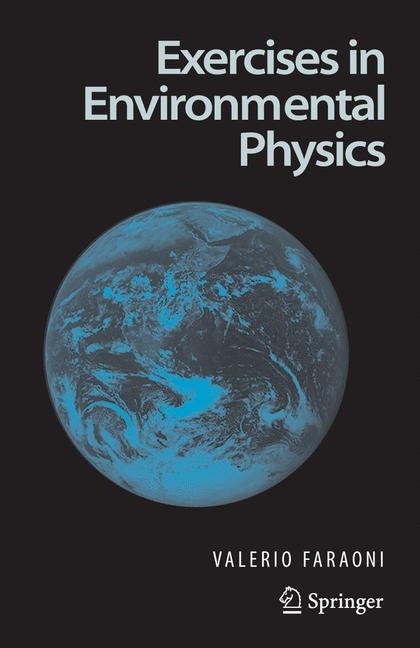
Exercises in Environmental Physics (eBook)
XV, 330 Seiten
Springer New York (Verlag)
978-0-387-35835-2 (ISBN)
Valerio Faraoni is currently a Professor in the Physics Department at Bishop's University, Lennoxville, Quebec, Canada.
The study of environmental physics requires understanding topics from many di?erent areas of physics as well as comprehension of phy- cal aspects of the world around us. Several excellent textbooks are available covering most aspects of environmental physics and of appli- tions of physics to the natural environment from various points of view. However, while teaching environmental physics to university students, I sorelymissedabookspeci?callydevotedtoexercisesfortheenvironm- tal science student. Thus, the motivation for this book came about as in physics, as well as in many other disciplines, satisfactory knowledge of a subject cannot be acquired without practice. Usually students are not familiar with the various areas of physics that are required to describe both the environment and the human impact upon it. At the same time, students need to develop skills in the manipulation of the ideas and c- cepts learned in class. Therefore, this exercise book is addressed to all levels of university students in environmental sciences. Because of the wide range of potential users this book contains both calculus-based and algebra-based problems ranging from very simple to advanced ones. Multiple solutions at di?erent levels are presented for certainproblems-thestudentwhoisjustbeginningtolearncalculuswill bene?t from the comparison of the di?erent methods of solution. The material is also useful for courses in atmospheric physics, environmental aspects of energy generation and transport, groundwater hydrology, soil physics,andoceanphysics,andselectedpartsmayevenbeusedforbasic undergraduate physics courses. This collection of exercises is based on courses taught at the University of Northern British Columbia and at the University of Victoria, Canada.
Valerio Faraoni is currently a Professor in the Physics Department at Bishop's University, Lennoxville, Quebec, Canada.
Contents 6
Preface 9
Acknowledgments 12
MATHEMATICAL METHODS 13
1.1 Complex numbers 14
1.2 Differentiation and integration of functions of a single variable 18
1.2.1 Differentiation 18
1.2.2 Integration 22
1.2.3 Maxima, minima, and graphs 26
1.3 Ordinary differential equations 36
1.3.1 Solution methods 36
1.3.2 Qualitative analysis 45
1.4 Functions of two or more variables 49
1.4.1 Differentiation 49
1.4.2 Integration 52
1.5 Vector calculus 57
1.6 Partial differential equations 68
1.7 Tensors 81
1.8 Dimensional analysis 85
PLANET EARTH IN SPACE 92
2.1 Astronomy 93
2.2 Planet Earth 98
OCEAN AND ATMOSPHERIC PHYSICS 113
3.1 The blue planet 114
3.2 Oceanic circulation 117
3.3 Ocean waves 125
3.4 General features of the atmosphere 132
3.5 Temperature and pressure 138
3.6 Atmospheric circulation 140
3.7 Precipitation 142
ELECTROMAGNETIC RADIATION AND RADIOACTIVITY 148
4.1 The electromagnetic spectrum 149
4.2 Blackbody radiation 151
4.3 Propagation of electromagnetic radiation 156
4.4 Greenhouse effect and global warming 165
4.5 Electromagnetic radiation and human health 170
4.6 Environmental spectroscopy 173
4.6.1 Quantum mechanics 174
4.6.2 Vibrational and rotational levels of molecules 178
4.7 Radioactivity 182
ENERGY AND THE ENVIRONMENT 191
5.1 Mechanical energy 192
5.1.1 Storage and transport 192
5.1.2 Transportation and vehicles 197
5.1.3 Eolic energy 198
5.2 Heat transfer 204
5.3 Thermodynamics 222
5.4 Electricity 227
FLUID MECHANICS 231
6.1 Liquids 231
6.1.1 Fluid statics 232
6.1.2 Capillarity and surface tension 239
6.1.3 Fluid dynamics 243
6.2 Gases 252
EVAPOTRANSPIRATION, SOILS, AND HYDROLOGY 259
7.1 Phase transitions, hygrometry, and evapotranspiration 260
7.2 Soil physics 270
7.3 Groundwater hydrology 284
POLLUTION 295
8.1 Transport equations 296
8.2 Water pollution 304
8.3 Air pollution 315
Appendix A Physical constants 322
Appendix B Mathematical identities 325
Appendix C Differential operators in various coordinate systems 327
References 329
Index 333
| Erscheint lt. Verlag | 15.1.2007 |
|---|---|
| Zusatzinfo | XV, 330 p. |
| Verlagsort | New York |
| Sprache | englisch |
| Themenwelt | Mathematik / Informatik ► Mathematik ► Angewandte Mathematik |
| Naturwissenschaften ► Biologie ► Ökologie / Naturschutz | |
| Naturwissenschaften ► Geowissenschaften | |
| Naturwissenschaften ► Physik / Astronomie ► Angewandte Physik | |
| Technik ► Umwelttechnik / Biotechnologie | |
| Schlagworte | air pollution and air quality • Atmospheric physics • Energy • Environmental Science • Hydrology • Mathematics • pollution • Temperature • Transport |
| ISBN-10 | 0-387-35835-8 / 0387358358 |
| ISBN-13 | 978-0-387-35835-2 / 9780387358352 |
| Informationen gemäß Produktsicherheitsverordnung (GPSR) | |
| Haben Sie eine Frage zum Produkt? |
 PDF (Wasserzeichen)
DRM: Digitales Wasserzeichen
Dieses eBook enthält ein digitales Wasserzeichen und ist damit für Sie personalisiert. Bei einer missbräuchlichen Weitergabe des eBooks an Dritte ist eine Rückverfolgung an die Quelle möglich.
Dateiformat: PDF (Portable Document Format)
Mit einem festen Seitenlayout eignet sich die PDF besonders für Fachbücher mit Spalten, Tabellen und Abbildungen. Eine PDF kann auf fast allen Geräten angezeigt werden, ist aber für kleine Displays (Smartphone, eReader) nur eingeschränkt geeignet.
Systemvoraussetzungen:
PC/Mac: Mit einem PC oder Mac können Sie dieses eBook lesen. Sie benötigen dafür einen PDF-Viewer - z.B. den Adobe Reader oder Adobe Digital Editions.
eReader: Dieses eBook kann mit (fast) allen eBook-Readern gelesen werden. Mit dem amazon-Kindle ist es aber nicht kompatibel.
Smartphone/Tablet: Egal ob Apple oder Android, dieses eBook können Sie lesen. Sie benötigen dafür einen PDF-Viewer - z.B. die kostenlose Adobe Digital Editions-App.
Buying eBooks from abroad
For tax law reasons we can sell eBooks just within Germany and Switzerland. Regrettably we cannot fulfill eBook-orders from other countries.
aus dem Bereich