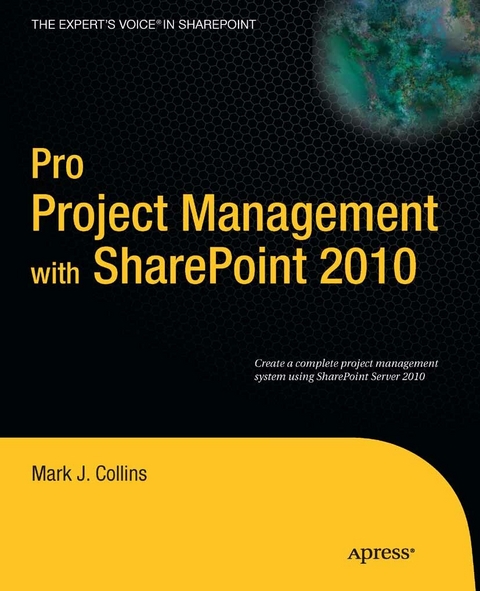
Pro Project Management with SharePoint 2010 (eBook)
XVIII, 424 Seiten
Apress (Verlag)
978-1-4302-2830-1 (ISBN)
Each chapter is focused on a typical project management activity and demonstrates techniques that can be used to facilitate that activity. The book covers all project phases from managing requirements, implementation, testing and post production support. By the end of the book you'll have a toolbox full of solutions and plenty of working examples. With these you'll be able to build your own PMIS uniquely suited to your organization.
Mark Collins has developed software for more than 25 years, mostly using the Microsoft stack. He has served many roles including development manager, architect, team lead, database administrator, and project manager. He has extensive experience in retail (point-of-sale and inventory) and customer relationship management (CRM) solutions. Mark currently serves as a senior software engineer for a non-profit organization, providing a custom CRM, mail processing, and fulfillment system.
Many successful project managers are beginning to utilize Microsoft SharePoint to drive their projects and operational initiatives. SharePoint Server provides teams with a centralized location for project information and facilitates collaboration between project team members. The intention of this book is to provide a hands-on case study that you can follow to create a complete project management information system (PMIS) using SharePoint Server 2010. Each chapter is focused on a typical project management activity and demonstrates techniques that can be used to facilitate that activity. The book covers all project phases from managing requirements, implementation, testing and post production support. By the end of the book you'll have a toolbox full of solutions and plenty of working examples. With these you'll be able to build your own PMIS uniquely suited to your organization.
Mark Collins has developed software for more than 25 years, mostly using the Microsoft stack. He has served many roles including development manager, architect, team lead, database administrator, and project manager. He has extensive experience in retail (point-of-sale and inventory) and customer relationship management (CRM) solutions. Mark currently serves as a senior software engineer for a non-profit organization, providing a custom CRM, mail processing, and fulfillment system.
Contents at a Glance 5
Contents 6
About the Author 17
About the Technical Reviewer 18
Acknowledgments 19
Introduction 20
About This Book 20
Prerequisites 21
Project Management Activities 21
Requirements 23
Collecting Requirements 24
Defining Requirements 24
Creating a Project Management Site 24
Defining Functional Areas 25
Defining the Requirements 30
Testing the Requirements List 38
Summary 40
Processing Incoming E-mail 41
Incoming E-mails 41
Configuring Incoming E-mail 42
Configuring an Incoming List 49
Adding a Workflow 53
Summary 59
Managing Requirements 60
Analyzing Requirements 60
Adding Factors 61
Calculating the Overall Score 65
Supporting Non-Negotiable Requirements 68
Supporting Dependencies 70
Summary 72
Supporting Discussions 73
Adding the Requirement Discussions List 73
Combining Lists 81
Using Outlook 90
Summary 94
Managing Development 95
User Stories 97
Defining User Stories 97
Implementing User Stories in SharePoint 99
Modifying the New Form 111
Summary 115
Project Backlog 116
Describing Agile Methodology 116
Implementing Iterations 118
Implementing a Project Backlog 129
Summary 134
Iteration Backlog 136
Review 136
Populating the Iteration Backlog 136
Using the Iteration Backlog 138
Implementing an Iteration Items List 138
Using the Iteration Items List 144
Creating the Iteration Backlog 150
Summary 153
Burndown Charts 155
Review 155
Using Burndown Charts 155
Implementing an Iteration Burndown 157
Creating a Developer’s Portal 169
Creating a Project Burndown 179
Summary 183
Testing 184
Getting Organized 185
Using Document Libraries 185
Using Calendars 194
Organizing Links 196
Putting It All Together 197
Summary 199
Creating Test Cases 200
Glossary 200
Defining Test Cases 201
Building a SharePoint Solution 203
Creating a Test Scenarios Page 216
Summary 219
Reporting Defects 220
Review 220
Test Cycles 221
Implementing Test Cycles 223
Implementing the Test Cycle Workflow 231
Recording the Test Results 242
Generating Defects in the Iteration Backlog 245
Summary 251
Testing Metrics 252
Review 252
Using Testing Metrics 253
Supporting Testing Metrics 256
Computing the Metrics 264
Adding Defect Source Analysis 279
Summary 283
Postproduction 285
Workflow Tasks 287
Understanding Workflows 287
Designing an Issue-Tracking System 292
Creating the SharePoint Objects 294
Summary 307
State Machine Workflows 308
Creating the Workflow Project 308
Implementing the Event Handlers 318
Designing the State Initialization 328
Designing the Event Handlers 338
Configuring the Workflow 351
Testing the Workflow 357
Summary 363
Creating Custom Forms 365
Creating a Custom Task Form 365
Creating the Remaining Task Forms 374
Creating a Custom Issue Form 376
Summary 384
Epilogue 386
Index 387
| Erscheint lt. Verlag | 25.2.2011 |
|---|---|
| Zusatzinfo | XVIII, 424 p. |
| Verlagsort | Berkeley |
| Sprache | englisch |
| Themenwelt | Mathematik / Informatik ► Informatik ► Netzwerke |
| Mathematik / Informatik ► Informatik ► Programmiersprachen / -werkzeuge | |
| Mathematik / Informatik ► Informatik ► Software Entwicklung | |
| Mathematik / Informatik ► Informatik ► Theorie / Studium | |
| Schlagworte | information system • Management • metrics • organization • Processing • Project Management |
| ISBN-10 | 1-4302-2830-X / 143022830X |
| ISBN-13 | 978-1-4302-2830-1 / 9781430228301 |
| Informationen gemäß Produktsicherheitsverordnung (GPSR) | |
| Haben Sie eine Frage zum Produkt? |
 PDF (Wasserzeichen)
DRM: Digitales Wasserzeichen
Dieses eBook enthält ein digitales Wasserzeichen und ist damit für Sie personalisiert. Bei einer missbräuchlichen Weitergabe des eBooks an Dritte ist eine Rückverfolgung an die Quelle möglich.
Dateiformat: PDF (Portable Document Format)
Mit einem festen Seitenlayout eignet sich die PDF besonders für Fachbücher mit Spalten, Tabellen und Abbildungen. Eine PDF kann auf fast allen Geräten angezeigt werden, ist aber für kleine Displays (Smartphone, eReader) nur eingeschränkt geeignet.
Systemvoraussetzungen:
PC/Mac: Mit einem PC oder Mac können Sie dieses eBook lesen. Sie benötigen dafür einen PDF-Viewer - z.B. den Adobe Reader oder Adobe Digital Editions.
eReader: Dieses eBook kann mit (fast) allen eBook-Readern gelesen werden. Mit dem amazon-Kindle ist es aber nicht kompatibel.
Smartphone/Tablet: Egal ob Apple oder Android, dieses eBook können Sie lesen. Sie benötigen dafür einen PDF-Viewer - z.B. die kostenlose Adobe Digital Editions-App.
Buying eBooks from abroad
For tax law reasons we can sell eBooks just within Germany and Switzerland. Regrettably we cannot fulfill eBook-orders from other countries.
aus dem Bereich