


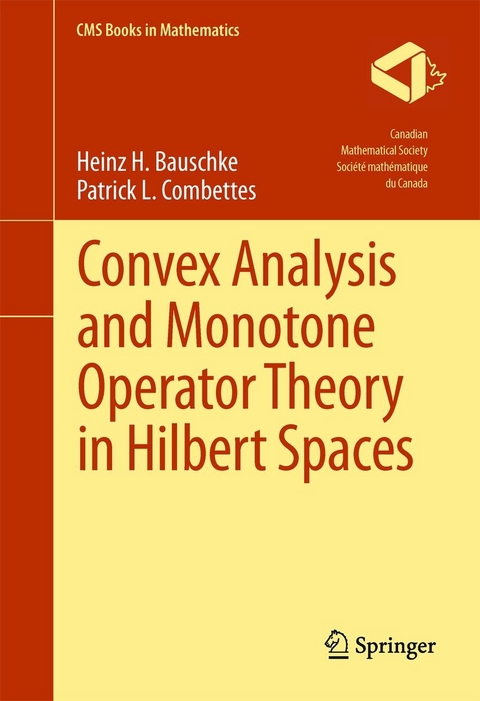
Convex Analysis and Monotone Operator Theory in Hilbert Spaces (eBook)
468 Seiten
Springer New York (Verlag)
978-1-4419-9467-7 (ISBN)
This book provides a largely self-contained account of the main results of convex analysis and optimization in Hilbert space. A concise exposition of related constructive fixed point theory is presented, that allows for a wide range of algorithms to construct solutions to problems in optimization, equilibrium theory, monotone inclusions, variational inequalities, best approximation theory, and convex feasibility. The book is accessible to a broad audience, and reaches out in particular to applied scientists and engineers, to whom these tools have become indispensable.
Foreword 8
Preface 10
Contents 12
Chapter 1: Background 18
1.1 Sets in Vector Spaces 18
1.2 Operators 19
1.3 Order 20
1.4 Nets 21
1.5 The Extended Real Line 21
1.6 Functions 22
1.7 Topological Spaces 24
1.8 Two–Point Compactification of the Real Line 26
1.9 Continuity 26
1.10 Lower Semicontinuity 27
1.11 Sequential Topological Notions 32
1.12 Metric Spaces 33
Exercises 39
Chapter 2: Hilbert Spaces 43
2.1 Notation and Examples 43
2.2 Basic Identities and Inequalities 45
2.3 Linear Operators and Functionals 47
2.4 Strong and Weak Topologies 49
2.5 Weak Convergence of Sequences 52
2.6 Differentiability 53
Exercises 56
Chapter 3: Convex Sets 59
3.1 Definition and Examples 59
3.2 Best Approximation Properties 60
3.3 Topological Properties 68
3.4 Separation 71
Exercises 73
Chapter 4: Convexity and Nonexpansiveness 75
4.1 Nonexpansive Operators 75
4.2 Projectors onto Convex Sets 77
4.3 Fixed Points of Nonexpansive Operators 78
4.4 Averaged Nonexpansive Operators 83
4.5 Common Fixed Points 87
Exercises 88
Chapter 5: Fejér Monotonicity and Fixed Point Iterations 91
5.1 Fejér Monotone Sequences 91
5.2 Krasnosel’skii–Mann Iteration 94
5.3 Iterating Compositions of Averaged Operators 98
Exercises 101
Chapter 6: Convex Cones and Generalized Interiors 103
6.1 Convex Cones 103
6.2 Generalized Interiors 106
6.3 Polar and Dual Cones 112
6.4 Tangent and Normal Cones 116
6.5 Recession and Barrier Cones 119
Exercises 120
Chapter 7: Support Functions and Polar Sets 123
7.1 Support Points 123
7.2 Support Functions 125
7.3 Polar Sets 126
Exercises 127
Chapter 8: Convex Functions 129
8.1 Definition and Examples 129
8.2 Convexity–Preserving Operations 132
8.3 Topological Properties 136
Exercises 141
Chapter 9: Lower Semicontinuous Convex Functions 144
9.1 Lower Semicontinuous Convex Functions 144
9.2 Proper Lower Semicontinuous Convex Functions 147
9.3 Affine Minorization 148
9.4 Construction of Functions in .0 (H) 151
Exercises 156
Chapter 10: Convex Functions: Variants 157
10.1 Between Linearity and Convexity 157
10.2 Uniform and Strong Convexity 158
10.3 Quasiconvexity 162
Exercises 165
Chapter 11: Convex Variational Problems 168
11.1 Infima and Suprema 168
11.2 Minimizers 169
11.3 Uniqueness of Minimizers 170
11.4 Existence of Minimizers 170
11.5 Minimizing Sequences 173
Exercises 177
Chapter 12: Infimal Convolution 179
12.1 Definition and Basic Facts 179
12.2 Infimal Convolution of Convex Functions 182
12.3 Pasch–Hausdorff Envelope 184
12.4 Moreau Envelope 185
12.5 Infimal Postcomposition 190
Exercises 190
Chapter 13: Conjugation 193
13.1 Definition and Examples 193
13.2 Basic Properties 196
13.3 The Fenchel–Moreau Theorem 202
Exercises 206
Chapter 14: Further Conjugation Results 208
14.1 Moreau’s Decomposition 208
14.2 Proximal Average 210
14.3 Positively Homogeneous Functions 212
14.4 Coercivity 213
14.5 The Conjugate of the Difference 215
Exercises 216
Chapter 15: Fenchel–Rockafellar Duality 218
15.1 The Attouch–Brézis Theorem 218
15.2 Fenchel Duality 222
15.3 Fenchel–Rockafellar Duality 224
15.4 A Conjugation Result 228
15.5 Applications 229
Exercises 231
Chapter 16: Subdifferentiability 234
16.1 Basic Properties 234
16.2 Convex Functions 238
16.3 Lower Semicontinuous Convex Functions 240
16.4 Subdifferential Calculus 244
Exercises 251
Chapter 17: Differentiability of Convex Functions 252
17.1 Directional Derivatives 252
17.2 Characterizations of Convexity 255
17.3 Characterizations of Strict Convexity 257
17.4 Directional Derivatives and Subgradients 258
17.5 Gâteaux and Fréchet Differentiability 262
17.6 Differentiability and Continuity 268
Exercises 269
Chapter 18: Further Differentiability Results 271
18.1 The Ekeland–Lebourg Theorem 271
18.2 The Subdifferential of a Maximum 274
18.3 Differentiability of Infimal Convolutions 276
18.4 Differentiability and Strict Convexity 277
18.5 Stronger Notions of Differentiability 278
18.6 Differentiability of the Distance to a Set 281
Exercises 283
Chapter 19: Duality in Convex Optimization 285
19.1 Primal Solutions via Dual Solutions 285
19.2 Parametric Duality 289
19.3 Minimization under Equality Constraints 293
19.4 Minimization under Inequality Constraints 295
Exercises 301
Chapter 20: Monotone Operators 303
20.1 Monotone Operators 303
20.2 Maximally Monotone Operators 307
20.3 Bivariate Functions and Maximal Monotonicity 312
20.4 The Fitzpatrick Function 314
Exercises 318
Chapter 21: Finer Properties of Monotone Operators 320
21.1 Minty’s Theorem 320
21.2 The Debrunner–Flor Theorem 324
21.3 Domain and Range 325
21.4 Local Boundedness and Surjectivity 327
21.5 Kenderov’s Theorem and Fréchet Differentiability 329
Exercises 330
Chapter 22: Stronger Notions of Monotonicity 331
22.1 Para, Strict, Uniform, and Strong Monotonicity 331
22.2 Cyclic Monotonicity 334
22.3 Rockafellar’s Cyclic Monotonicity Theorem 335
22.4 Monotone Operators on R 337
Exercises 338
Chapter 23: Resolvents of Monotone Operators 340
23.1 Definition and Basic Identities 340
23.2 Monotonicity and Firm Nonexpansiveness 342
23.3 Resolvent Calculus 344
23.4 Zeros of Monotone Operators 351
23.5 Asymptotic Behavior 353
Exercises 356
Chapter 24: Sums of Monotone Operators 358
24.1 Maximal Monotonicity of a Sum 358
24.2 3* Monotone Operators 361
24.3 The Brézis–Haraux Theorem 364
24.4 Parallel Sum 366
Exercises 368
Chapter 25: Zeros of Sums of Monotone Operators 370
25.1 Characterizations 370
25.2 Douglas–Rachford Splitting 373
25.3 Forward–Backward Splitting 377
25.4 Tseng’s Splitting Algorithm 379
25.5 Variational Inequalities 382
Exercises 385
Chapter 26: Fermat’s Rule in Convex Optimization 387
26.1 General Characterizations of Minimizers 387
26.2 Abstract Constrained Minimization Problems 389
26.3 Affine Constraints 392
26.4 Cone Constraints 393
26.5 Convex Inequality Constraints 395
26.6 Regularization of Minimization Problems 399
Exercises 401
Chapter 27: Proximal Minimization 404
27.1 The Proximal-Point Algorithm 404
27.2 Douglas–Rachford Algorithm 405
27.3 Forward–Backward Algorithm 410
27.4 Tseng’s Splitting Algorithm 412
27.5 A Primal–Dual Algorithm 413
Exercises 416
Chapter 28: Projection Operators 419
28.1 Basic Properties 419
28.2 Projections onto Affine Subspaces 421
28.3 Projections onto Special Polyhedra 423
28.4 Projections Involving Convex Cones 429
28.5 Projections onto Epigraphs and Lower Level Sets 431
Exercises 433
Chapter 29: Best Approximation Algorithms 435
29.1 Dykstra’s Algorithm 435
29.2 Haugazeau’s Algorithm 440
Exercises 444
Bibliographical Pointers 445
Symbols and Notation 447
References 452
Index 463
| Erscheint lt. Verlag | 19.4.2011 |
|---|---|
| Reihe/Serie | CMS Books in Mathematics |
| Zusatzinfo | XVI, 468 p. |
| Verlagsort | New York |
| Sprache | englisch |
| Themenwelt | Mathematik / Informatik ► Informatik ► Programmiersprachen / -werkzeuge |
| Mathematik / Informatik ► Mathematik | |
| Technik | |
| ISBN-10 | 1-4419-9467-X / 144199467X |
| ISBN-13 | 978-1-4419-9467-7 / 9781441994677 |
| Informationen gemäß Produktsicherheitsverordnung (GPSR) | |
| Haben Sie eine Frage zum Produkt? |
 PDF (Wasserzeichen)
Größe: 4,3 MB
DRM: Digitales Wasserzeichen
Dieses eBook enthält ein digitales Wasserzeichen und ist damit für Sie personalisiert. Bei einer missbräuchlichen Weitergabe des eBooks an Dritte ist eine Rückverfolgung an die Quelle möglich.
Dateiformat: PDF (Portable Document Format)
Mit einem festen Seitenlayout eignet sich die PDF besonders für Fachbücher mit Spalten, Tabellen und Abbildungen. Eine PDF kann auf fast allen Geräten angezeigt werden, ist aber für kleine Displays (Smartphone, eReader) nur eingeschränkt geeignet.
Systemvoraussetzungen:
PC/Mac: Mit einem PC oder Mac können Sie dieses eBook lesen. Sie benötigen dafür einen PDF-Viewer - z.B. den Adobe Reader oder Adobe Digital Editions.
eReader: Dieses eBook kann mit (fast) allen eBook-Readern gelesen werden. Mit dem amazon-Kindle ist es aber nicht kompatibel.
Smartphone/Tablet: Egal ob Apple oder Android, dieses eBook können Sie lesen. Sie benötigen dafür einen PDF-Viewer - z.B. die kostenlose Adobe Digital Editions-App.
Buying eBooks from abroad
For tax law reasons we can sell eBooks just within Germany and Switzerland. Regrettably we cannot fulfill eBook-orders from other countries.
aus dem Bereich


