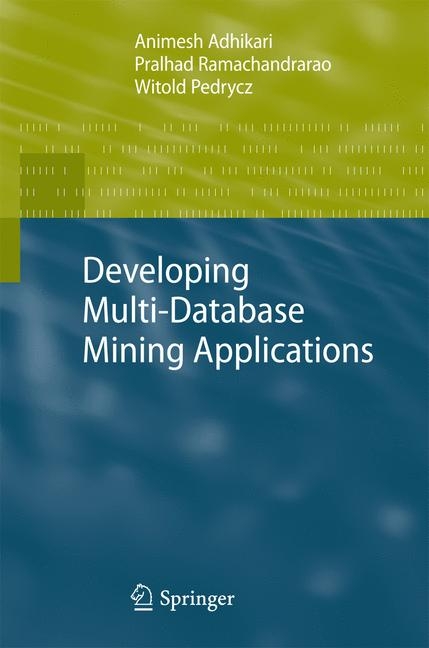
Developing Multi-Database Mining Applications (eBook)
X, 130 Seiten
Springer London (Verlag)
9781849960441 (ISBN)
Animesh Adhikari is an associate professor in the department of Computer Science, Chowgule College, Goa, India. His education includes: Doctor of Philosophy in Computer Science, Goa University, Goa, India (2009); Master of Technology in Computer Science, Indian Statistical Institute, Kolkata, India (1993); Master of Computer Application, Jadavpur University, Kolkata, India (1991). The dissertations he has written cover: [Ph D] Knowledge Discovery in Databases with an Emphasis on Multiple Large Databases (Goa University, 2009). This dissertation has the following parts: (i) Association analysis and patterns recognition in a database, (ii) Pattern recognition in multiple databases, (iii) Developing better multi-database mining applications; [M Tech] Fractal-based Image Segmentation (Indian Statistical Institute, 1993). Adhikari's areas of interest include: data mining and knowledge discovery, database systems, decision support systems, artificial intelligence, statistics and other related topics. Adhikari's professional activities are: Member, Program Committee, Indian International Conference on Artificial Intelligence (2009) Session Chair, Data Mining and Knowledge Discovery, Indian International Conference on Artificial Intelligence (2009); Reviewer, IEEE Transactions on Knowledge and Data Engineering journal; Member, Editorial Board, International Journal of Knowledge-Based Organizations, IGI Global (2009 - date); Member, Program Committee, Ph D Workshop;International Conference on Management of Data (2009); Reviewer, IEEE Transactions on Parallel and Distibuted Systems journal. Witold Pedrycz is a Professor and Canada Research Chair (CRC) in Computational Intelligence in the Department of Electrical and Computer Engineering, University of Alberta, Edmonton, Canada. Dr. Pedrycz is an IEEE Fellow, IFSA Fellow and a Fellow of the Engineering Institute of Canada (EIC). Dr. Pedrycz received the M.Sc., and Ph.D., D.Sci. all from the Silesian University of Technology, Gliwice, Poland. His main research interests encompass fundamentals of Computational Intelligence, Granular Computing, fuzzy modeling, knowledge discovery and data mining, fuzzy control including fuzzy controllers, pattern recognition, knowledge-based neural networks, relational computing, and Software Engineering. He has published vigorously in these areas. He is an author of 11 research monographs and over 250 journal papers published in highly reputable journals. His research is highly cited and he is also on the list Highly cited researcher on ISI HighlyCited.com. Dr. Pedrycz is the past president of IFSA and the past president of NAFIPS. He is a recipient of the prestigious Norbert Wiener Award which is one of the two highest awards of the IEEE Systems, Man, and Cybernetics Society. He is also a recipient of the K.S. Fu of NAFIPS and a 2008 IEEE Canada Silver Medal in Computer Engineering Dr. Pedrycz has been a member of numerous program committees of IEEE conferences in the area of Computational Intelligence, Granular Computing, fuzzy sets and neurocomputing. He was a Program Chair of the 2007 Int. Conf on Machine Learning and Cybernetics, August 19-22, 2007, Hong Kong. He was also a General Chair of NAFIPS 2004, June 24-26, 2004, Banff, Alberta- a flagship conference of the NAFIPS Society. Currently Dr. Pedrycz serves as an Associate Editor of IEEE Transactions on Fuzzy Systems. He is on editorial boards of over 10 international journals. Dr Pedrycz is also an Editor-in-Chief of Information Sciences and IEEE Transactions on Systems, Man, and Cybernetics part A.
Multi-database mining has been recognized recently as an important and strategically essential area of research in data mining. In this book, we discuss various issues regarding the systematic and efficient development of multi-database mining applications. It explains how systematically one could prepare data warehouses at different branches. As appropriate multi-database mining technique is essential to develop better applications. Also, the efficiency of a multi-database mining application could be improved by processing more patterns in the application. A faster algorithm could also play an important role in developing a better application. Thus the efficiency of a multi-database mining application could be enhanced by choosing an appropriate multi-database mining model, an appropriate pattern synthesizing technique, a better pattern representation technique, and an efficient algorithm for solving the problem. This book illustrates each of these issues either in the context of a specific problem, or in general.
Animesh Adhikari is an associate professor in the department of Computer Science, Chowgule College, Goa, India. His education includes: Doctor of Philosophy in Computer Science, Goa University, Goa, India (2009); Master of Technology in Computer Science, Indian Statistical Institute, Kolkata, India (1993); Master of Computer Application, Jadavpur University, Kolkata, India (1991). The dissertations he has written cover: [Ph D] Knowledge Discovery in Databases with an Emphasis on Multiple Large Databases (Goa University, 2009). This dissertation has the following parts: (i) Association analysis and patterns recognition in a database, (ii) Pattern recognition in multiple databases, (iii) Developing better multi-database mining applications; [M Tech] Fractal-based Image Segmentation (Indian Statistical Institute, 1993). Adhikari’s areas of interest include: data mining and knowledge discovery, database systems, decision support systems, artificial intelligence, statistics and other related topics. Adhikari’s professional activities are: Member, Program Committee, Indian International Conference on Artificial Intelligence (2009) Session Chair, Data Mining and Knowledge Discovery, Indian International Conference on Artificial Intelligence (2009); Reviewer, IEEE Transactions on Knowledge and Data Engineering journal; Member, Editorial Board, International Journal of Knowledge-Based Organizations, IGI Global (2009 - date); Member, Program Committee, Ph D Workshop;International Conference on Management of Data (2009); Reviewer, IEEE Transactions on Parallel and Distibuted Systems journal. Witold Pedrycz is a Professor and Canada Research Chair (CRC) in Computational Intelligence in the Department of Electrical and Computer Engineering, University of Alberta, Edmonton, Canada. Dr. Pedrycz is an IEEE Fellow, IFSA Fellow and a Fellow of the Engineering Institute of Canada (EIC). Dr. Pedrycz received the M.Sc., and Ph.D., D.Sci. all from the Silesian University of Technology, Gliwice, Poland. His main research interests encompass fundamentals of Computational Intelligence, Granular Computing, fuzzy modeling, knowledge discovery and data mining, fuzzy control including fuzzy controllers, pattern recognition, knowledge-based neural networks, relational computing, and Software Engineering. He has published vigorously in these areas. He is an author of 11 research monographs and over 250 journal papers published in highly reputable journals. His research is highly cited and he is also on the list Highly cited researcher on ISI HighlyCited.com. Dr. Pedrycz is the past president of IFSA and the past president of NAFIPS. He is a recipient of the prestigious Norbert Wiener Award which is one of the two highest awards of the IEEE Systems, Man, and Cybernetics Society. He is also a recipient of the K.S. Fu of NAFIPS and a 2008 IEEE Canada Silver Medal in Computer Engineering Dr. Pedrycz has been a member of numerous program committees of IEEE conferences in the area of Computational Intelligence, Granular Computing, fuzzy sets and neurocomputing. He was a Program Chair of the 2007 Int. Conf on Machine Learning and Cybernetics, August 19-22, 2007, Hong Kong. He was also a General Chair of NAFIPS 2004, June 24-26, 2004, Banff, Alberta- a flagship conference of the NAFIPS Society. Currently Dr. Pedrycz serves as an Associate Editor of IEEE Transactions on Fuzzy Systems. He is on editorial boards of over 10 international journals. Dr Pedrycz is also an Editor-in-Chief of Information Sciences and IEEE Transactions on Systems, Man, and Cybernetics part A.
Chapter 1: Introduction
1.1 Motivation
1.2 Distributed Data Mining
1.3 Existing Multi-database Mining Approaches
1.4 Applications of Multi-database Mining
1.5 Improving Multi-database Mining
1.6 Future Directions
Chapter 2: An Extended Model of Local Pattern Analysis
2.1 Introduction
2.2 Some Extreme Types of Association Rules in Multiple Databases
2.3 An Extended Model of Local Pattern Analysis for Synthesizing Global Patterns from Local Patterns in Different Databases
2.4 An Application: Synthesizing Heavy Association Rules in Multiple Real Databases
2.5 Conclusions
Chapter 3: Mining Multiple Large Databases
3.1 Introduction
3.2. Multi-database Mining Using Local Pattern Analysis
3.3. Generalized Multi-database Mining Techniques
3.4. Specialized Multi-database Mining Techniques
3.5. Mining Multiple Databases Using Pipelined Feedback Model (PFM)
3.6. Error Evaluation
3.7. Experiments
3.8. Conclusions
Chapter 4: Mining Patterns of Select Items in Multiple Databases
4.1 Introduction
4.2 Mining Global Patterns of Select Items
4.3 Overall Association Between Two Items in a Database
4.4 An Application: Study of Select Items in Multiple Databases by Grouping
4.5 Related work
4.6 Conclusions
Chapter 5: Enhancing Quality of Knowledge Synthesized from Multi-database Mining
5.1 Introduction
5.2 Related work
5.3. Simple Bit Vector (SBV) Coding
5.4 Antecedent-consequent Pair (ACP) Coding
5.5 Experiments
5.6 Conclusions
Chapter 6: Efficient Clustering of Databases Induced by Local Patterns
6.1 Introduction
6.2 Problem Statement
6.3 Related Work
6.4 Clustering Databases
6.5 Experiments
6.6 Conclusions
Chapter 7: A Framework for Developing Effective Multi-database Mining Applications
7.1 Introduction
7.2 Shortcomings of Existing Approaches to Multi-database Mining
7.3 Improving Multi-database Mining Applications
7.4 Conclusions
References
Index
| Erscheint lt. Verlag | 14.6.2010 |
|---|---|
| Reihe/Serie | Advanced Information and Knowledge Processing | Advanced Information and Knowledge Processing |
| Zusatzinfo | X, 130 p. |
| Verlagsort | London |
| Sprache | englisch |
| Themenwelt | Informatik ► Datenbanken ► Data Warehouse / Data Mining |
| Schlagworte | Clustering • Coding patterns • Data Mining • Exception association rule • Grouping • Heavy association rule • High-frequent association rule • Local pattern analysis • Synthesis of patterns |
| ISBN-13 | 9781849960441 / 9781849960441 |
| Informationen gemäß Produktsicherheitsverordnung (GPSR) | |
| Haben Sie eine Frage zum Produkt? |
 PDF (Wasserzeichen)
DRM: Digitales Wasserzeichen
Dieses eBook enthält ein digitales Wasserzeichen und ist damit für Sie personalisiert. Bei einer missbräuchlichen Weitergabe des eBooks an Dritte ist eine Rückverfolgung an die Quelle möglich.
Dateiformat: PDF (Portable Document Format)
Mit einem festen Seitenlayout eignet sich die PDF besonders für Fachbücher mit Spalten, Tabellen und Abbildungen. Eine PDF kann auf fast allen Geräten angezeigt werden, ist aber für kleine Displays (Smartphone, eReader) nur eingeschränkt geeignet.
Systemvoraussetzungen:
PC/Mac: Mit einem PC oder Mac können Sie dieses eBook lesen. Sie benötigen dafür einen PDF-Viewer - z.B. den Adobe Reader oder Adobe Digital Editions.
eReader: Dieses eBook kann mit (fast) allen eBook-Readern gelesen werden. Mit dem amazon-Kindle ist es aber nicht kompatibel.
Smartphone/Tablet: Egal ob Apple oder Android, dieses eBook können Sie lesen. Sie benötigen dafür einen PDF-Viewer - z.B. die kostenlose Adobe Digital Editions-App.
Buying eBooks from abroad
For tax law reasons we can sell eBooks just within Germany and Switzerland. Regrettably we cannot fulfill eBook-orders from other countries.
aus dem Bereich