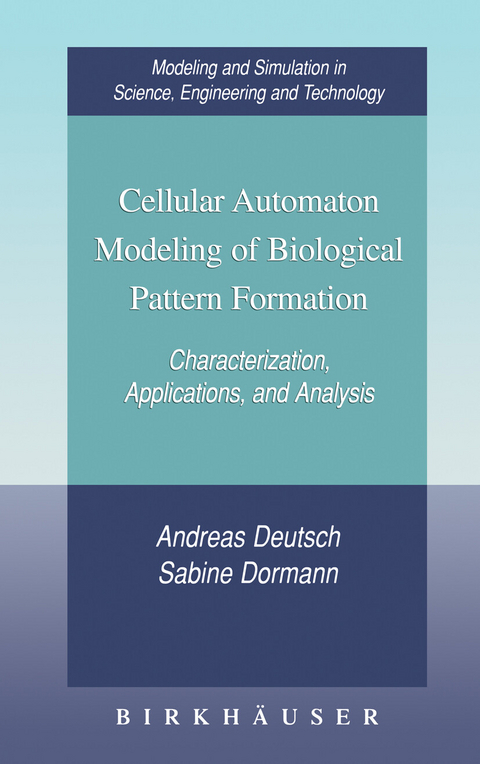
Cellular Automaton Modeling of Biological Pattern Formation (eBook)
XXIII, 331 Seiten
Birkhäuser Boston (Verlag)
978-0-8176-4415-4 (ISBN)
This book focuses on a challenging application field of cellular automata: pattern formation in biological systems, such as the growth of microorganisms, dynamics of cellular tissue and tumors, and formation of pigment cell patterns. These phenomena, resulting from complex cellular interactions, cannot be deduced solely from experimental analysis, but can be more easily examined using mathematical models, in particular, cellular automaton models.
While there are various books treating cellular automaton modeling, this interdisciplinary work is the first one covering biological applications. The book is aimed at researchers, practitioners, and students in applied mathematics, mathematical biology, computational physics, bioengineering, and computer science interested in a cellular automaton approach to biological modeling.
The recent dramatic advances inbiotechnology have led to an explosion of data in the life sciences at the molecular level as well as more detailed observation and ch- acterization at the cellular and tissue levels. Itis now absolutely clear that one needs a theoretical framework inwhich to place this data to gain from it as much information as possible. Mathematical and computational modelling approaches are the obvious waytodothis. Heeding lessons from the physical sciences, one might expect that all areas in the life sciences would be actively pursuing quantitative methods to c- solidate the vast bodies of data that exist and to integrate rapidly accumulating new information. Remarkably, with a few notable exceptions, quite the contrary situation exists. However, things are now beginning to change and there is the sense that we are at the beginning of an exciting new era of research inwhich the novel problems posed by biologists will challenge the mathematicians and computer scientists, who, in turn, will use their tools to inform the experimentalists, who will verify model predictions. Only through such a tight interaction among disciplines will we have the opportunity to solve many of the major problems in the life sciences. One such problem, central to developmental biology, is the understanding of how various processes interact to produce spatio-temporal patterns in the embryo.
Foreword - Philip K. Maini List of Figures List of Notation Introduction and Outline On the Origin of Patterns Mathematical Modeling of Biological Pattern Formation Cellular Automata Random Movement Growth Processes Adhesive Cell Interaction Alignment and Cellular Swarming Pigment Cell Pattern Formation Tissue and Tumor Development Turing Patterns and Excitable Media Discussion and Outlook Appendix A. Growth Processes: A Mean-Field Equation Appendix B. Turing Patterns Appendix C. Excitable Media: Complete Interaction Rule Appendix D. Isotropy, Lattices, and Tensors References Index
| Erscheint lt. Verlag | 26.12.2007 |
|---|---|
| Reihe/Serie | Modeling and Simulation in Science, Engineering and Technology | Modeling and Simulation in Science, Engineering and Technology |
| Vorwort | Philip K. Maini |
| Zusatzinfo | XXIII, 331 p. |
| Verlagsort | Boston |
| Sprache | englisch |
| Themenwelt | Informatik ► Theorie / Studium ► Künstliche Intelligenz / Robotik |
| Mathematik / Informatik ► Mathematik | |
| Naturwissenschaften ► Biologie | |
| Technik ► Maschinenbau | |
| Technik ► Nachrichtentechnik | |
| Schlagworte | Biocomputing • Development • Java • Modeling • pattern recognition • Simulation • Simulation and modeling |
| ISBN-10 | 0-8176-4415-6 / 0817644156 |
| ISBN-13 | 978-0-8176-4415-4 / 9780817644154 |
| Informationen gemäß Produktsicherheitsverordnung (GPSR) | |
| Haben Sie eine Frage zum Produkt? |
 PDF (Wasserzeichen)
DRM: Digitales Wasserzeichen
Dieses eBook enthält ein digitales Wasserzeichen und ist damit für Sie personalisiert. Bei einer missbräuchlichen Weitergabe des eBooks an Dritte ist eine Rückverfolgung an die Quelle möglich.
Dateiformat: PDF (Portable Document Format)
Mit einem festen Seitenlayout eignet sich die PDF besonders für Fachbücher mit Spalten, Tabellen und Abbildungen. Eine PDF kann auf fast allen Geräten angezeigt werden, ist aber für kleine Displays (Smartphone, eReader) nur eingeschränkt geeignet.
Systemvoraussetzungen:
PC/Mac: Mit einem PC oder Mac können Sie dieses eBook lesen. Sie benötigen dafür einen PDF-Viewer - z.B. den Adobe Reader oder Adobe Digital Editions.
eReader: Dieses eBook kann mit (fast) allen eBook-Readern gelesen werden. Mit dem amazon-Kindle ist es aber nicht kompatibel.
Smartphone/Tablet: Egal ob Apple oder Android, dieses eBook können Sie lesen. Sie benötigen dafür einen PDF-Viewer - z.B. die kostenlose Adobe Digital Editions-App.
Buying eBooks from abroad
For tax law reasons we can sell eBooks just within Germany and Switzerland. Regrettably we cannot fulfill eBook-orders from other countries.
aus dem Bereich