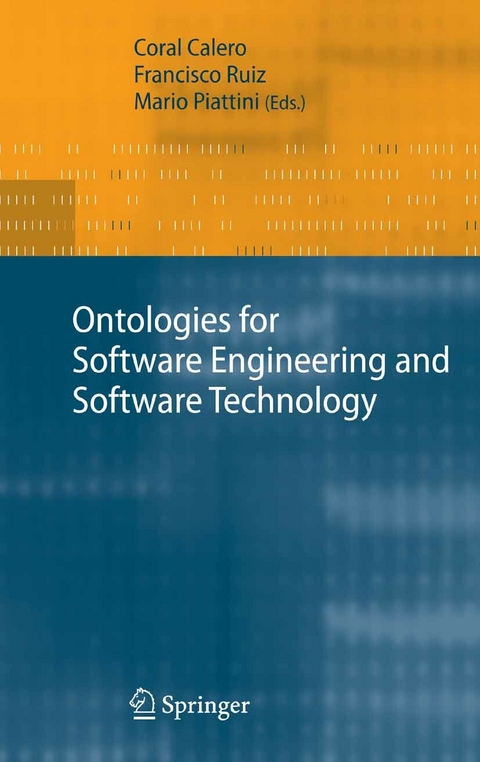
Ontologies for Software Engineering and Software Technology (eBook)
XIV, 340 Seiten
Springer Berlin (Verlag)
978-3-540-34518-3 (ISBN)
This book covers two applications of ontologies in software engineering and software technology: sharing knowledge of the problem domain and using a common terminology among all stakeholders; and filtering the knowledge when defining models and metamodels. By presenting the advanced use of ontologies in software research and software projects, this book is of benefit to software engineering researchers in both academia and industry.
Francisco Ruiz is associate professor in the Computer Science Department at the University of Castilla-La Mancha (UCLM) and Vice-Director of the Alarcos Research Group. He has been Dean of the UCLM Computer Science School for seven years and Data Processing Director at the same University for four years. His current research interests include: business process management systems, software process technology and modeling, software maintenance, and software projects planning and managing.
Coral Calero is Associate Professor in the Computer Science Department at the University of Castilla-La Mancha (UCLM). Her research interests are: software quality metrics, quality models, web and portal quality, databases and data warehouse quality and software architectures.
Mario Piattini is a Certified Information System Auditor and a Certified information System Manager by ISACA (Information System Audit and Control Association) as well as a Full Professor in the Department of Computer Science at the University of Castilla-La Mancha, in Ciudad Real, Spain. He leads the ALARCOS research group of the Department of Computer Science at the University of Castilla-La Mancha, in Ciudad Real, Spain. His research interests are: advanced databases, database quality, software metrics, security and audit, software maintenance.
Francisco Ruiz is associate professor in the Computer Science Department at the University of Castilla-La Mancha (UCLM) and Vice-Director of the Alarcos Research Group. He has been Dean of the UCLM Computer Science School for seven years and Data Processing Director at the same University for four years. His current research interests include: business process management systems, software process technology and modeling, software maintenance, and software projects planning and managing. Coral Calero is Associate Professor in the Computer Science Department at the University of Castilla-La Mancha (UCLM). Her research interests are: software quality metrics, quality models, web and portal quality, databases and data warehouse quality and software architectures. Mario Piattini is a Certified Information System Auditor and a Certified information System Manager by ISACA (Information System Audit and Control Association) as well as a Full Professor in the Department of Computer Science at the University of Castilla-La Mancha, in Ciudad Real, Spain. He leads the ALARCOS research group of the Department of Computer Science at the University of Castilla-La Mancha, in Ciudad Real, Spain. His research interests are: advanced databases, database quality, software metrics, security and audit, software maintenance.
Preface 5
Contents 8
1. Ontological Engineering: Principles, Methods, Tools and Languages 13
1.1 Introduction 13
1.2 What Is an Ontology? Viewpoints from a Philosopher and from an Ontology Engineer 15
1.3 What Are the Main Components of an Ontology? 17
1.4 Ontological Engineering 18
1.5 Principles for the Design of Ontologies 20
1.6 Ontology Development Process and Life Cycle 21
1.7 Methods, Methodologies, Tools and Languages 28
1.8 Conclusions 50
1.9 Acknowledgements 51
References 51
2. Using Ontologies in Software Engineering and Technology 61
2.1 Introduction 61
2.2 Kinds of Ontologies 62
2.3 A Review of the Uses in SET 69
2.4 A Proposal of Taxonomy 85
2.5 Review and Classification of Proposals in the Literature 91
References 107
3. Engineering the Ontology for the SWEBOK: Issues and Techniques 115
3.1 Introduction 115
3.2 History and Principles of the SWEBOK Project 117
3.3 The Ontology of the SWEBOK from a Conceptual and Consensus-Reaching Perspective 121
3.4 The Ontology of the SWEBOK as a Formal Artifact 124
3.5 Fundamental Elements of the Ontology of the SWEBOK 126
3.6 Conclusions 131
References 132
4. An Ontology for Software Development Methodologies and Endeavours 134
4.1 Introduction 134
4.2 Ontology Architecture 136
4.3 Endeavour-Related Concepts 144
4.4 Method-Related Concepts 153
4.5 Conclusion 159
References 160
5. Software Maintenance Ontology 163
5.1 Introduction 163
5.2 Software Maintenance 164
5.3 An Ontology for Software Maintenance 166
5.4. Validating the Ontology 176
5.5 Putting the Maintenance Ontology to Work 179
5.6 Conclusion 181
References 182
6. An Ontology for Software Measurement 184
6.1 Introduction 184
6.2 Previous Analysis 186
6.3 A Running Example 187
6.4 The Proposal of Software Measurement Ontology 188
6.5 Conclusions 203
References 204
7. An Ontological Approach to SQL:2003 206
7.1 Introduction 206
7.2 SQL Evolution 207
7.3 The Ontology for SQL:2003 210
7.4 Example 218
7.5 Conclusions 221
References 223
8. The Object Management Group Ontology Definition Metamodel 225
8.1 Introduction 226
8.2 Why a MOF Ontology Metamodel? 227
8.3 The Ontology Development Metamodel 230
8.4 Profiles and Mappings 243
8.5 Extendibility 250
8.6 Discussion 252
8.7 Acknowledgments 253
References 254
9. Ontologies, Meta-models, and the Model- Driven Paradigm 256
9.1 Introduction 256
9.2 Models and Ontologies 260
9.3 Similarity Relations and Meta-modelling 264
9.4 MDE and Ontologies 269
9.5 Related Work 277
9.6 Conclusions 278
9.7 Acknowledgments 278
References 278
10. Use of Ontologies in Software Development Environments 281
10.1 Introduction 281
10.2 From SDE to DOSDE 283
10.3 Domain-Oriented Software Development Environment 285
10.4 From DOSDE to EOSDE 298
10.5 Enterprise-Oriented Software Development Environments 300
10.6 Tools in DOSDE and EOSDE 306
10.7 Conclusion 311
References 312
11. Semantic Upgrade and Publication of Legacy Data 316
11.1 Introduction and Motivation 316
11.2 Global Approach to Database-to-Ontology Mapping 319
11.3 Mapping Situations between Databases and Ontologies 320
11.4. The R2O Language 324
11.5 The ODEMapster Processor 335
11.6 Experimentation: The Fund Finder Application 335
11.7 Conclusions and Future Work 340
11.8 Acknowledgements 342
References 342
| Erscheint lt. Verlag | 12.10.2006 |
|---|---|
| Zusatzinfo | XIV, 340 p. |
| Verlagsort | Berlin |
| Sprache | englisch |
| Themenwelt | Informatik ► Theorie / Studium ► Künstliche Intelligenz / Robotik |
| Mathematik / Informatik ► Informatik ► Web / Internet | |
| Schlagworte | Communication • Development • filtering • Knowledge • language • Meta-Object Facility • Model Driven Architecture • ontological engineering • Ontologies • Ontology • Software • software development • Software engineering • SQL • SWEBOK |
| ISBN-10 | 3-540-34518-3 / 3540345183 |
| ISBN-13 | 978-3-540-34518-3 / 9783540345183 |
| Informationen gemäß Produktsicherheitsverordnung (GPSR) | |
| Haben Sie eine Frage zum Produkt? |
 PDF (Wasserzeichen)
DRM: Digitales Wasserzeichen
Dieses eBook enthält ein digitales Wasserzeichen und ist damit für Sie personalisiert. Bei einer missbräuchlichen Weitergabe des eBooks an Dritte ist eine Rückverfolgung an die Quelle möglich.
Dateiformat: PDF (Portable Document Format)
Mit einem festen Seitenlayout eignet sich die PDF besonders für Fachbücher mit Spalten, Tabellen und Abbildungen. Eine PDF kann auf fast allen Geräten angezeigt werden, ist aber für kleine Displays (Smartphone, eReader) nur eingeschränkt geeignet.
Systemvoraussetzungen:
PC/Mac: Mit einem PC oder Mac können Sie dieses eBook lesen. Sie benötigen dafür einen PDF-Viewer - z.B. den Adobe Reader oder Adobe Digital Editions.
eReader: Dieses eBook kann mit (fast) allen eBook-Readern gelesen werden. Mit dem amazon-Kindle ist es aber nicht kompatibel.
Smartphone/Tablet: Egal ob Apple oder Android, dieses eBook können Sie lesen. Sie benötigen dafür einen PDF-Viewer - z.B. die kostenlose Adobe Digital Editions-App.
Buying eBooks from abroad
For tax law reasons we can sell eBooks just within Germany and Switzerland. Regrettably we cannot fulfill eBook-orders from other countries.
aus dem Bereich