Machine Learning for Multimedia Content Analysis (eBook)
XVI, 277 Seiten
Springer US (Verlag)
9780387699424 (ISBN)
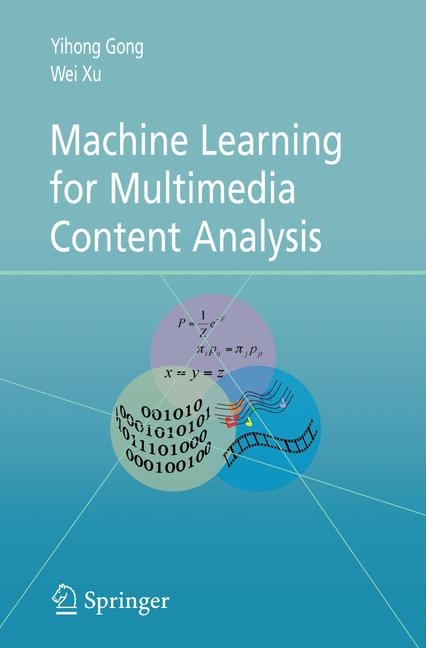
This volume introduces machine learning techniques that are particularly powerful and effective for modeling multimedia data and common tasks of multimedia content analysis. It systematically covers key machine learning techniques in an intuitive fashion and demonstrates their applications through case studies. Coverage includes examples of unsupervised learning, generative models and discriminative models. In addition, the book examines Maximum Margin Markov (M3) networks, which strive to combine the advantages of both the graphical models and Support Vector Machines (SVM).
Challenges in complexity and variability of multimedia data have led to revolutions in machine learning techniques. Multimedia data, such as digital images, audio streams and motion video programs, exhibit richer structures than simple, isolated data items. A number of pixels in a digital image collectively conveys certain visual content to viewers. A TV video program consists of both audio and image streams that unfold the underlying story. To recognize the visual content of a digital image, or to understand the underlying story of a video program, we may need to label sets of pixels or groups of image and audio frames jointly.Machine Learning for Multimedia Content Analysis introduces machine learning techniques that are particularly powerful and effective for modeling spatial, temporal structures of multimedia data and for accomplishing common tasks of multimedia content analysis. This book systematically covers these techniques in an intuitive fashion and demonstrates their applications through case studies. This volume uses a large number of figures to illustrate and visualize complex concepts, and provides insights into the characteristics of many algorithms through examinations of their loss functions and straightforward comparisons.Machine Learning for Multimedia Content Analysis is designed for an academic and professional audience. Researchers will find this book an invaluable tool for applying machine learning techniques to multimedia content analysis. This volume is also suitable for practitioners in industry.
Preface 6
Contents 11
1 Introduction 16
1.1 Basic Statistical Learning Problems 17
1.2 Categorizations of Machine Learning Techniques 19
1.3 Multimedia Content Analysis 23
Part I Unsupervised Learning 27
2 Dimension Reduction 28
2.1 Objectives 28
2.2 Singular Value Decomposition 29
2.3 Independent Component Analysis 33
2.4 Dimension Reduction by Locally Linear Embedding 39
2.5 Case Study 43
Problems 47
3 Data Clustering Techniques 49
3.1 Introduction 49
3.2 Spectral Clustering 51
3.3 Data Clustering by Non-Negative Matrix Factorization 63
3.4 Spectral vs. NMF 71
3.5 Case Study: Document Clustering Using Spectral and NMF Clustering Techniques 73
Problems 80
Part II Generative Graphical Models 83
4 Introduction of Graphical Models 84
4.1 Directed Graphical Model 85
4.2 Undirected Graphical Model 88
4.3 Generative vs. Discriminative 90
4.4 Content of Part II 91
5 Markov Chains and Monte Carlo Simulation 92
5.1 Discrete-Time Markov Chain 92
5.2 Canonical Representation 95
5.3 Definitions and Terminologies 99
5.4 Stationary Distribution 102
5.5 Long Run Behavior and Convergence Rate 105
5.6 Markov Chain Monte Carlo Simulation 111
Problems 123
6 Markov Random Fields and Gibbs Sampling 126
6.1 Markov Random Fields 126
6.2 Gibbs Distributions 128
6.3 Gibbs – Markov Equivalence 131
6.4 Gibbs Sampling 134
6.5 Simulated Annealing 137
6.6 Case Study: Video Foreground Object Segmentation by MRF 144
Problems 157
7 Hidden Markov Models 159
7.1 Markov Chains vs. Hidden Markov Models 159
7.2 Three Basic Problems for HMMs 163
7.3 Solution to Likelihood Computation 164
7.4 Solution to Finding Likeliest State Sequence 168
7.5 Solution to HMM Training 170
7.6 Expectation-Maximization Algorithm and its Variances 172
7.7 Case Study: Baseball Highlight Detection Using HMMs 177
Problems 185
8 Inference and Learning for General Graphical Models 188
8.1 Introduction 188
8.2 Sum-product algorithm 191
8.3 Max-product algorithm 197
8.4 Approximate inference 198
8.5 Learning 200
Problems 205
Part III Discriminative Graphical Models 207
9 Maximum Entropy Model and Conditional Random Field 208
9.1 Overview of Maximum Entropy Model 209
9.2 Maximum Entropy Framework 211
9.3 Comparison to Generative Models 217
9.4 Relation to Conditional Random Field 220
9.5 Feature Selection 222
9.6 Case Study: Baseball Highlight Detection Using Maximum Entropy Model 224
Problems 239
10 Max-Margin Classifications 241
10.1 Support Vector Machines (SVMs) 242
9) 257
9, 257
10.2 Maximum Margin Markov Networks 263
Problems 270
A Appendix 273
References 274
Index 280
| Erscheint lt. Verlag | 26.9.2007 |
|---|---|
| Reihe/Serie | Multimedia Systems and Applications | Multimedia Systems and Applications |
| Zusatzinfo | XVI, 277 p. 20 illus. |
| Verlagsort | New York |
| Sprache | englisch |
| Themenwelt | Mathematik / Informatik ► Informatik ► Datenbanken |
| Mathematik / Informatik ► Informatik ► Grafik / Design | |
| Informatik ► Theorie / Studium ► Künstliche Intelligenz / Robotik | |
| Schlagworte | algorithms • Complexity • Dimensionsreduktion • Dom • Gong • Hidden Markov Model • learning • machine learning • Maximum Margin Markov (M3) networks • Multimedia • Networks • Simulation • Support Vector Machine • techniques • Technology |
| ISBN-13 | 9780387699424 / 9780387699424 |
| Informationen gemäß Produktsicherheitsverordnung (GPSR) | |
| Haben Sie eine Frage zum Produkt? |
 PDF (Wasserzeichen)
DRM: Digitales Wasserzeichen
Dieses eBook enthält ein digitales Wasserzeichen und ist damit für Sie personalisiert. Bei einer missbräuchlichen Weitergabe des eBooks an Dritte ist eine Rückverfolgung an die Quelle möglich.
Dateiformat: PDF (Portable Document Format)
Mit einem festen Seitenlayout eignet sich die PDF besonders für Fachbücher mit Spalten, Tabellen und Abbildungen. Eine PDF kann auf fast allen Geräten angezeigt werden, ist aber für kleine Displays (Smartphone, eReader) nur eingeschränkt geeignet.
Systemvoraussetzungen:
PC/Mac: Mit einem PC oder Mac können Sie dieses eBook lesen. Sie benötigen dafür einen PDF-Viewer - z.B. den Adobe Reader oder Adobe Digital Editions.
eReader: Dieses eBook kann mit (fast) allen eBook-Readern gelesen werden. Mit dem amazon-Kindle ist es aber nicht kompatibel.
Smartphone/Tablet: Egal ob Apple oder Android, dieses eBook können Sie lesen. Sie benötigen dafür einen PDF-Viewer - z.B. die kostenlose Adobe Digital Editions-App.
Buying eBooks from abroad
For tax law reasons we can sell eBooks just within Germany and Switzerland. Regrettably we cannot fulfill eBook-orders from other countries.
aus dem Bereich