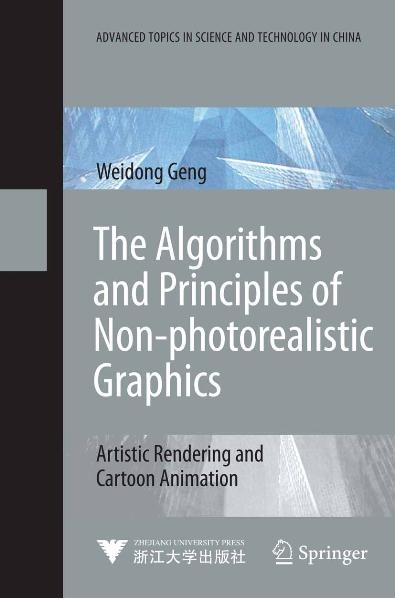
The Algorithms and Principles of Non-photorealistic Graphics (eBook)
360 Seiten
Springer Berlin (Verlag)
9783642048913 (ISBN)
'The Algorithms and Principles of Non-photorealistic Graphics: Artistic Rendering and Cartoon Animation' provides a conceptual framework for and comprehensive and up-to-date coverage of research on non-photorealistic computer graphics including methodologies, algorithms and software tools dedicated to generating artistic and meaningful images and animations. This book mainly discusses how to create art from a blank canvas, how to convert the source images into pictures with the desired visual effects, how to generate artistic renditions from 3D models, how to synthesize expressive pictures from textual, graphical and pictorial data, and how to speed up the production of cartoon animation sequences with temporal coherence. It is intended for researchers and graduate students in the fields of computer graphics, digital media arts, and cartoon animation.
Dr. Weidong Geng is a professor at the Department of Digital Media Technology and State Key Laboratory of Computer Aided Design and Computer Graphics, Zhejiang University, China.
Title Page 4
Copyright Page 5
Preface 6
Coverage and Audience 6
Objective 7
Acknowledgement 7
Table of Contents 9
1 Introduction 13
1.1 The Brief History: from Photorealism to Non-photorealism 13
1.2 What is Non-photorealistic Computer Graphics 14
1.2.1 Image, Picture, and Visualization 15
1.2.2 Photorealistic versus Non-photorealistic Rendering 16
1.3 The Framework for Non-photorealistic Computer Graphics 18
References 21
2 Simulating Artistic Media for Digitized Creation of Artworks 23
2.1 Stroke-based Artistic Drawing 23
2.1.1 Interactive Drawing Based on Brushstrokes 23
2.1.2 Pen-and-ink Illustration by Stroke Textures 27
2.1.3 Interactive Pencil Drawing 30
2.1.3.1 Graphite Pencil Drawing 30
2.1.3.2 Colored Pencil Drawing 36
2.1.4 Simulating Wax Crayons 38
2.2 Oriental Calligraphy and Black Ink Painting 42
2.2.1 Modeling of Soft Brushes 43
2.2.1.1 Brush Modeling with 2D Strokes 43
2.2.1.2 Parametric 3D Brush Modeling 44
2.2.1.3 Virtual brush with 3D solid geometry 48
2.2.1.4 Brush Modeling Driven by an Expressive Input Device 50
2.2.2 Calligraphy with Soft Brushes 51
2.2.3 Oriental Black Ink Painting 55
2.2.3.1 The Ink Diffusion Principles and Mechanism on the Paper 57
2.2.3.2 The Ink Diffusion Interacted with the Paper 60
2.3 Simulation of a Colored Painting 66
2.3.1 The Computational Model of Rendering Colored Pigments 67
2.3.2 Simulation of Watercolor Painting 70
2.3.2.1 Watercolor Canvas Modeling 70
2.3.2.2 Fluid Simulation of Pigment and Water 72
2.3.2.3 Illumination of Watercolor Pigment 77
2.3.3 Simulation of Oil Painting 80
2.3.3.1 Modeling of Oil Painting Canvas 80
2.3.3.2 Modeling of Oil Painting Brushes 82
2.3.3.3 Coloring of Oil Painting 85
2.4 Digitized Sculpting 89
2.4.1 Digitized Wood Sculpting 90
2.4.2 Digitized Metal Embossing 93
2.5 Creation of Artwork in a Virtual Environment 95
2.6 Summary 98
References 99
3 Computer-aided Design of Art Patterns 102
3.1 The Overview of Art Pattern Design 103
3.2 Art Pattern Creation by Fractals 105
3.3 Art Pattern Creation by Shape Grammars 107
3.4 Layout-based Creation of Art Patterns 111
3.4.1 Novel Layout Creation Based on Regular Structures 111
3.4.2 Layout Creation Integrated with Fabrication Craft 114
3.4.3 Art Pattern Creation by Stylized Layout 115
3.5 Knowledge-based Creation of Art Patterns 117
3.5.1 Aesthetical Knowledge Representation for Art Pattern Generation 118
3.5.2 Generation of Art Patterns by Synthesis Reasoning 119
3.6 Summary 122
References 122
4 Artistic Painting by Reference Images 124
4.1 Artistic Effect Generation by Pixel-level Image Processing 124
4.1.1 Artistic Processing via Digital Half-toning 125
4.1.2 Artistic Processing with Heuristic Rules 126
4.1.2.1 Shape and texture preserving for sketching 127
4.1.2.2 Facial engraving 128
4.1.2.3 Cubist style simulation 128
4.2 Converting Images into Artistic Painting by Strokes 129
4.2.1 Image-based Stippling Drawing 131
4.2.2 Image-based Mosaic and Stained Glass Simulation 135
4.2.3 Image-based Pen-and-ink Illustration 138
4.2.4 Image-based Pencil Drawing 142
4.2.5 Image-based Oriental Painting 148
4.2.6 Image-based Colored Painting 149
4.3 Artistic Transfer of Color and Texture from Reference Images 156
4.3.1 Artistic Transfer of Color 157
4.3.2 Artistic Transfer of Texture 160
4.4 Image-based Painting Driven by Examples 163
4.4.1 Painting Style Simulation by Image Analogy 164
4.4.2 Artistic Painting Generation by Stroke Templates from Examples 166
4.5 Summary 168
References 169
5 Artistic Rendering for 3D ObjectThe 172
5.1 Artistic Rendering Based on Traditional 3D Rendering Pipeline 173
5.1.1 Non-photorealistic Lighting Model 173
5.1.2 Non-realistic Projection 179
5.1.3 Non-photorealistic Texture Mapping and Synthesis 185
5.2 Non-photorealistic Rendering with Interim Images 190
5.2.1 Pen-and-ink Illustration from 3D Object 191
5.2.2 Pencil Drawing from 3D Polygonal Object 196
5.2.3 Chinese Painting from 3D Model 198
5.2.4 Colorful Painting from 3D Model 202
5.3 Artistic Silhouette and Line-drawing for 3D Model 203
5.3.1 Silhouette Rendering from 3D Polygonal Object 203
5.3.2 Line-drawing for 3D Surface 209
5.4 Artistic Rendering for 3D Landscape 212
5.4.1 Artistic Simulation by Placing Artistic Particles and Strokes on the 3D Surface 213
5.4.2 Artistic Rendering of Plants Based on Their 3D Structure 215
5.4.3 Artistic Rendition for Point-based Models 220
5.5 Artistic Illustration of Volume-based Models 223
5.5.1 Artistic Rendering of Surface Features of Volume Model 224
5.5.2 Artistic Illustration of Internal Structure of Volume Model 228
5.6 Summary 234
References 235
6 Expressive Rendering 240
6.1 Comprehensible Rendering 241
6.1.1 Enhancement of Rendering by Emphasis of Visual Cues 241
6.1.1.1 Emphasis of the normal 242
6.1.1.2 Emphasis on depth 243
6.1.1.3 Emphasis on lighting 243
6.1.1.4 Emphasis on discontinuity 246
6.1.2 Cutaway Illustration 247
6.1.3 Comprehensive Rendering via Composite Viewpoints 250
6.2 Shape-conveying Illustrations 252
6.2.1 Expressing Shape Features via Stroke Texture 252
6.2.2 Expressing Shape Features by Selective Depiction 254
6.3 Intent-based 3D Illustration 260
6.3.1 Intent Communication by Multimedia Presentation 261
6.3.2 Interpreting Intent by Graphical Abstraction 263
6.3.3 Visual Explanation of Iconic Symbols 265
6.4 Expressive Rendering for Transparency 266
6.5 Summary 270
References 271
7 Computer-assisted Cartoon Animation by Traditional Production Pipeline 274
7.1 The Traditional Animation Process 274
7.2 The Role of the Computer in Traditional 2D Animation 279
7.3 Computer-assisted Coloring 281
7.3.1 Auto-coloring of Inbetweening Frames 282
7.3.2 Colorizing Black-and-white Cartoons 288
7.4 Computer-assisted Inbetweening 293
7.4.1 Generation of Inbetween Poses 293
7.4.2 Generation of inbetweening Facial Expression 299
7.5 Summary 301
References 302
8 Novel Approaches to Computer-assisted Cartoon Animation 304
8.1 Video Driven Cartoon Animation 305
8.1.1 Directly Converting Video Segment into Painterly Animation 305
8.1.2 Contour-based Animation Generation from Video 311
8.1.3 Video-driven Facial Animation with Style 314
8.2 Cartoon Production Integrated with 3D Geometric Elements 321
8.2.1 Automated inbetweening by the 3D Approximate Model 322
8.2.2 Cartoon Animation by 3D Canvas 326
8.2.3 Cartoon Animation by View-dependent Geometry 329
8.3 Cartoon Generation by Temporal Coherent Rendering 333
8.4 Cartoon Generation Together with 3D Graphical Processing Techniques 338
8.4.1 Cartoon Production Integrated with 3D Transformation 338
8.4.2 Cartoon Animation Enhanced with Artistic Texture Mapping 341
8.4.3 Cartoon Motions Augmented by 3D Physical Models 342
8.4.4 Stylized Highlight and Shadow Generation for Cartoon Animation 345
8.5 Cartoon Production via Reuse of Traditional Animation 347
8.5.1 Reusing Visual Style for Cartoon Animation 348
8.5.2 Reusing Motions for Cartoon Animation 351
8.6 Summary 354
References 356
9 Perspectives of Non-photorealistic Computer Graphics 359
References 363
Index 364
| Erscheint lt. Verlag | 2.2.2011 |
|---|---|
| Reihe/Serie | Advanced Topics in Science and Technology in China | Advanced Topics in Science and Technology in China |
| Zusatzinfo | 360 p. 310 illus. in color. |
| Verlagsort | Berlin |
| Sprache | englisch |
| Themenwelt | Mathematik / Informatik ► Informatik ► Grafik / Design |
| Schlagworte | 3D • Animation • artistic rendering • ATSTC • cartoon animation • Computer-Aided Design • Computer Graphics • non-photorealistic computer graphics • Rendering • simulating artistic media • ZJUP |
| ISBN-13 | 9783642048913 / 9783642048913 |
| Informationen gemäß Produktsicherheitsverordnung (GPSR) | |
| Haben Sie eine Frage zum Produkt? |
 PDF (Wasserzeichen)
DRM: Digitales Wasserzeichen
Dieses eBook enthält ein digitales Wasserzeichen und ist damit für Sie personalisiert. Bei einer missbräuchlichen Weitergabe des eBooks an Dritte ist eine Rückverfolgung an die Quelle möglich.
Dateiformat: PDF (Portable Document Format)
Mit einem festen Seitenlayout eignet sich die PDF besonders für Fachbücher mit Spalten, Tabellen und Abbildungen. Eine PDF kann auf fast allen Geräten angezeigt werden, ist aber für kleine Displays (Smartphone, eReader) nur eingeschränkt geeignet.
Systemvoraussetzungen:
PC/Mac: Mit einem PC oder Mac können Sie dieses eBook lesen. Sie benötigen dafür einen PDF-Viewer - z.B. den Adobe Reader oder Adobe Digital Editions.
eReader: Dieses eBook kann mit (fast) allen eBook-Readern gelesen werden. Mit dem amazon-Kindle ist es aber nicht kompatibel.
Smartphone/Tablet: Egal ob Apple oder Android, dieses eBook können Sie lesen. Sie benötigen dafür einen PDF-Viewer - z.B. die kostenlose Adobe Digital Editions-App.
Buying eBooks from abroad
For tax law reasons we can sell eBooks just within Germany and Switzerland. Regrettably we cannot fulfill eBook-orders from other countries.
aus dem Bereich