


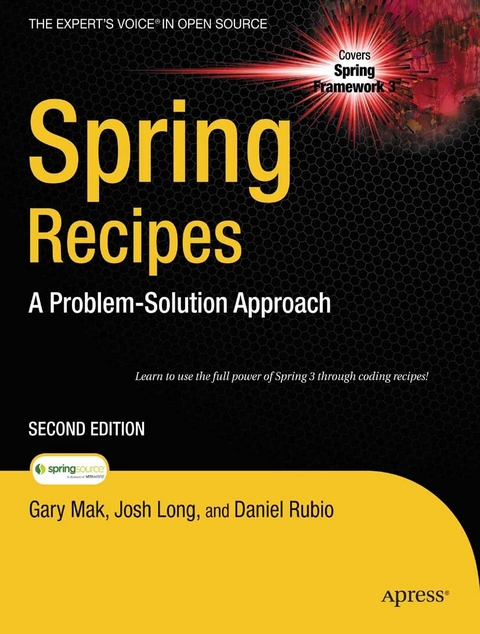
Spring Recipes (eBook)
XLIV, 1104 Seiten
Apress (Verlag)
9781430225003 (ISBN)
Gary Mak, founder and chief consultant of Meta-Archit Software Technology Limited, has been a technical architect and application developer on the enterprise Java platform for more than seven years. He is the author of the Apress books Spring Recipes: A Problem-Solution Approach and Pro SpringSource dm Server. In his career, Gary has developed a number of Java-based software projects, most of which are application frameworks, system infrastructures, and software tools. He enjoys designing and implementing the complex parts of software projects. Gary has a master's degree in computer science. His research interests include object-oriented technology, aspect-oriented technology, design patterns, software reuse, and domain-driven development. Gary specializes in building enterprise applications on technologies including Spring, Hibernate, JPA, JSF, Portlet, AJAX, and OSGi. He has been using the Spring Framework in his projects since Spring version 1.0. Gary has been an instructor of courses on enterprise Java, Spring, Hibernate, Web Services, and agile development. He has written a series of Spring and Hibernate tutorials as course materials, parts of which are open to the public, and they're gaining popularity in the Java community. In his spare time, he enjoys playing tennis and watching tennis competitions.
The Spring framework is growing. It has always been about choice. Java EE focused on a few technologies, largely to the detriment of alternative, better solutions. When the Spring framework debuted, few would have agreed that Java EE represented the best-in-breed architectures of the day. Spring debuted to great fanfare, because it sought to simplify Java EE. Each release since marks the introduction of new features designed to both simplify and enable solutions. With version 2.0 and later, the Spring framework started targeting multiple platforms. The framework provided services on top of existing platforms, as always, but was decoupled from the underlying platform wherever possible. Java EE is a still a major reference point, but it's not the only target. OSGi (a promising technology for modular architectures) has been a big part of the SpringSource strategy here. Additionally, the Spring framework runs on Google App Engine. With the introduction of annotation-centric frameworks andXML schemas, SpringSource has built frameworks that effectively model the domain of a specific problem, in effect creating domain-specific languages (DSLs). Frameworks built on top of the Spring framework have emerged supporting application integration, batch processing, Flex and Flash integration, GWT, OSGi, and much more.
Gary Mak, founder and chief consultant of Meta-Archit Software Technology Limited, has been a technical architect and application developer on the enterprise Java platform for more than seven years. He is the author of the Apress books Spring Recipes: A Problem-Solution Approach and Pro SpringSource dm Server. In his career, Gary has developed a number of Java-based software projects, most of which are application frameworks, system infrastructures, and software tools. He enjoys designing and implementing the complex parts of software projects. Gary has a master's degree in computer science. His research interests include object-oriented technology, aspect-oriented technology, design patterns, software reuse, and domain-driven development. Gary specializes in building enterprise applications on technologies including Spring, Hibernate, JPA, JSF, Portlet, AJAX, and OSGi. He has been using the Spring Framework in his projects since Spring version 1.0. Gary has been an instructor of courses on enterprise Java, Spring, Hibernate, Web Services, and agile development. He has written a series of Spring and Hibernate tutorials as course materials, parts of which are open to the public, and they're gaining popularity in the Java community. In his spare time, he enjoys playing tennis and watching tennis competitions.
Title Page 1
Copyright Page 2
Contents at a Glance 4
Table of Contents 6
About the Authors 37
About the Technical Reviewers 38
Acknowledgments 39
Introduction 41
Who This Book Is For 41
How This Book Is Structured 41
Conventions 43
Prerequisites 43
Downloading the code 44
Contacting the Authors 44
CHAPTER 1 Introduction to Spring 45
1-1. Instantiating the Spring IoC Container 45
Problem 45
Solution 45
How It Works 47
Instantiating an Application Context 47
Getting Beans from the IoC Container 47
1-2. Configuring Beans in the Spring IoC Container 48
Problem 48
Solution 48
How It Works 49
Creating the Bean Class 49
Creating the Bean Configuration File 50
Declaring Beans in the Bean Configuration File 50
Defining Bean Properties by Shortcut 51
Configuring Collections for Your Beans 52
Lists, Arrays, and Sets 52
Maps and Properties 55
1-3. Creating Beans by Invoking a Constructor 58
Problem 58
Solution 59
How It Works 59
1-4. Resolving Constructor Ambiguity 62
Problem 62
Solution 62
How It Works 62
1-5. Specifying Bean References 65
Problem 65
Solution 65
How It Works 65
Specifying Bean References for Setter Methods 66
Specifying Bean References for Constructor Arguments 68
Declaring Inner Beans 68
1-6. Specifying the Data Type for Collection Elements 69
Problem 69
Solution 69
How It Works 69
1-7. Creating Beans Using Spring’s FactoryBean 72
Problem 72
Solution 72
How It Works 72
1-8. Defining Collections Using Factory Beans and the Utility Schema 74
Problem 74
Solution 74
How It Works 74
Specifying the Concrete Class for Collections 74
Defining Stand-Alone Collections 75
1-9. Checking Properties with Dependency Checking 76
Problem 76
Solution 76
How It Works 77
Checking Properties of the Simple Types 77
Checking Properties of the Object Types 78
Checking Properties of All Types 78
Dependency Checking and Constructor Injection 79
1-10. Checking Properties with the @Required Annotation 79
Problem 79
Solution 79
How It Works 79
1-11. Auto-Wiring Beans with XML Configuration 82
Problem 82
Solution 82
How It Works 83
Auto-Wiring by Type 83
Auto-Wiring by Name 84
Auto-Wiring by Constructor 84
Auto-Wiring by Auto-Detection 85
Auto-Wiring and Dependency Checking 86
1-12. Auto-Wiring Beans with @Autowired and @Resource 86
Problem 86
Solution 86
How It Works 87
Auto-Wiring a Single Bean of Compatible Type 87
Auto-Wiring All Beans of Compatible Type 89
Auto-Wiring by Type with Qualifiers 90
Auto-Wiring by Name 92
1-13. Inheriting Bean Configuration 93
Problem 93
Solution 93
How It Works 94
1-14. Scanning Components from the Classpath 97
Problem 97
Solution 97
How It Works 97
Scanning Components Automatically 99
Filtering Components to Scan 101
Naming Detected Components 102
Summary 102
CHAPTER 2 Advanced Spring IoC Container 104
2-1. Creating Beans by Invoking a Static Factory Method 104
Problem 104
Solution 104
How It Works 104
2-2. Creating Beans by Invoking an Instance Factory Method 105
Problem 105
Solution 106
How It Works 106
2-3. Declaring Beans from Static Fields 107
Problem 107
Solution 107
How It Works 107
2-4. Declaring Beans from Object Properties 109
Problem 109
Solution 109
How It Works 109
2-5. Using the Spring Expression Language 111
Problem 111
Solution 111
How It Works 111
Features of the Language Syntax 112
Uses of the Language in Your Configurations 114
Using the Spring Expression Language Parser 115
2-6. Setting Bean Scopes 117
Problem 117
Solution 117
How It Works 117
2-7. Customizing Bean Initialization and Destruction 120
Problem 120
Solution 120
How It Works 120
Implementing the InitializingBean and DisposableBean Interfaces 122
Setting the init-method and destroy-method Attributes 123
Annotating the @PostConstruct and @PreDestroy Annotations 123
2-8. Reducing XML Configuration with Java Config 125
Problem 125
Solution 125
How It Works 125
2-9. Making Beans Aware of the Container 129
Problem 129
Solution 129
How It Works 130
2-10. Loading External Resources 131
Problem 131
Solution 131
How It Works 132
Resource Prefixes 133
Injecting Resources 133
2-11. Creating Bean Post Processors 134
Problem 134
Solution 134
How It Works 135
2-12. Externalizing Bean Configurations 138
Problem 138
Solution 138
How It Works 138
2-13. Resolving Text Messages 139
Problem 139
Solution 140
How It Works 140
2-14. Communicating with Application Events 142
Problem 142
Solution 142
How It Works 142
Defining Events 142
Publishing Events 143
Listening to Events 144
2-15. Registering Property Editors in Spring 145
Problem 145
Solution 145
How It Works 145
2-16. Creating Custom Property Editors 148
Problem 148
Solution 148
How It Works 148
2-17. Concurrency with TaskExecutors 150
Problem 150
Solution 150
How It Works 150
Java SE 150
Java EE 153
Spring’s Solution 154
Summary 159
CHAPTER 3 Spring AOP and AspectJ Support 160
3-1. Enabling AspectJ Annotation Support in Spring 160
Problem 160
Solution 161
How It Works 161
3-2. Declaring Aspects with AspectJ Annotations 163
Problem 163
Solution 163
How It Works 164
Before Advices 164
After Advices 166
After Returning Advices 166
After Throwing Advices 167
Around Advices 168
3-3. Accessing the Join Point Information 169
Problem 169
Solution 170
How It Works 170
3-4. Specifying Aspect Precedence 171
Problem 171
Solution 171
How It Works 171
3-5. Reusing Pointcut Definitions 173
Problem 173
Solution 173
How It Works 173
3-6. Writing AspectJ Pointcut Expressions 175
Problem 175
Solution 175
How It Works 176
Method Signature Patterns 176
Type Signature Patterns 178
Bean Name Patterns 179
Combining Pointcut Expressions 179
Declaring Pointcut Parameters 180
3-7. Introducing Behaviors to Your Beans 181
Problem 181
Solution 181
How It Works 181
3-8. Introducing States to Your Beans 184
Problem 184
Solution 184
How It Works 184
3-9. Declaring Aspects with XML-Based Configurations 186
Problem 186
Solution 186
How It Works 186
Declaring Aspects 187
Declaring Pointcuts 187
Declaring Advices 188
Declaring Introductions 188
3-10. Load-Time Weaving AspectJ Aspects in Spring 189
Problem 189
Solution 189
How It Works 190
Load-Time Weaving by the AspectJ Weaver 193
Load-Time Weaving by Spring Load-Time Weaver 194
3-11. Configuring AspectJ Aspects in Spring 195
Problem 195
Solution 195
How It Works 196
3-12. Injecting Spring Beans into Domain Objects 197
Problem 197
Solution 197
How It Works 197
Summary 201
CHAPTER 4 Scripting in Spring 202
19-1. Implementing Beans with Scripting Languages 202
Problem 202
Solution 202
How It Works 203
Scripting Beans with JRuby 203
Scripting Beans with Groovy 205
Scripting Beans with BeanShell 206
19-2. Injecting Spring Beans into Scripts 207
Problem 207
Solution 207
How It Works 207
Injecting Spring Beans into JRuby 209
Injecting Spring Beans into Groovy 209
Injecting Spring Beans into BeanShell 210
19-3. Refreshing Beans from Scripts 210
Problem 210
Solution 210
How It Works 211
19-4. Defining Script Sources Inline 211
Problem 211
Solution 211
How It Works 212
Summary 213
CHAPTER 5 Spring Security 214
5-1. Securing URL Access 215
Problem 215
Solution 215
How It Works 216
Setting Up a Spring MVC Application That Uses Spring Security 217
Creating the Configuration Files 218
Creating the Controllers and Page Views 220
Securing URL Access 223
5-2. Logging In to Web Applications 226
Problem 226
Solution 226
How It Works 226
HTTP Basic Authentication 226
Form-Based Login 227
The Logout Service 229
Anonymous Login 230
Remember-Me Support 230
5-3. Authenticating Users 230
Problem 230
Solution 231
How It Works 231
Authenticating Users with In-Memory Definitions 231
Authenticating Users Against a Database 232
Encrypting Passwords 235
Authenticating Users Against an LDAP Repository 237
Caching User Details 241
5-4. Making Access Control Decisions 242
Problem 242
Solution 243
How It Works 243
5-5. Securing Method Invocations 246
Problem 246
Solution 246
How It Works 246
Securing Methods by Embedding a Security Interceptor 246
Securing Methods with Pointcuts 247
Securing Methods with Annotations 248
5-6. Handling Security in Views 249
Problem 249
Solution 249
How It Works 249
Displaying Authentication Information 249
Rendering View Contents Conditionally 250
5-7. Handling Domain Object Security 251
Problem 251
Solution 251
How It Works 252
Setting Up an ACL Service 252
Maintaining ACLs for Domain Objects 255
Making Access Control Decisions Based on ACLs 257
Handling Domain Objects Returned from Methods 259
Summary 261
CHAPTER 6 Integrating Spring with Other Web Frameworks 262
6-1. Accessing Spring in Generic Web Applications 263
Problem 263
Solution 263
How It Works 263
6-2. Using Spring in Your Servlets and Filters 267
Problem 267
Solution 268
How It Works 268
Servlets 268
Filters 270
6-3. Integrating Spring with Struts 1.x 273
Problem 273
Solution 273
How It Works 274
Loading Spring’s Application Context into a Struts Application 275
Accessing Spring’s Application Context in Struts Actions 276
Declaring Struts Actions in Spring’s Bean Configuration File 278
6-4. Integrating Spring with JSF 280
Problem 280
Solution 280
How It Works 281
Resolving Spring Beans in JSF 285
Declaring JSF Managed Beans in Spring’s Bean Configuration File 286
6-5. Integrating Spring with DWR 287
Problem 287
Solution 287
How It Works 287
Exposing Spring Beans for Remote Invocation 289
Configuring DWR in Spring’s Bean Configuration File 290
Summary 291
CHAPTER 7 Spring Web Flow 292
7-1. Managing a Simple UI Flow with Spring Web Flow 292
Problem 292
Solution 292
How It Works 293
Setting Up a Spring MVC Application That Uses Spring Web Flow 294
Creating the Configuration Files 296
Creating Web Flow Definitions 299
Creating the Page Views 300
7-2. Modeling Web Flows with Different State Types 301
Problem 301
Solution 302
How It Works 302
Defining View States 305
Defining Action States 309
Defining Decision States 311
Defining End States 312
Defining Subflow States 313
7-3. Securing Web Flows 315
Problem 315
Solution 316
How It Works 316
7-4. Persisting Objects in Web Flows 318
Problem 318
Solution 318
How It Works 318
Configuring JPA in Spring’s Application Context 320
Setting Up JPA for Spring Web Flow 321
Using JPA in Web Flows 322
7-5. Integrating Spring Web Flow with JSF 326
Problem 326
Solution 326
How It Works 326
Rendering JSF Views for Spring Web Flow 326
Actions and ActionListeners 331
Using the JSF Components of Spring Faces 332
7-6. Using RichFaces with Spring Web Flow 334
Problem 334
Solution 334
Approach 334
Setting Up RichFaces With JSF 334
Summary 338
CHAPTER 8 Spring @MVC 339
8-1. Developing a Simple Web Application with Spring MVC 339
Problem 339
Solution 339
How It Works 341
Setting up a Spring MVC Application 343
Creating the Configuration Files 344
Activating Spring MVC annotation scanning 346
Creating Spring MVC Controllers 347
Creating JSP Views 350
Deploying the Web Application 352
8-2. Mapping requests with @RequestMapping 352
Problem 352
Solution 353
How It Works 353
Mapping requests by method 353
Mapping requests by class 354
Mapping requests by HTTP request type 355
8-3. Intercepting Requests with Handler Interceptors 356
Problem 356
Solution 357
How It Works 357
8-4. Resolving User Locales 360
Problem 360
Solution 361
How It Works 361
Resolving Locales by an HTTP Request Header 361
Resolving Locales by a Session Attribute 361
Resolving Locales by a Cookie 361
Changing a User’s Locale 362
8-5. Externalizing Locale-Sensitive Text Messages 363
Problem 363
Solution 363
How It Works 363
8-6. Resolving Views by Names 364
Problem 364
Solution 364
How It Works 365
Resolving Views Based on a template’s name and location 365
Resolving Views from an XML Configuration File 365
Resolving Views from a Resource Bundle 366
Resolving Views with Multiple Resolvers 366
The Redirect Prefix 367
8-7. Views and Content Negotiation 367
Problem 367
Solution 368
How It Works 368
8-8. Mapping Exceptions to Views 371
Problem 371
Solution 371
How It Works 371
8-9. Assigning values in a Controller with @Value 373
Problem 373
Solution 373
How It Works 373
8-10. Handling Forms with Controllers 375
Problem 375
Solution 375
How It Works 375
Creating a form’s views 376
Creating a form’s service processing 378
Creating a form’s controller 378
Initializing a model attribute object and pre-populating a form with values 380
Providing form Reference Data 382
Binding Properties of Custom Types 384
Validating Form Data 386
Expiring a controller’s Session Data 389
8-11. Handling Multipage Forms with Wizard Form Controllers 390
Problem 390
Solution 390
How It Works 391
Creating Wizard Form Pages 392
Creating a Wizard Form Controller 395
Validating Wizard Form Data 398
8-12. Bean validation with Annotations (JSR-303) 401
Problem 401
Solution 401
How It Works 401
8-13. Creating Excel and PDF Views 404
Problem 404
Solution 404
How It Works 404
Creating Excel Views 406
Creating PDF Views 407
Creating resolvers for Excel and PDF views 409
Creating date based PDF and XLS file names 409
Summary 411
CHAPTER 9 Spring REST 412
9-1. Publishing a REST Service with Spring 412
Problem 412
Solution 412
How It Works 413
9-2. Accessing a REST Service with Spring 417
Problem 417
Solution 417
How It Works 418
9-3. Publishing RSS and Atom feeds 422
Problem 422
Solution 422
How It Works 423
9-4. Publishing JSON with REST services 432
Problem 432
Solution 432
How It Works 433
9-5. Accessing REST Services with Elaborate XML Responses 435
Problem 435
Solution 435
How It Works 435
Summary 445
CHAPTER 10 Spring and Flex 446
10-1. Getting started with Flex 447
Problem 447
Solution 448
How It Works 448
Flex Development Basics 448
The Tools 452
10-2. Leaving the Sandbox 453
Problem 453
Solution 453
How It Works 454
FlashVars 454
ExternalInterface 455
HTTP and HTTPS 458
Consuming SOAP Services 461
Flash Remoting with AMF 463
10-3. Adding the Spring BlazeDS support to an application 465
Problem 465
Solution 465
How It Works 466
Installing the Spring Support 466
10-4. Exposing Services Through BlazeDS / Spring 471
Problem 471
Solution 471
How It Works 471
10-5. Working With Server-Side Objects 478
Problem 478
Solution 478
How It Works 478
10-6. Consuming Message-Oriented Services Using BlazeDS and Spring 481
Problem 481
Solution 482
How It Works 482
JMS 485
Spring Integration 486
BlazeDS 491
Sending Messages from Flex 492
10-7. Bringing Dependency Injection to your ActionScript Client 493
Problem 493
Solution 494
How It Works 494
Summary 498
CHAPTER 11 Grails 499
11-1. Getting and Installing Grails 499
Problem 499
Solution 499
How It Works 500
11-2. Creating a Grails Application 500
Problem 500
Solution 501
How It Works 501
A Grails Application’s File and Directory Structure 502
Running an Application 503
Creating Your First Grails Application Construct 504
Exporting a Grails Application to a WAR 505
11-3. Grails Plug-Ins 506
Problem 506
Solution 506
How It Works 507
11-4. Developing, Producing, and Testing in Grails Environments 508
Problem 508
Solution 508
How It Works 508
11-5. Creating an Application’s Domain Classes 510
Problem 510
Solution 511
How It Works 511
11-6. Generating CRUD Controllers and Views for an Application’s Domain Classes 513
Problem 513
Solution 513
How It Works 513
11-7. Internationalization (I18n) Message Properties 517
Problem 517
Solution 517
How it works 517
11-8. Changing Permanent Storage Systems 520
Problem 520
Solution 520
How It Works 520
Setting Up an RDBMS Driver 521
Configuring an RDBMS Instance 521
11-9. Logging 523
Problem 523
Solution 523
How It Works 523
Configuring Custom Appenders and Loggers 524
Configuring Layouts 526
11-10. Running Unit and Integration Tests 526
Problem 526
Solution 526
How It Works 527
11-11. Using Custom Layouts and Templates 532
Problem 532
Solution 532
How It Works 532
11-12. Using GORM Queries 535
Problem 535
Solution 535
How It Works 535
11-13. Creating Custom Tags 537
Problem 537
Solution 537
How It Works 537
Summary 539
CHAPTER 12 Spring Roo 540
12-1. Setting Up the Spring Roo Development Environment 542
Problem 542
Solution 542
How It Works 542
Maven 543
SpringSource Tool Suite 543
Spring Roo 544
12-2. Creating Your First Spring Roo Project 545
Problem 545
Solution 545
How It Works 545
Exploring the Maven Project 548
Getting Started Using STS 549
12-3. Importing an Existing Project into SpringSource Tool Suite 551
Problem 551
Solution 551
How It Works 551
12-4. Building A Better Application, Quicker 553
Problem 553
Solution 554
How It Works 554
Coding the Backend 554
Coding the Front-end 558
12-5. Removing Spring Roo from Your Project 560
Problem 560
Solution 561
How It Works 561
Summary 562
CHAPTER 13 Spring Testing 563
13-1. Creating Tests with JUnit and TestNG 564
Problem 564
Solution 564
How It Works 564
Testing with JUnit 3 565
Testing with JUnit 4 567
Testing with TestNG 568
13-2. Creating Unit Tests and Integration Tests 570
Problem 570
Solution 570
How It Works 571
Creating Unit Tests for Isolated Classes 571
Creating Unit Tests for Dependent Classes Using Stubs and Mock Objects 574
Creating Integration Tests 579
13-3. Unit Testing Spring MVC Controllers 580
Problem 580
Solution 580
How It Works 580
13-4. Managing Application Contexts in Integration Tests 582
Problem 582
Solution 582
How It Works 583
Accessing the Context with JUnit 3 Legacy Support 583
Accessing the Context with the TestContext Framework in JUnit 4 585
Accessing the Context with the TestContext Framework in JUnit 3 587
Accessing the Context with the TestContext Framework in TestNG 587
13-5. Injecting Test Fixtures into Integration Tests 589
Problem 589
Solution 589
How It Works 589
Injecting Test Fixtures with JUnit 3 Legacy Support 589
Injecting Test Fixtures with the TestContext Framework in JUnit 4 590
Injecting Test Fixtures with the TestContext Framework in JUnit 3 591
Injecting Test Fixtures with the TestContext Framework in TestNG 592
13-6. Managing Transactions in Integration Tests 593
Problem 593
Solution 593
How It Works 594
Managing Transactions with JUnit 3 Legacy Support 595
Managing Transactions with the TestContext Framework in JUnit 4 596
Managing Transactions with the TestContext Framework in JUnit 3 598
Managing Transactions with the TestContext Framework in TestNG 599
13-7. Accessing a Database in Integration Tests 599
Problem 599
Solution 599
How It Works 600
Accessing a Database with JUnit 3 Legacy Support 600
Accessing a Database with the TestContext Framework 601
13-8. Using Spring’s Common Testing Annotations 603
Problem 603
Solution 603
How It Works 604
Using Common Testing Annotations with JUnit 3 Legacy Support 604
Using Common Testing Annotations with the TestContext Framework 605
Summary 606
CHAPTER 14 Spring Portlet MVC Framework 607
14-1. Developing a Simple Portlet with Spring Portlet MVC 607
Problem 607
Solution 607
How It Works 609
Setting Up a Portlet Application 609
Creating the Configuration Files 610
Creating Portlet Controllers 612
Resolving View Names into Views 614
Creating Portlet Views 614
Deploying the Portlet Application 615
14-2. Mapping Portlet Requests to Handlers 617
Problem 617
Solution 617
How It Works 617
Mapping Requests by the Portlet Mode 619
Mapping Requests by a Parameter 623
14-3. Handling Portlet Forms with Simple Form Controllers 625
Problem 625
Solution 625
How It Works 625
Creating Form Controllers 627
Validating Form Data 631
Summary 633
CHAPTER 15 Data Access 635
Problems with Direct JDBC 636
Setting Up the Application Database 636
Understanding the Data Access Object Design Pattern 638
Implementing the DAO with JDBC 638
Configuring a Data Source in Spring 640
How It Works 642
Running the DAO 643
Taking It A Step Further 644
15-1. Using a JDBC Template to Update a Database 644
Problem 644
Solution 645
How It Works 645
Updating a Database with a Statement Creator 645
Updating a Database with a Statement Setter 647
Updating a Database with a SQL Statement and Parameter Values 648
Batch Updating a Database 648
15-2. Using a JDBC Template to Query a Database 650
Problem 650
Solution 650
How It Works 650
Extracting Data with Row Callback Handler 650
Extracting Data with a Row Mapper 651
Querying for Multiple Rows 652
Querying for a Single Value 654
15-3. Simplifying JDBC Template Creation 655
Problem 655
Solution 655
How It Works 656
Injecting a JDBC Template 656
Extending the JdbcDaoSupport Class 657
15-4. Using the Simple JDBC Template with Java 1.5 658
Problem 658
Solution 658
How It Works 658
Using a Simple JDBC Template to Update a Database 658
Using a Simple JDBC Template to Query a Database 659
15-5. Using Named Parameters in a JDBC Template 662
Problem 662
Solution 662
How It Works 662
15-6. Handling Exceptions in the Spring JDBC Framework 664
Problem 664
Solution 664
How It Works 665
Understanding Exception Handling in the Spring JDBC Framework 665
Customizing Data Access Exception Handling 668
15-7. Problems with Using ORM Frameworks Directly 670
Problem 670
Solution 670
How It Works 670
Persisting Objects Using the Hibernate API with Hibernate XML Mappings 672
Persisting Objects Using the Hibernate API with JPA Annotations 675
Persisting Objects Using JPA with Hibernate as the Engine 677
15-8. Configuring ORM Resource Factories in Spring 681
Problem 681
Solution 681
How It Works 681
Configuring a Hibernate Session Factory in Spring 681
Configuring a JPA Entity Manager Factory in Spring 685
15-9. Persisting Objects with Spring’s ORM Templates 687
Problem 687
Solution 688
How It Works 688
Using a Hibernate Template and a JPA Template 688
Extending the Hibernate and JPA DAO Support Classes 692
15-10. Persisting Objects with Hibernate’s Contextual Sessions 694
Problem 694
Solution 694
How It Works 694
15-11. Persisting Objects with JPA’s Context Injection 697
Problem 697
Solution 697
How It Works 698
Summary 700
CHAPTER 16 Transaction Management in Spring 701
16-1. Problems with Transaction Management 702
Managing Transactions with JDBC Commit and Rollback 708
16-2. Choosing a Transaction Manager Implementation 709
Problem 709
Solution 709
How It Works 710
16-3. Managing Transactions Programmatically with the Transaction Manager API 711
Problem 711
Solution 711
How It Works 711
16-4. Managing Transactions Programmatically with a Transaction Template 713
Problem 713
Solution 713
How It Works 714
16-5. Managing Transactions Declaratively with Transaction Advices 716
Problem 716
Solution 717
How It Works 717
16-6. Managing Transactions Declaratively with the @Transactional Annotation 719
Problem 719
Solution 719
How It Works 720
16-7. Setting the Propagation Transaction Attribute 721
Problem 721
Solution 721
How It Works 722
The REQUIRED Propagation Behavior 724
The REQUIRES_NEW Propagation Behavior 726
Setting the Propagation Attribute in Transaction Advices, Proxies, and APIs 727
16-8. Setting the Isolation Transaction Attribute 727
Problem 727
Solution 727
How It Works 728
The READ_UNCOMMITTED and READ_COMMITTED Isolation Levels 730
The REPEATABLE_READ Isolation Level 733
The SERIALIZABLE Isolation Level 735
Setting the Isolation Level Attribute in Transaction Advices, Proxies, and APIs 736
16-9. Setting the Rollback Transaction Attribute 736
Problem 736
Solution 736
How It Works 737
16-10. Setting the Timeout and Read-Only Transaction Attributes 738
Problem 738
Solution 738
How It Works 738
16-11. Managing Transactions with Load-Time Weaving 739
Problem 739
Solution 740
How It Works 740
Summary 743
CHAPTER 17 EJB, Spring Remoting, and Web Services 744
17-1. Exposing and Invoking Services Through RMI 744
Problem 744
Solution 744
How It Works 745
Exposing an RMI Service 746
Invoking an RMI Service 747
17-2. Creating EJB 2.x Components with Spring 748
Problem 748
Solution 749
How It Works 749
Creating EJB 2.x Components Without Spring’s Support 750
Creating EJB 2.x Components with Spring’s Support 753
17-3. Accessing Legacy EJB 2.x Components in Spring 755
Problem 755
Solution 756
How It Works 756
Accessing EJB 2.x Components 757
17-4. Creating EJB 3.0 Components in Spring 760
Problem 760
Solution 760
How It Works 760
17-5. Accessing EJB 3.0 Components in Spring 762
Problem 762
Solution 762
How It Works 762
Accessing EJB 3.0 Components with Spring’s Support 762
17-6. Exposing and Invoking Services Through HTTP 764
Problem 764
Solution 764
How It Works 764
Exposing a Hessian Service 764
Invoking a Hessian Service 766
Exposing a Burlap Service 767
Invoking a Burlap Service 767
Exposing an HTTP Invoker Service 767
Invoking an HTTP Invoker Service 767
17-7. Choosing a SOAP Web Service Development Approach 768
Problem 768
Solution 768
How It Works 768
Contract-Last Web Services 768
Contract-First Web Services 769
Comparison 769
17-8. Exposing and Invoking a Contract-Last SOAP Web Services Using JAX-WS 770
Problem 770
Solution 770
How It Works 770
Exposing a Web Service Using The JAX-WS Endpoint Support in the JDK 771
Exposing a Web Service Using CXF 774
Invoking a Web Service Using CXF 776
17-9. Defining the Contract of a Web Service 777
Problem 777
Solution 777
How It Works 778
Creating Sample XML Messages 778
Generating an XSD File from Sample XML Messages 779
Optimizing the Generated XSD File 780
Previewing the Generated WSDL File 781
17-10. Implementing Web Services Using Spring-WS 782
Problem 782
Solution 782
How It Works 783
Setting Up a Spring-WS Application 783
Mapping Web Service Requests to Endpoints 784
Creating Service Endpoints 784
Publishing the WSDL File 787
17-11. Invoking Web Services Using Spring-WS 788
Problem 788
the contract. You want to use Spring-WS to create the service client. 788
How It Works 788
17-12. Developing Web Services with XML Marshalling 792
Problem 792
Solution 792
How It Works 793
Creating Service Endpoints with XML Marshalling 793
Invoking Web Services with XML Marshalling 797
17-13. Creating Service Endpoints with Annotations 798
Problem 798
Solution 798
How It Works 798
Summary 800
CHAPTER 18 Spring in the Enterprise 801
18-1. Exporting Spring Beans as JMX MBeans 801
Problem 801
Solution 802
How It Works 802
Registering MBeans Without Spring’s Support 805
Exporting Spring Beans as MBeans 807
Exposing MBeans for Remote Access 809
Assembling the Management Interface of MBeans 810
Auto-Detecting MBeans by Annotations 812
18-2. Publishing and Listening to JMX Notifications 814
Problem 814
Solution 814
How It Works 814
Publishing JMX Notifications 814
Listening to JMX Notifications 815
18-3. Accessing Remote JMX MBeans in Spring 816
Problem 816
Solution 816
How It Works 816
Accessing Remote MBeans Through an MBean Server Connection 816
Accessing Remote MBeans Through an MBean Proxy 818
18-4. Sending E-mail with Spring’s E-mail Support 819
Problem 819
Solution 820
How It Works 820
Sending E-mail Using the JavaMail API 821
Sending E-mail with Spring’s MailSender 823
Defining an E-mail Template 824
Sending MIME Messages 826
18-5. Scheduling with Spring’s Quartz Support 828
Problem 828
Solution 828
How It Works 828
Using Quartz Without Spring’s Support 828
Using Quartz with Spring’s Support 831
18-6. Scheduling With Spring 3.0’s Scheduling Namespace 833
Problem 833
Solution 833
How It Works 833
Summary 837
CHAPTER 19 Messaging 838
19-1. Sending and Receiving JMS Messages with Spring 839
Problem 839
Solution 839
How It Works 840
Sending and Receiving Messages Without Spring’s Support 841
Sending and Receiving Messages with Spring’s JMS Template 846
Sending and Receiving Messages to and from a Default Destination 849
Extending the JmsGatewaySupport Class 851
19-2. Converting JMS Messages 851
Problem 851
Solution 852
Approach 852
19-3. Managing JMS Transactions 854
Problem 854
Approach 854
Solution 854
19-4. Creating Message-Driven POJOs in Spring 856
Problem 856
Solution 856
How It Works 856
Listening for JMS Messages with Message Listeners 856
Listening for JMS Messages with POJOs 858
Converting JMS Messages 859
Managing JMS Transactions 861
Using Spring’s JMS Schema 861
19-5. Making the Connection 862
Problem 862
Solution 862
How It Works 863
Summary 863
CHAPTER 20 Spring Integration 864
20-1. Integrating One System with Another Using EAI 865
Problem 865
Solution 865
How It Works 866
Picking an Integration Style 866
Building on an ESB Solution 867
20-2. Integrating Two Systems Using JMS 868
Problem 868
Solution 868
How it Works 868
Building an Message Driven Pojo (MDP) Using Spring Integration 868
20-3. Interrogating Spring Integration Messages for Context Information 872
Problem 872
Solution 872
How it Works 873
Using MessageHeaders for Fun and Profit 873
20-4. Integrating Two Systems Using a File System 875
Problem 875
Solution 875
How It Works 876
Concerns in Dealing with a File System 876
20-5. Transforming a Message from One Type to Another 878
Problem 878
Solution 878
How It Works 878
Modifying a Message’s Payload 878
Modifying a Message’s Headers 881
20-6. Error Handling Using Spring Integration 881
Problem 881
Solution 882
How It Works 882
Routing to Custom Handlers Based on the Type of Exception 883
Building a Solution with Multiple Error Channels 884
20-7. Forking Integration Control: Splitters and Aggregators 884
Problem 884
Solution 884
How it Works 885
Using a Splitter 885
Using Aggregators 887
20-8. Conditional Routing with Routers 888
Problem 888
Solution 888
How It Works 888
20-9. Adapting External Systems to the Bus 889
Problem 889
Solution 889
How It Works 890
An Inbound Twitter Adapter 890
Twitter Messages 891
A Simple MessageSource 891
An Outbound Twitter Example 897
20-10. Staging Events Using Spring Batch 900
Problem 900
Solution 900
How It Works 900
20-11. Using Gateways 901
Problem 901
Solution 901
How It Works 902
SimpleMessagingGateway 902
Breaking the Interface Dependency 903
Summary 908
CHAPTER 21 Spring Batch 909
Runtime Metadata Model 910
21-1. Setting Up Spring Batch’s Infrastructure 911
Problem 911
Solution 911
How It Works 912
21-2. Reading and Writing (but No Arithmetic) 914
Problem 914
Solution 914
How It Works 914
The Job Configuration 916
Input 917
Output 918
21-3. Writing a Custom ItemWriter and ItemReader 919
Problem 919
Solution 919
How It Works 919
Writing a Custom ItemReader 919
Writing a Custom ItemWriter 920
21-4. Processing Input Before Writing 922
Problem 922
Solution 922
How It Works 922
Chaining Processors Together 924
21-5. Better Living through Transactions 925
Problem 925
Solution 925
How It Works 925
Transactions 925
Rollbacks 926
21-6. Retrying 927
Problem 927
Solution 927
How It Works 927
Configuring a Step 927
Retry Template 928
AOP-Based Retries 930
21-7. Controlling Step Execution 930
Problem 930
Solution 930
How It Works 931
Sequential Steps 931
Concurrency 931
Conditional Steps with Statuses 932
Conditional Steps with Decisions 934
21-8. Launching a Job 934
Problem 934
Solution 935
How It Works 935
Launching From a Web Application 936
Running from the Command Line 936
Running On A Schedule 937
21-9. Parameterizing a Job 939
Problem 939
Solution 939
How It Works 939
Launching a Job with Parameters 939
Accessing JobParameters 940
Summary 941
CHAPTER 22 Spring on the Grid 942
22-1. Clustering Object State Using Terracotta 944
Problem 944
Solution 944
How It Works 944
Deploying a Simple Example with Terracotta 945
Terracotta Architecture and Deployment 950
The XML Configuration File 951
22-2. Farming Out Execution to a Grid 954
Problem 954
Solution 954
Approach 954
Deployment 955
22-3. Load Balancing a Method 956
Problem 956
Solution 956
Approach 956
22-4. Parallelizing Processing 960
Problem 960
Solution 960
Approach 960
22-5. Deploying on GridGain 962
Problem 962
Solution 962
How It Works 962
Creating a Grid Node 962
Provisioning a Grid Node 963
Getting Access to the Spring Container from a Task 964
Node-Specific GridGain Configuration 964
Summary 967
CHAPTER 23 jBPM and Spring 968
Software Processes 969
23-1. Understanding Workflow Models 972
Problem 972
Solution 972
How It Works 972
23-2. Installing jBPM 974
Problem 974
Solution 974
How It Works 974
23-3. Integrating jBPM 4 with Spring 977
Problem 977
Solution 977
How It Works 977
The Application Context 978
23-4. Building a Service with Spring 983
Problem 983
Solution 983
How It Works 983
23-5. Building a Business Process 986
Problem 986
Solution 987
How It Works 987
Summary 989
CHAPTER 24 OSGi and Spring 991
24-1. Getting Started with OSGi 992
Problem 992
Solution 992
How It Works 992
OSGi and JavaBeans 993
The helloworld-service Service 993
Installing Equinox 996
Using the Service in a Client Bundle 996
24-2. Getting Started Using Spring Dynamic Modules 999
Problem 999
Solution 999
How It Works 999
24-3. Exporting a Service Using Spring Dynamic Modules 1003
Problem 1003
Solution 1003
How It Works 1003
Interfacing with the OSGi Runtime 1005
24-4. Finding a Specific Service in the OSGi Registry 1007
Problem 1007
Solution 1007
How It Works 1007
Ranking 1007
Service Attributes 1008
Cardinality 1009
24-5. Publishing a Service Under Multiple Interfaces 1009
Problem 1009
Solution 1009
How It Works 1010
24-6. Customizing Spring Dynamic Modules 1011
Problem 1011
Solution 1011
How It Works 1011
Making Spring Process OSGi Annotations on Beans 1011
Changing the Default HTTP Server That Spring Uses When Deploying a .war 1012
24-7. Using SpringSource dm Server 1013
Problem 1013
Solution 1013
How It Works 1013
24-8. SpringSource’s Tooling 1014
Problem 1014
Solution 1014
How it Works 1015
Summary 1015
Index 1016
| Erscheint lt. Verlag | 28.12.2010 |
|---|---|
| Zusatzinfo | XLIV, 1104 p. |
| Verlagsort | Berkeley |
| Sprache | englisch |
| Themenwelt | Mathematik / Informatik ► Informatik ► Programmiersprachen / -werkzeuge |
| Mathematik / Informatik ► Informatik ► Web / Internet | |
| Schlagworte | Framework • Grails • Java • Java EE • JavaScript • Rest • techniques • Web Services |
| ISBN-13 | 9781430225003 / 9781430225003 |
| Informationen gemäß Produktsicherheitsverordnung (GPSR) | |
| Haben Sie eine Frage zum Produkt? |
 PDF (Wasserzeichen)
DRM: Digitales Wasserzeichen
Dieses eBook enthält ein digitales Wasserzeichen und ist damit für Sie personalisiert. Bei einer missbräuchlichen Weitergabe des eBooks an Dritte ist eine Rückverfolgung an die Quelle möglich.
Dateiformat: PDF (Portable Document Format)
Mit einem festen Seitenlayout eignet sich die PDF besonders für Fachbücher mit Spalten, Tabellen und Abbildungen. Eine PDF kann auf fast allen Geräten angezeigt werden, ist aber für kleine Displays (Smartphone, eReader) nur eingeschränkt geeignet.
Systemvoraussetzungen:
PC/Mac: Mit einem PC oder Mac können Sie dieses eBook lesen. Sie benötigen dafür einen PDF-Viewer - z.B. den Adobe Reader oder Adobe Digital Editions.
eReader: Dieses eBook kann mit (fast) allen eBook-Readern gelesen werden. Mit dem amazon-Kindle ist es aber nicht kompatibel.
Smartphone/Tablet: Egal ob Apple oder Android, dieses eBook können Sie lesen. Sie benötigen dafür einen PDF-Viewer - z.B. die kostenlose Adobe Digital Editions-App.
Buying eBooks from abroad
For tax law reasons we can sell eBooks just within Germany and Switzerland. Regrettably we cannot fulfill eBook-orders from other countries.
aus dem Bereich


