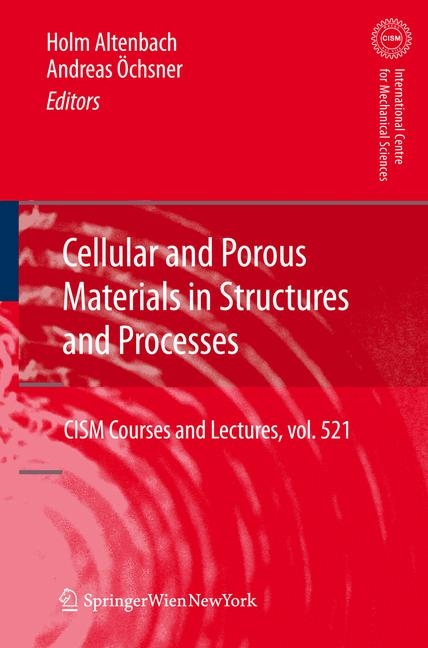
Cellular and Porous Materials in Structures and Processes (eBook)
XII, 334 Seiten
Springer Wien (Verlag)
978-3-7091-0297-8 (ISBN)

Title Page 3
Copyright Page 4
PREFACE 5
Table of Contents 7
Fracture Mechanics of Foams 13
1 Fundamentals of Fracture Mechanics 13
1.1 Introduction 13
1.2 Linear Elastic Fracture Mechanics 15
1.3 Crack tip stress and displacement fields in anisotropic materials 24
2 Experimental Determination of Fracture Toughness of Foam Materials 28
2.1 Tear Test for Flexible Cellular Materials 28
2.2 Standard Test Methods for Plane-Strain FractureToughness and Strain Energy Release Rate of Plastic Materials 30
2.3 Fracture Toughness Experimental Results 36
2.4 Impact Fracture Toughness 41
3 Micromechanical Models for Foams Fracture 45
4 Concluding Remarks 54
Bibliography 55
Finite Element Modeling of Foams 59
1 Introduction 59
2 Homogenization and the Unit Cell Method 61
3 Micro-Mechanical Finite Element Models of Cellular Materials 69
3.1 Introduction 69
3.2 Open-Cell Foams 75
3.3 Closed-Cell Foams 79
3.4 Open-Cell Foams with Hollow Struts 84
4 Micro-Mechanical Models - Methods and Results 85
4.1 Elastic Properties 86
4.2 Yielding 87
4.3 Buckling 92
4.4 Densification 103
4.5 Fracture 105
5 Optimization of Foam Density Distribution 108
6 Summary 110
Bibliography 110
Plasticity of Three-dimensional Foams 119
1 Fundamentals of Continuum Mechanics 119
1.1 Stress Tensor and Decomposition 119
1.2 Invariants 121
1.3 Constitutive Equations 124
1.4 Linear Elastic Behaviour: Generalised Hooke'sLaw for Isotropic Materials 125
2 Constitutive Relationships for Pressure Sensitive Materials: Systematic Overview 131
3 Simple Cubic Cell Models based on Beams and Shells for Open and Closed Cell Materials 141
3.1 Relative Density 145
3.2 Geometrical Moment of Inertia 147
3.3 Young's Modulus 147
3.4 Shear Modulus and Poisson's Ratio 148
3.5 Yield Stress 152
4 Procedures to Determine the Influence of the Hydrostatic Stress on the Yield Behaviour 153
5 Implementation of New Constitutive Equations into Commercial Finite Element Codes 158
5.1 One-Dimensional Drucker-Prager Yield Condition 158
5.2 Integration of the Constitutive Equations 160
5.3 Mathematical Derivation of the Fully Implicit Backward Euler Algorithm 164
5.4 Example Problem: Return Mapping for Ideal Plasticity and Linear Hardening 170
Bibliography 176
Thin-walled Structures Made of Foams 179
1 Introduction 180
1.1 Plates as Structural Elements 180
1.2 Foams as a Material for Structural Elements 181
2 Direct Two-dimensional Plate Theory 183
2.1 Classical Approaches in the Plate Theory 183
2.2 Governing Equations 185
2.3 Material-independent Equations 186
2.4 Two-dimensional Constitutive Equations 187
2.5 Basic Equations in Cartesian Coordinates 188
3 Stiffness Identification 191
3.1 Orthotropic Material Behavior 192
3.2 Classical Stiffness Values 193
3.3 Non-classical Stiffness Values 195
3.4 Special Case - Isotropic Behavior 197
4 Examples of Effective Stiffness Properties Estimates 198
4.1 Homogeneous Plate 198
4.2 Classical Sandwich Plate in Reissner's Sense 199
4.3 Functionally Graded Materials and Foams 200
4.4 On the Plates Made of Nanofoams 205
5 Symmetric Orthotropic Plate - Static Case 208
5.1 Bending Problem - One-dimensional Case 210
5.2 Bending Problem - Two-dimensional Case 210
5.3 Bending of an Isotropic Plate 211
5.4 Bending of an Elastic Plate Made of FGM (SymmetricCase) 212
6 Dynamics of Plates Made of an Elastic Foam 213
6.1 Equations of Motion for a Symmetric Isotropic Plate 213
6.2 Free Oscillations and Dispersion curves of a Rectangular Plate 215
7 Plate Made of a Linear Viscoelastic Material 221
7.1 Constitutive Equations 221
7.2 Effective Properties 222
7.3 Bounds for the Eigen-values 226
7.4 Quasi-static Behavior of a Symmetric Orthotropic Plate 227
7.5 Examples of Effective Stiffness Relaxation Functions 229
7.6 Bending of a Viscoelastic Plate 234
8 Plate Theory Deduced from the Cosserat Continuu 238
8.1 Two-dimensional Governing Equations 238
8.2 Reduction of theThree-dimensional Micropolar Equations 240
9 Summary 244
Bibliography 246
Plasticity Theory of Porous and Powder Metals 255
1 Introduction 255
2 Fundamentals of the Theory of Plasticity 257
2.1 Rigid Perfectly/Plastic Solids 257
2.2 Rigid Plastic Hardening Solids 264
2.3 Rigid Viscoplastic Solids 265
2.4 Maximum Friction Law and Singular VelocityFields (Rigid Perfectly/Plast ic Material) 266
2.5 Maximum Friction Law and Other Models of Pressure-independent Plasticity 273
3 Plasticity Theory for Porous and Powder Metals Based on the Associated Flow Rule 274
3.1 Preliminaries 274
3.2 Yield Criteria and the Associated Flow Rule for Porous and Powder Materials 277
3.3 Additional Remarks on the Yield Criteria 282
3.4 Simple Analytic Example 283
4 Plasticity Theory for Porous and Powder Metals Based on Non-associated Flow Rules 289
4.1 Stress Equations 289
4.2 Kinematic Theories 292
4.3 The Coaxial Model 293
4.4 The Double-shearing Model 294
4.5 The Double-slip and Rotation Model 296
5 Qualitative Behavior of Plastic Solutions for Porous and Powder Metals in the Vicinity of Frictional Interfaces 297
5.1 Preliminaries 297
5.2 Statement of the Problem 297
5.3 Solution for Stresses 301
5.4 Solutions for Velocities 302
5.5 Frictional Boundary Condition 304
5.6 Solution for Pressure-independent Plasticity 311
5.7 Singularity in Velocity Fields 312
6 Applications 314
Bibliography 317
Impact of Cellular Materials 321
1 Introduction 321
2 Wave Propagation in a Cellular Rod 323
3 Rigid Object Strikes on a Cellular Rod of Fixed End 328
3.1 Basic Assumptions 328
3.2 Shock Wave Analysis 329
4 Rigid Object Strikes on a Free Cellular Rod 337
5 Concluding Remarks 345
Bibliography 345
| Erscheint lt. Verlag | 27.1.2011 |
|---|---|
| Reihe/Serie | CISM International Centre for Mechanical Sciences | CISM International Centre for Mechanical Sciences |
| Zusatzinfo | XII, 334 p. |
| Verlagsort | Vienna |
| Sprache | englisch |
| Themenwelt | Mathematik / Informatik ► Mathematik |
| Naturwissenschaften ► Physik / Astronomie | |
| Technik ► Bauwesen | |
| Technik ► Maschinenbau | |
| Schlagworte | Continuum Me • Continuum Mechanics • experimental mechanics • Finite-Element-Methods • Impact Mechanics • Mechanics • Modeling • Simulation • Strength of materials |
| ISBN-10 | 3-7091-0297-9 / 3709102979 |
| ISBN-13 | 978-3-7091-0297-8 / 9783709102978 |
| Informationen gemäß Produktsicherheitsverordnung (GPSR) | |
| Haben Sie eine Frage zum Produkt? |
 PDF (Wasserzeichen)
DRM: Digitales Wasserzeichen
Dieses eBook enthält ein digitales Wasserzeichen und ist damit für Sie personalisiert. Bei einer missbräuchlichen Weitergabe des eBooks an Dritte ist eine Rückverfolgung an die Quelle möglich.
Dateiformat: PDF (Portable Document Format)
Mit einem festen Seitenlayout eignet sich die PDF besonders für Fachbücher mit Spalten, Tabellen und Abbildungen. Eine PDF kann auf fast allen Geräten angezeigt werden, ist aber für kleine Displays (Smartphone, eReader) nur eingeschränkt geeignet.
Systemvoraussetzungen:
PC/Mac: Mit einem PC oder Mac können Sie dieses eBook lesen. Sie benötigen dafür einen PDF-Viewer - z.B. den Adobe Reader oder Adobe Digital Editions.
eReader: Dieses eBook kann mit (fast) allen eBook-Readern gelesen werden. Mit dem amazon-Kindle ist es aber nicht kompatibel.
Smartphone/Tablet: Egal ob Apple oder Android, dieses eBook können Sie lesen. Sie benötigen dafür einen PDF-Viewer - z.B. die kostenlose Adobe Digital Editions-App.
Buying eBooks from abroad
For tax law reasons we can sell eBooks just within Germany and Switzerland. Regrettably we cannot fulfill eBook-orders from other countries.
aus dem Bereich