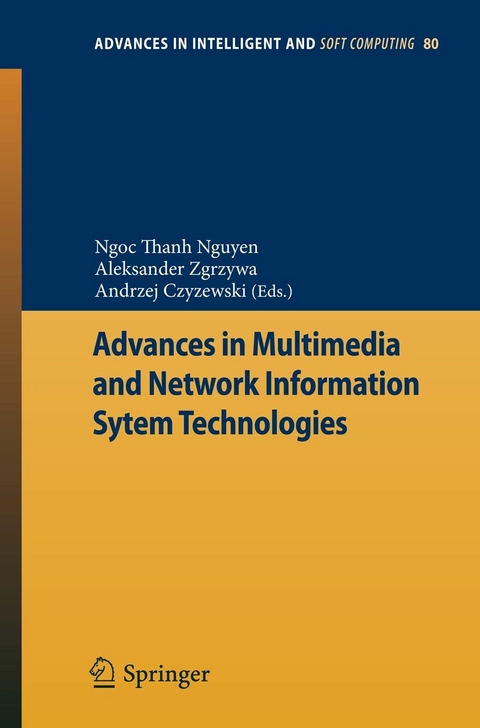
Advances in Multimedia and Network Information System Technologies (eBook)
XXII, 318 Seiten
Springer Berlin (Verlag)
9783642149894 (ISBN)

Title Page 1
Preface 5
Contents 7
List of Contributors 16
Part I Multimedia Information Technology 21
Chapter 1 Interseum - From Physical to Virtual Showrooms 22
Introduction 22
The Showroom Concept 24
The Physical Showroom 24
Concept of the Virtual Showroom “Interseum” 27
Conclusions 31
References 31
Chapter 2 The Synchronization of the Images Based on Normalized Mean Square Error Algorithm 33
Introduction 33
The Principle of the Algorithm of Determination of the Rotation Axis and Angle Based on the NMSE 38
The Experimental Results 41
Conclusions 42
References 42
Chapter 3 Evaluation of the Separation Algorithm Performance Employing ANNs 44
Introduction 44
AMT System Engineered at the MSD 45
Experiment Lay-Out 48
Comparative Analysis of the ANN-Based Recognition Results, Subjective Tests and Energy-Based Separation Error Evaluation 51
Conclusions 53
References 53
Chapter 4 Localization of Sound Source Direction in Real Time 55
Introduction 55
A and B Formats 56
Analysis of “Soundfield” Microphone Operation Principle 58
Experimental Testing 60
Conclusions 63
References 63
Chapter 5 Dangerous Sound Event Recognition Using Support Vector Machine Classifiers 64
Introduction 64
Feature Extraction 65
Energy-Based Parameters 65
Transient-Sensitive Parameters 66
MPEG-7 Features 67
Building SVM Model 68
Principles of Support Vector Machine Classification 68
Parameters of the Model 70
Classification Results 70
Conclusions 71
References 71
Chapter 6 Noise Tolerant Community Detection Using a Mixed Graph Model 73
Introduction 73
Overview of Previous Methods 74
What to Model by a Graph? 74
How to Build up the Graph? 74
How to Define a Group? 74
The New Algorithm 76
The Model 76
Handling Noisy and Missing Data 77
Finding Cores of Clusters Using Complete Information Vectors 77
Clustering the Nodes Using a Bipartite Graph and Fuzzy Membership Functions 78
Test Results 80
Conclusions 81
References 82
Chapter 7 Fuzzy Rule-Based Dynamic Gesture Recognition Employing Camera and Multimedia Projector 83
Introduction 83
Study Objectives 84
System Overview 85
Methodology 85
Image Processing 86
Hand Motion Modeling 86
Fuzzy Rule-Based Gesture Recognition 88
Results 89
Conclusions 91
References 92
Chapter 8 Video Structure Analysis and Content-Based Indexing in the Automatic Video Indexer AVI 93
Introduction 93
Related Works 94
Text Structure vs. Video Structure 96
AVI – Automatic Video Indexer 97
Temporal Segmentation Process 98
Automatic Scene Detection 100
Shot Clustering 100
TV Sports News Categorization 101
Scene Repetitive Patterns 102
Final Conclusion and Further Studies 103
References 103
Part II Data Processing in Information Systems 105
Chapter 9 Acoustic Radar Employing Particle Velocity Sensors 106
Introduction 106
Acoustic Particle Velocity Sensors 107
The Algorithm of the Acoustic Radar 108
Practical Evaluation of the Acoustic Radar 109
Measurement Results 110
The Pure Tone Measurement Results 110
One-Third Octave Band Noise Measurement Results 113
The Impulsive Sounds Measurement Results 114
PTZ Camera Control 115
Conclusions 115
References 115
Chapter 10 Superresolution Algorithm to Video Surveillance System 117
Introduction 117
Multiframe Superresolution Algorithm 118
Superresolution Challenges in Surveillance System 119
Algorithm 121
Experiment 121
Conclusion 123
References 124
Chapter 11 Social Network Analysis in Corporate Management 125
Introduction 125
Social Network Approach to Corporate Assessment 126
Social Network Extraction 126
Comparison with Corporate Hierarchy 127
Static Analysis of Social Networks 128
Centralities 128
Social Groups 128
Lonely Entities 129
Dynamic Social Network Analysis 129
Social Concept Networks (SCN) 129
Discussion 130
Profile of Relationships 130
Decision Making 130
Conclusions and Future Work 130
References 131
Chapter 12 AAM Toolkit: A System for Visual Object Appearance Modeling 133
Introduction 133
The Architecture of AAM Toolkit 134
Training Set Creator 134
Model Creator 136
Regression Matrix Creator 139
Experiments 140
Conclusions 141
References 141
Chapter 13 Service Discovery Approach Based on Rough Sets for SOA Systems 142
Introduction 142
Service Discovery Problem 143
Problem Statement 143
Service Discovery in SOA Systems 144
SLA Contract Negotiation and Translation Using Ontologies 144
Performance Index for Matchmaking 145
Rough Set-Based Approach 146
Rough Set Theory – Fundamental Definitions 146
Rough Set-Based Approach 148
Application 148
Ontology of Vehicle Services 148
Illustrative Example 150
Discussion and Future Works 151
References 152
Chapter 14 Towards Self-defending Mechanisms Using Data Mining in the EFIPSANS Framework 153
Introduction 153
Self-defending Functionality 154
Current Threats to Be Detected 155
Method of Detection 155
Experiments and Results 157
Conclusions and Future Work 160
References 160
Part III Information Systems Applications 162
Chapter 15 User Adaptivity Features of Secured Biomedical User Adaptive System 163
Introduction 163
The User Adaptivity of the System 164
Logged User Context Adapting 165
UI Adapting by Interaction 165
Smart Environment Adaptation 165
Hardware Adaptability 166
Architecture and Backgrounds of Biomedical Adaptive System 166
Server and Database Parts 166
Embedded and Desktop Part 167
Mobile Parts 168
Safety Features in Our System 168
User Interface Designing Adaptation 170
Visualization Adaptation 170
Conclusions 171
References 172
Chapter 16 Exploration of Continuous Sequential Patterns Using the CPGrowth Algorithm 173
Introduction 173
Continuous Sequential Patterns 174
The UCP-Tree Index and the CPGrowth Algorithm 175
Pseudocodes 177
Experiments 178
Conclusion 179
References 179
Chapter 17 Detecting New and Unknown Malwares Using Honeynet 181
Introduction 181
Honeypot’s Network 182
Malware 183
Multi-agents System in a Honeynet 184
Detection of Malicious Traffic 186
Conclusion 187
References 188
Chapter 18 Average Prior Distribution of All Possible Probability Density Distributions 189
Introduction 189
Safe a Priori Distribution of Probability Density in the Case of Complete Ignorance of the Real Distribution 190
The Average Distribution in the Case when the Real, Unknown Distribution Is Unimodal 194
Conclusions 198
References 198
Chapter 19 Interactive Visualization of a Product Search Space 199
Introduction 199
Related Work 200
Requirements 201
Methodology 202
Presentation of the System Use 205
Use Case I – Searching an Item 205
Use Case II – Navigating through a Vector Space 207
Use Case III – Comparing Data Entity Arrangement Algorithms 207
Conclusions and Future Work 207
References 209
Part IV Web Systems and Network Technologies 211
Chapter 20 Adaptive User Profile in Web IR System with Heuristic-Based Acquisition of Significant Terms 212
Introduction 212
Analysis of Web System Answer 213
Relevant Document’s Terms Weighting 214
Significant Terms Selection from Relevant Documents 214
User Profile 216
Modification of User Profile 217
Experiments 218
Conclusions and Future Work 220
References 220
Chapter 21 Vertical Search Strategy in Federated Environment 222
Introduction 222
Methodology and a Draft of the Research Overall Framework 223
Related Work 225
Semantic Mutual Resemblance of Bi-Texts 225
Multilingual Information Technologies 228
Multilingual Federated Environment 229
Access to the Deep Web 230
Query Models Efficiency in Translingual Retrieval 231
Vertical Search Strategy 232
Conclusion 233
References 234
Chapter 22 Music Information Retrieval on the Internet 235
Introduction 235
Differences and Similarities between Music Information Retrieval and Text Information Retrieval 236
The Method of Extracting Information from Audio Files 237
Internet Music Information Retrieval Systems Based on MIDI Files 238
Algorithms for Songs Identification Based on Spectral Analysis and Fingerprint Generation 241
The Method of Updating Missing Metadata in Audio Files 242
Algorithms for Positioning Search Results Music Files URLS 243
Proposals for Quality Measures of Contemporary Internet Music Information Retrieval Systems 245
The File Retrieval Module 246
The Music Search Engine Module 247
The Trends in Development of Internet Music Information Retrieval Systems 248
References 249
Chapter 23 Verifying Text Similarity Measures for Two Layered Retrieval 250
Introduction 250
Two Layered Retrieval 251
Statistical Full Text Search 252
Semantic Full Text Search 253
BestSim Measure 253
The SimSum Measure 254
ExtSim Measure 255
Synsets Based Measures 255
Semantic Groups Based Measures 256
Verification 256
Conclusions 259
References 259
Chapter 24 Verification of Open SourceWeb Frameworks for Java Platform 261
Introduction 261
Application Performance Study 262
JavaMetrics Study 263
Page Templates Study 266
Accessibility and Maintainability Study of Trinidad Components 267
Conclusions and Future Work 269
References 270
Part V E-Learning Platforms 271
Chapter 25 E-Learning Usability Testing Platform 272
Introduction 272
Web Usability Testing 273
Testing and Measuring Web Usability 274
User Activity Tracking Platform 275
Tests 277
Conclusions and Future Work 280
References 280
Chapter 26 E-Learning in Teaching the Object Oriented Programming 282
Introduction 282
Materials for Students 283
Materials for Teachers 286
System of the e-Learning Materials 287
Conclusion 288
References 288
Chapter 27 Analytical Framework for Mirroring and Reflection of User Activities in E-Learning Environment 290
Introduction 290
Related Work 291
Technical Description of the Analytical Framework 292
Data for Analyses as Log of Events 293
Experimental Integration with Selected Systems 294
Analytical Approaches 295
Time-Line Based Analyses 295
Evaluation within KP-Lab System 296
Conclusions 298
References 298
Chapter 28 The Paradigm of Screencasting in E-Learning 300
Introduction 300
Educational Aspects of Screencasting 301
Experiment 302
Results and Discussion 304
Conclusions 307
References 307
Chapter 29 An Opened Agent-Oriented System for Collaborative Learning 309
Introduction 309
MAETIC Method 310
Description of the Method 310
Contribution of Multi-agents System 310
Related Works 311
A Multi-agent Approach for Modeling a Collaborative Learning System 311
The System Modeling 312
The Analysis Phase 312
The Design Phase 313
The Relaization Phase 314
The COLYPAN System 314
The GroupWorking Way 315
Conclusion and Future Work 317
References 318
Author Index 319
| Erscheint lt. Verlag | 28.9.2010 |
|---|---|
| Reihe/Serie | Advances in Intelligent and Soft Computing | Advances in Intelligent and Soft Computing |
| Zusatzinfo | XXII, 318 p. 110 illus. |
| Verlagsort | Berlin |
| Sprache | englisch |
| Themenwelt | Mathematik / Informatik ► Informatik ► Grafik / Design |
| Informatik ► Theorie / Studium ► Künstliche Intelligenz / Robotik | |
| Technik | |
| Schlagworte | Cognition • Computational Intelligence • Data Mining • information system • Knowledge • learning • Management • Model • Modeling • Multimedia • Multimedia Information Systems • Network Information Systems • Norm • programming • Sensor • Service • Usability |
| ISBN-13 | 9783642149894 / 9783642149894 |
| Informationen gemäß Produktsicherheitsverordnung (GPSR) | |
| Haben Sie eine Frage zum Produkt? |
 PDF (Wasserzeichen)
DRM: Digitales Wasserzeichen
Dieses eBook enthält ein digitales Wasserzeichen und ist damit für Sie personalisiert. Bei einer missbräuchlichen Weitergabe des eBooks an Dritte ist eine Rückverfolgung an die Quelle möglich.
Dateiformat: PDF (Portable Document Format)
Mit einem festen Seitenlayout eignet sich die PDF besonders für Fachbücher mit Spalten, Tabellen und Abbildungen. Eine PDF kann auf fast allen Geräten angezeigt werden, ist aber für kleine Displays (Smartphone, eReader) nur eingeschränkt geeignet.
Systemvoraussetzungen:
PC/Mac: Mit einem PC oder Mac können Sie dieses eBook lesen. Sie benötigen dafür einen PDF-Viewer - z.B. den Adobe Reader oder Adobe Digital Editions.
eReader: Dieses eBook kann mit (fast) allen eBook-Readern gelesen werden. Mit dem amazon-Kindle ist es aber nicht kompatibel.
Smartphone/Tablet: Egal ob Apple oder Android, dieses eBook können Sie lesen. Sie benötigen dafür einen PDF-Viewer - z.B. die kostenlose Adobe Digital Editions-App.
Buying eBooks from abroad
For tax law reasons we can sell eBooks just within Germany and Switzerland. Regrettably we cannot fulfill eBook-orders from other countries.
aus dem Bereich