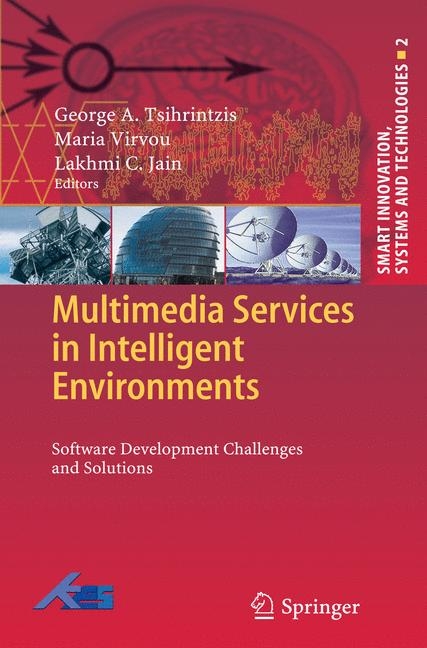
Multimedia Services in Intelligent Environments (eBook)
XIV, 186 Seiten
Springer Berlin (Verlag)
9783642133558 (ISBN)
Foreword 6
Editors 8
Preface 11
Table of Contents 13
Advances in Multimedia Services in Intelligent Environments – Software Development Challenges and Solutions 15
Introduction 15
Conclusions 16
References and Further Reading 16
Evaluating the Generality of a Life-Cycle Framework for Incorporating Clustering Algorithms in Adaptive Systems 18
Introduction 18
The Software Life Cycle 20
Inception 20
Defining Requirements for the Prototype System and Analysis and Design of the Prototype Adaptive Recommender System 20
Building and Evaluating the Prototype Adaptive Recommender System 21
Elaboration 23
Computing the Resemblance Coefficients for the Data Set and Developing the Clustering Algorithm 23
Execute the Clustering Method for the Prototype and Evaluating the Results of the Clustering Algorithm used in the Prototype 24
Construction 26
The Most Efficient Algorithm and Designing Stereotypes Based on This Algorithm 26
Building the User Modeling Component Based on the Stereotypes and Incorporating Them into the System 26
Transition-Dynamically Improving System Performance while Used by Real Users 28
Conclusion about the Life Cycle Process 37
References 37
A Distributed Multimedia Data Management over the Grid 39
Introduction 39
Related Work 42
Overall Framework 43
Replicated Multidimensional Index Structure 45
Distributed Query Processing 47
Automatic Load Balancing 51
Empirical Study 53
Conclusion and Future Works 57
References 59
A View of Monitoring and Tracing Techniques and Their Application to Service-Based Environments 61
Introduction 61
Execution Monitoring and Tracing 63
Categories of Execution Monitoring 63
What Can Be Traced? 64
Monitoring Techniques 64
Comparison 66
Monitoring Challenges for Multimedia Services 69
Behavioral Change 70
Information Access 70
Timing 70
Synchronization of Event Traces 71
Distributed Monitoring 71
Trace Transmission 71
Conclusion 71
References 72
An Ontological SW Architecture SupportingContribution and Retrieval of Service and Process Models 75
Introduction 75
An Application in the Healthcare Domain 77
Ontological SW Architecture 78
Three Tier with Ontologies 79
Encoding Procedures through Ontologies 80
Enabling Direct Contribution through Ontologies 81
Enabling Semantic Queries 85
Enabling Adapted Presentation through Ontologies 86
Conclusions 88
References 90
Model-Driven Quality Engineering of Service-Based Systems 93
Introduction 93
Related Work 95
QoS-Enabled WSDL (Q-WSDL) 97
QoS Characteristics of Web Services 98
Q-WSDL Metamodel 100
Composite Web Services 103
QoS Prediction of Composite Web Services 104
Model-Driven Reliability Prediction 106
Example Application 108
Conclusions 111
References 113
Application of Logic Models for Pervasive Computing Environments and Context-Aware Services Support 116
Introduction 116
Contextual Models Requirements for Pervasive Computing 117
The LogiPerSe First Order Logic Model 119
Partial Validation and Ambiguity 121
Scalability 121
Composability 121
Pervasive Service Scenario 122
Logic-Based System Architecture 124
Logic Model – Object-Oriented Model - Ontology Integration 125
Conclusions 126
References 127
Intelligent Host Discovery from Malicious Software 129
Introduction 129
Instant Message Clients 131
Search Engines 135
Social Networks 137
Torrent Trackers 140
Conclusions 144
References 145
Swarm Intelligence: The Ant Paradigm 147
Introduction 147
Swarm Intelligence 147
Principles of Natural Swarms 148
The Biological Origins of Ant Algorithms 152
Ant Algorithms of the Ant Colony Optimization Framework 156
Ant System 157
MAX MIN Ant System 160
Ant Colony System 163
Conclusion 165
References 166
Formulating Discrete Geometric Random Sums for Facilitating Intelligent Behaviour of a Complex System under a Major Risk 168
Introduction 168
Formulation of a Discrete Geometric Random Sum 170
Stochastic Derivation of a Discrete Geometric Random Sum 174
Risk and Crisis Management Applications and Computational Intelligence Interpretation of a Discrete Geometric Random Sum 176
Conclusions 180
References 180
Incorporating a Discrete Renewal Random Sum in Computational Intelligence and Cindynics 181
Introduction 181
Formulation of a Discrete Renewal Random Sum 183
Stochastic Derivation of a Discrete Renewal Random Sum 187
Application in Cindynics and Interpretation in Computational Intelligence of a Discrete Renewal Random Sum 191
Conclusions 194
References 194
Author Index 195
| Erscheint lt. Verlag | 7.9.2010 |
|---|---|
| Reihe/Serie | Smart Innovation, Systems and Technologies | Smart Innovation, Systems and Technologies |
| Zusatzinfo | XIV, 186 p. |
| Verlagsort | Berlin |
| Sprache | englisch |
| Themenwelt | Mathematik / Informatik ► Informatik ► Grafik / Design |
| Informatik ► Theorie / Studium ► Künstliche Intelligenz / Robotik | |
| Technik | |
| Schlagworte | Behavior • Computational Intelligence • Development • Environment • Intelligence • Intelligent Environments • Logic • Management • Multimedia • Multimedia Services • quality • Risk • Service • Software • software development • Software development challenges and solutions • Swarm intelligence |
| ISBN-13 | 9783642133558 / 9783642133558 |
| Informationen gemäß Produktsicherheitsverordnung (GPSR) | |
| Haben Sie eine Frage zum Produkt? |
 PDF (Wasserzeichen)
DRM: Digitales Wasserzeichen
Dieses eBook enthält ein digitales Wasserzeichen und ist damit für Sie personalisiert. Bei einer missbräuchlichen Weitergabe des eBooks an Dritte ist eine Rückverfolgung an die Quelle möglich.
Dateiformat: PDF (Portable Document Format)
Mit einem festen Seitenlayout eignet sich die PDF besonders für Fachbücher mit Spalten, Tabellen und Abbildungen. Eine PDF kann auf fast allen Geräten angezeigt werden, ist aber für kleine Displays (Smartphone, eReader) nur eingeschränkt geeignet.
Systemvoraussetzungen:
PC/Mac: Mit einem PC oder Mac können Sie dieses eBook lesen. Sie benötigen dafür einen PDF-Viewer - z.B. den Adobe Reader oder Adobe Digital Editions.
eReader: Dieses eBook kann mit (fast) allen eBook-Readern gelesen werden. Mit dem amazon-Kindle ist es aber nicht kompatibel.
Smartphone/Tablet: Egal ob Apple oder Android, dieses eBook können Sie lesen. Sie benötigen dafür einen PDF-Viewer - z.B. die kostenlose Adobe Digital Editions-App.
Buying eBooks from abroad
For tax law reasons we can sell eBooks just within Germany and Switzerland. Regrettably we cannot fulfill eBook-orders from other countries.
aus dem Bereich