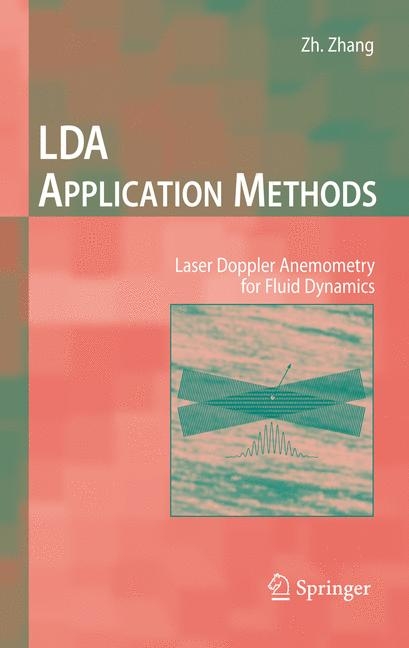
LDA Application Methods (eBook)
XVI, 272 Seiten
Springer Berlin (Verlag)
978-3-642-13514-9 (ISBN)
Dr. -Ing. Zh. Zhang graduated from the School of Energy & Power Engineering of Xi'an Jiaotong University (PR China) in 1981. He received his PhD at the Institute of Thermo and Fluid Dynamics of Ruhr-University Bochum (Germany). Afterwards he joined Sulzer Markets & Technology Ltd in Winterthur, Switzerland, for experimental research of engineering flows. He is currently an engineer at the Oberhasli Hydroelectric Power Company (KWO), working on hydraulic designs and optimizations of hydraulic machineries. He is the author of the monograph «Freistrahlturbinen» 2009.
Dr. -Ing. Zh. Zhang graduated from the School of Energy & Power Engineering of Xi’an Jiaotong University (PR China) in 1981. He received his PhD at the Institute of Thermo and Fluid Dynamics of Ruhr-University Bochum (Germany). Afterwards he joined Sulzer Markets & Technology Ltd in Winterthur, Switzerland, for experimental research of engineering flows. He is currently an engineer at the Oberhasli Hydroelectric Power Company (KWO), working on hydraulic designs and optimizations of hydraulic machineries. He is the author of the monograph «Freistrahlturbinen» 2009.
Preface 5
Contents 7
Symbols 12
Subscript 14
1 Introduction 15
1.1 Flows and Flow Measurements 15
1.2 Traditional Methods of Flow Measurements 16
1.3 Laser Methods and Laser Doppler Anemometry (LDA) 16
1.3.1 Developments of LDA Fundamentals and Instrumentations 18
1.3.2 Developments of LDA Application Methods 19
1.4 Purposeful Flow Measurements and Rational Measurement Evaluations 22
1.5 Purposes of this Book 23
2 Specifications of Engineering Turbulent Flows 24
2.1 Turbulent Flow Properties 24
2.1.1 Statistical Views of Flow Turbulences 24
2.1.2 Isotropic and Anisotropic Turbulences 26
2.2 Reynolds Turbulent Stresses 28
3 LDA Principles and Laser Optics 31
3.1 Light Wave and Its Propagation 31
3.2 The Doppler Effect 34
3.3 Superposition of Two Plane Light Waves 36
3.4 LDA Principle 39
3.5 Fringe Model on the Light Interference 41
3.6 Frequency Shift Method to Resolve the Flow Direction 44
3.6.1 Fringe Shift Speed 46
3.7 Gaussian Beam Properties 47
3.7.1 Geometrical Specifications of the Gaussian Beam 47
3.7.2 Transmission Performance of the Gaussian Beam 50
3.8 Measurement Volume Size 51
4 LDA Systems 53
4.1 Hardware and Optical Components 53
4.2 Specification of LDA Measurement Volumes 55
5 Basic Data Processing Methods in LDA Measurements 58
5.1 Direct Data Processing for Mean Velocities and Velocity Fluctuations 58
5.2 Weighting Facilities of Mean Velocity and Fluctuations 62
6 Linear Transformation of Velocities and Turbulent Stresses 64
6.1 Orthogonal Linear Transformation 64
6.1.1 Velocity Transformation 64
6.1.2 Turbulent Stress Transformation 66
6.1.3 Directional Distribution of Turbulent Stresses 66
6.1.3.1 On the Basic Parameters sxx, syy and txy 66
6.1.3.2 On the Basic Parameters s11 and s22 71
6.1.3.3 Approximation .m ˜ . and Simplifications 72
6.2 Non-orthogonal Transformation 72
6.2.1 Velocity Transformation 73
6.2.2 Turbulent Stress Transformation 74
6.3 Graphical Presentation of Turbulent Stresses 76
6.3.1 Ellipse Form of the Turbulence Distribution 76
6.3.2 Expressions of Turbulent Stresses in Mohr's Stress Circle 77
7 Tracer Particles and Particle Motion Equations 79
7.1 Effective Forces Exerted on the Particle in the Flow 80
7.1.1 Viscous Drag Force 80
7.1.2 Gravitational and Lift Forces 81
7.1.3 Pressure Force 82
7.1.4 Force from Added Mass 83
7.2 Particle Motion Equation 84
7.3 Particle Motion in the Straight Flow of Constant Velocity 85
7.4 Particle Motion in Nozzle and Diffuser Flows 86
7.4.1 Nozzle Flow 88
7.4.2 Diffuser Flow 90
7.5 Particle Motion in the Oscillation Flow 92
7.5.1 Particle Flows of Small Stokes Numbers 96
7.5.2 Particle Flows of Large Stokes Numbers 98
8 Zero Correlation Method (ZCM) 99
8.1 Shear Stress Measurements with Non-coincident LDA 99
8.2 Basics of ZCM 100
8.3 Extension of ZCM 103
8.3.1 Non-orthogonal Velocity Components 103
8.3.2 Three-Dimensional Flow Turbulence 103
8.4 Restriction and Validation of ZCM 104
9 Dual Measurement Method (DMM) 107
9.1 Possibility of Resolving the Secondary Flow 107
9.2 DMM in Basic Form 109
9.3 DMM with Coordinate Transformation 113
9.4 Extension of DMM 115
9.4.1 Direct Component Measurements 116
9.4.2 Method of Using Coordinate Transformation 119
10 Symmetrical Method of 3D-Velocity Measurements 122
11 Non-stationary Turbulent Flows 126
11.1 Non-stationary Turbulent Flows in the Practice 126
11.2 Time-Resolved Non-stationary Turbulent Flows 128
11.2.1 Method of Linear Least Squares Fitting 128
11.2.2 Linear Trend of the Velocity and the Calculation Method 130
11.2.3 Time-Dependent Flow Turbulences 132
11.3 Phase-Resolved Non-stationary Turbulent Flows 135
11.3.1 Method of Linear Least Squares Fitting 136
11.3.2 Linear Trend of the Velocity and the Calculation Method 137
11.3.3 Phase-Dependent Flow Turbulences 139
12 Turbulent Flow with Spatial Velocity Gradient 141
12.1 Apparent Turbulence Intensity and Related Quantities 143
12.2 Combined Velocity Bias Effect 148
12.2.1 Mean Velocity 149
12.2.2 Turbulent Normal Stress 150
12.2.2.1 Uniform Velocity Distribution 152
12.2.2.2 Negligible Turbulent Flow Fluctuations 153
12.3 Method of Resolving the Non-uniform Velocity Distribution 153
13 Flow Measurements Behind the Plane Window: On-axis 155
13.1 Fringe Spacing 155
13.2 Shift of the Measurement Volume 156
13.3 Optical Dispersion and its Negligible Effect 157
14 Flow Measurements Behind the Plane Window: Off-axis 159
14.1 Off-axis Measurements and Velocity Transformation 160
14.2 Fringe Spacing in Measurement Volume and Velocity Corrections 161
14.3 Refraction of Optical Axis and Orientation of the Measurement Volume 163
14.4 Two-Dimensional Shift of the Measurement Volume 164
14.5 Astigmatism and its Presence in Transmitting Optics 167
14.6 Astigmatism at the Focused Laser Beam Bundle 171
14.6.1 One-time Refraction of a Focused Beam Bundle 171
14.6.2 Multiple Refraction of a Focused Beam Bundle 177
14.7 Measurement Volume and Its Distortion 178
14.7.1 Single Refraction of Laser Beams 180
14.7.2 Multiple Refractions of Laser Beams 181
14.7.3 Astigmatism at the On-axis LDA Alignment 182
14.8 Signal Qualities and the Lens Dependence 183
14.8.1 Deterioration of Signal Qualities and Strengths 183
14.8.2 Lens Dependence of Signal Qualities and Strengths 184
14.9 Error Sensitivities in Forming the Measurement Volume 187
14.9.1 Beam Separation in the Test Medium 187
14.9.1.1 Beam Separation Due to the Bias Angle . 190
14.9.1.2 Beam Separation Due to the Bias Angle d 191
14.9.1.3 Statement Regarding the Inaccurate Laser Beam Alignment 193
14.9.2 Beam Separation After Multiple Refractions 193
14.9.3 Possible Impact on PDA Measurements 193
14.10 Method for Compensation of Astigmatism 194
15 Flow Measurements in Circular Pipes 198
15.1 Measurements of Axial Velocities 200
15.2 Measurements of Tangential Velocities 204
15.2.1 Basic Geometrical Relationships 204
15.2.2 Simplifications of Calculations 205
15.2.3 Fringe Spacing and Velocity Corrections 206
15.3 Measurements of Radial Velocities 207
15.3.1 Accurate Positioning of the Measurement Volume 207
15.3.1.1 Determination of Intersection Points ya and yb 209
15.3.1.2 Simplifications of Calculations 210
15.3.1.3 Necessary Movement xr and yr of Laser Beam Pair 212
15.3.2 Laser Beam Intersection Angle 212
15.3.3 Fringe Spacing and Velocity Corrections 213
15.3.4 Orientation of the Measurement Volume 214
15.3.5 Determination of Radial Velocities 215
15.3.6 Remarks on the Method 215
15.4 Optical Aberrations and Measurement Volume Distortion 216
15.4.1 Optical Aberrations in Transmitting and Receiving Optics 217
15.4.2 Dislocation of Laser Beam Waists from the Measurement Volume 218
15.4.2.1 Laser Beam Waists in Measuring the Tangential Velocities 219
15.4.2.2 Laser Beam Waists in Measuring the Radial Velocities 222
16 Fringe Distortion Effects 225
16.1 Linear Longitudinal Distribution of the Fringe Spacing 226
16.2 Fringe Distortion Number and the Apparent Mean Velocity 227
16.3 Overestimation of the Flow Turbulence 230
17 Velocity Bias Effects 233
17.1 Velocity Bias as a Flow Phenomenon 233
17.2 Velocity Bias and the Momentum Flow Rate 235
17.3 Velocity Bias in One-Dimensional Flow Fluctuations 237
17.4 Velocity Bias in Two- and Three-Dimensional Flow Fluctuations 241
17.4.1 Velocity Bias in Mean Velocities 242
17.4.1.1 Two-Dimensional Flow Fluctuations 242
17.4.1.2 Three-Dimensional Flow Fluctuations 243
17.4.2 Velocity Bias in Turbulent Normal Stresses 244
17.4.2.1 Two-Dimensional Turbulence 245
17.4.2.2 Three-Dimensional Turbulence 246
17.4.3 Velocity Bias in Turbulent Shear Stresses 247
18 LDA Application Examples 248
18.1 High Speed Water Jet Flow in a Pelton Turbine 248
18.2 Measurements of Warp Yarn Speed in a Weaving Machine 252
18.3 Verification of the Shift Frequency in the Laser Beam 254
Appendix A Off-axis LDA Alignment and Measurement Volume Displacement 257
A.1 Laser Beams in the Meridian Plane 258
A.2 Laser Beams in the Sagittal Plane 259
A.3 Combination 261
Appendix B Laser Beam Orientation Under the Effect of the Bias Angle d 263
Appendix C Coordinate Transformation of the Reynolds Stress Matrix 266
References 269
Index 273
| Erscheint lt. Verlag | 12.8.2010 |
|---|---|
| Reihe/Serie | Experimental Fluid Mechanics | Experimental Fluid Mechanics |
| Zusatzinfo | XVI, 272 p. 115 illus. |
| Verlagsort | Berlin |
| Sprache | englisch |
| Themenwelt | Mathematik / Informatik ► Mathematik ► Statistik |
| Mathematik / Informatik ► Mathematik ► Wahrscheinlichkeit / Kombinatorik | |
| Naturwissenschaften ► Chemie | |
| Naturwissenschaften ► Physik / Astronomie | |
| Technik ► Bauwesen | |
| Technik ► Maschinenbau | |
| Schlagworte | anisotropic turbulence • flow measuremnts • fluid- and aerodynamics • Fluid Dynamics • Laser • Laser-Doppler Anemometry • optical aberrations • Optics • tracer particles • Turbulence • Turbulent flow |
| ISBN-10 | 3-642-13514-5 / 3642135145 |
| ISBN-13 | 978-3-642-13514-9 / 9783642135149 |
| Informationen gemäß Produktsicherheitsverordnung (GPSR) | |
| Haben Sie eine Frage zum Produkt? |
 PDF (Wasserzeichen)
DRM: Digitales Wasserzeichen
Dieses eBook enthält ein digitales Wasserzeichen und ist damit für Sie personalisiert. Bei einer missbräuchlichen Weitergabe des eBooks an Dritte ist eine Rückverfolgung an die Quelle möglich.
Dateiformat: PDF (Portable Document Format)
Mit einem festen Seitenlayout eignet sich die PDF besonders für Fachbücher mit Spalten, Tabellen und Abbildungen. Eine PDF kann auf fast allen Geräten angezeigt werden, ist aber für kleine Displays (Smartphone, eReader) nur eingeschränkt geeignet.
Systemvoraussetzungen:
PC/Mac: Mit einem PC oder Mac können Sie dieses eBook lesen. Sie benötigen dafür einen PDF-Viewer - z.B. den Adobe Reader oder Adobe Digital Editions.
eReader: Dieses eBook kann mit (fast) allen eBook-Readern gelesen werden. Mit dem amazon-Kindle ist es aber nicht kompatibel.
Smartphone/Tablet: Egal ob Apple oder Android, dieses eBook können Sie lesen. Sie benötigen dafür einen PDF-Viewer - z.B. die kostenlose Adobe Digital Editions-App.
Buying eBooks from abroad
For tax law reasons we can sell eBooks just within Germany and Switzerland. Regrettably we cannot fulfill eBook-orders from other countries.
aus dem Bereich