
Symmetries and Groups in Signal Processing (eBook)
XII, 160 Seiten
Springer Netherland (Verlag)
978-90-481-9434-6 (ISBN)
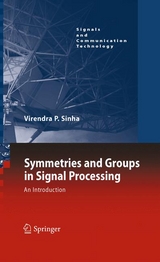
Symmetries and Groups in Signal Processing: An Introduction deals with the subject of symmetry, and with its place and role in modern signal processing. In the sciences, symmetry considerations and related group theoretic techniques have had a place of central importance since the early twenties. In engineering, however, a matching recognition of their power is a relatively recent development. Despite that, the related literature, in the form of journal papers and research monographs, has grown enormously. A proper understanding of the concepts that have emerged in the process requires a mathematical background that goes beyond what is traditionally covered in an engineering undergraduate curriculum.
Admittedly, there is a wide selection of excellent introductory textbooks on the subject of symmetry and group theory. But they are all primarily addressed to students of the sciences and mathematics, or to students of courses in mathematics. Addressed to students with an engineering background, this book is meant to help bridge the gap.
Symmetries and Groups in Signal Processing: An Introduction deals with the subject of symmetry, and with its place and role in modern signal processing. In the sciences, symmetry considerations and related group theoretic techniques have had a place of central importance since the early twenties. In engineering, however, a matching recognition of their power is a relatively recent development. Despite that, the related literature, in the form of journal papers and research monographs, has grown enormously. A proper understanding of the concepts that have emerged in the process requires a mathematical background that goes beyond what is traditionally covered in an engineering undergraduate curriculum.Admittedly, there is a wide selection of excellent introductory textbooks on the subject of symmetry and group theory. But they are all primarily addressed to students of the sciences and mathematics, or to students of courses in mathematics. Addressed to students with an engineering background, this book is meant to help bridge the gap.
Preface 6
Contents
9
Chapter 1:
11
1.1 What Is a Signal? 11
1.2 Spaces and Structures 13
1.3 Signal Spaces and Systems 17
1.4 Linearity, Shift–Invariance and Causality
22
1.4.1 Linearity 22
1.4.2 Shift–Invariance
25
1.4.3 Causality 26
1.4.4 Characterization 27
1.5 Convolutional Algebra and the Z–Transform
30
1.6 Shifts, Transforms and Spectra 34
1.6.1 Shift–Invariance on Finite Index Sets
36
1.6.2 Transforms and Spectra 41
References 48
Chapter 2:
51
2.1 What's in a Definition? 51
2.2 Set Theoretic Notation 52
2.3 Relations and Operations 55
2.3.1 Equivalence Relations and Partitions 55
2.3.2 Operations 56
2.4 Groups 58
2.4.1 Groups Within Groups 59
2.4.2 Group Morphisms 60
2.4.3 Groups and Geometry 61
2.5 Vector Spaces 62
2.5.1 Matrices of Vectors and Linear Transformations 62
2.5.2 Direct Sums of Subspaces 65
2.6 Posets, Lattices, and Boolean Algebras 69
2.6.1 From Posets to Lattices 69
2.6.2 Complemented and Distributive Lattices 71
2.6.3 Lattice of Subspaces of a Vector Space 72
2.7 Closing Remarks 74
References 75
Chapter 3:
77
3.1 Archimedes and the Tortoise 77
3.2 The Representational Approach 78
3.2.1 Measuring Lengths 78
3.2.2 From Measurement to Modeling 80
3.2.3 Time and Space 82
3.2.4 Models in General 84
3.3 Metaphors 84
References 86
Chapter 4:
88
4.1 Introduction 88
4.2 Symmetries and Automorphisms 90
4.3 Groups of Automorphisms 97
4.4 Symmetries of Linear Transformations 100
4.4.1 Symmetries and Symmetry Operations 100
4.4.2 Translation Operators 101
4.5 Symmetry Based Decompositions 103
4.5.1 Block–Diagonalizability and Invariant Subspaces
104
4.5.2 Transformation Groups and Their Invariant Subspaces 105
4.5.3 Transformations with Symmetries 107
References 109
Chapter 5:
111
5.1 The Notion of Representation 111
5.2 Matrix Representations of Groups 111
5.3 Automorphisms of a Vector Space 114
5.4 Group Representations in GL(V) 114
5.5 Reducible and Irreducible Representations 118
5.6 Reducibility of Representations 121
5.7 Schur's Lemma and the Orthogonality Theorem 125
5.8 Characters and Their Properties 128
5.9 Constructing Irreducible Representations 132
5.10 Complete Reduction of Representations 136
5.11 Further on Reduction 145
References 147
Chapter 6:
148
6.1 Signals as Functions on Groups 149
6.2 Symmetries of Linear Equations 150
6.3 Fast Discrete Signal Transforms 152
References 154
Appendix A:
156
A.1 Proper Pairing of Parentheses 156
A.2 Parentheses and the Associative Law 158
References 160
Index 161
| Erscheint lt. Verlag | 23.7.2010 |
|---|---|
| Reihe/Serie | Signals and Communication Technology | Signals and Communication Technology |
| Zusatzinfo | XII, 160 p. |
| Verlagsort | Dordrecht |
| Sprache | englisch |
| Themenwelt | Mathematik / Informatik ► Informatik ► Theorie / Studium |
| Technik ► Elektrotechnik / Energietechnik | |
| Schlagworte | Algebra • Closing • Modeling • Processing • Signal Processing • systems and signals |
| ISBN-10 | 90-481-9434-2 / 9048194342 |
| ISBN-13 | 978-90-481-9434-6 / 9789048194346 |
| Informationen gemäß Produktsicherheitsverordnung (GPSR) | |
| Haben Sie eine Frage zum Produkt? |
 PDF (Wasserzeichen)
DRM: Digitales Wasserzeichen
Dieses eBook enthält ein digitales Wasserzeichen und ist damit für Sie personalisiert. Bei einer missbräuchlichen Weitergabe des eBooks an Dritte ist eine Rückverfolgung an die Quelle möglich.
Dateiformat: PDF (Portable Document Format)
Mit einem festen Seitenlayout eignet sich die PDF besonders für Fachbücher mit Spalten, Tabellen und Abbildungen. Eine PDF kann auf fast allen Geräten angezeigt werden, ist aber für kleine Displays (Smartphone, eReader) nur eingeschränkt geeignet.
Systemvoraussetzungen:
PC/Mac: Mit einem PC oder Mac können Sie dieses eBook lesen. Sie benötigen dafür einen PDF-Viewer - z.B. den Adobe Reader oder Adobe Digital Editions.
eReader: Dieses eBook kann mit (fast) allen eBook-Readern gelesen werden. Mit dem amazon-Kindle ist es aber nicht kompatibel.
Smartphone/Tablet: Egal ob Apple oder Android, dieses eBook können Sie lesen. Sie benötigen dafür einen PDF-Viewer - z.B. die kostenlose Adobe Digital Editions-App.
Buying eBooks from abroad
For tax law reasons we can sell eBooks just within Germany and Switzerland. Regrettably we cannot fulfill eBook-orders from other countries.
aus dem Bereich