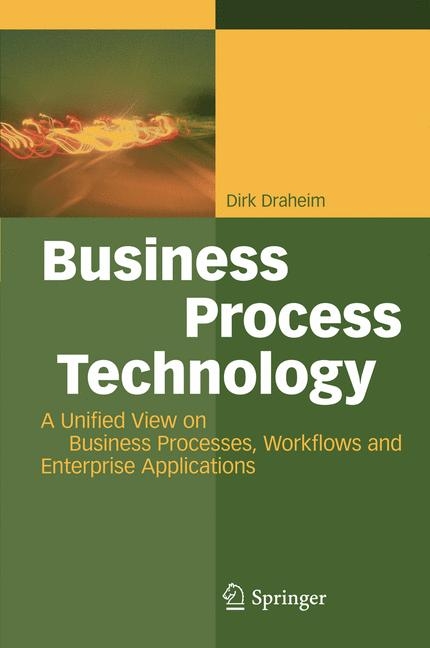
Business Process Technology (eBook)
XVII, 306 Seiten
Springer Berlin (Verlag)
978-3-642-01588-5 (ISBN)
Dirk Draheim holds a Diploma in Computer Science from the Technische Universität Berlin since 1994 and a PhD in Computer Science from the Freie Universität Berlin since 2002. Since 1999 he gives lectures on Software Engineering at the Freie Universität Berlin. From 2004 to 2006 he was a research associate in the project 'Typed User Interfaces', which is granted by the German Research Foundation DFG. In summer 2006 he was lecturer in human-computer interaction at the University of Auckland. Since summer 2006 until autumn 2008 he was senior researcher at the SCCH (Software Competence Center Hagenberg) in the position of the Area Manager Database Technology. Furthermore, he was guest professor in software engineering at the University of Mannheim in winter 2006 and guest lecturer in applied computer science at the Johannes Kepler University Linz in summer 2007 and summer 2008. Since autumn 2008 he is head of the IT department of the University of Innsbruck. Dirk Draheim is interested in system modeling, semantic web, web applications, and databases.
Dirk Draheim holds a Diploma in Computer Science from the Technische Universität Berlin since 1994 and a PhD in Computer Science from the Freie Universität Berlin since 2002. Since 1999 he gives lectures on Software Engineering at the Freie Universität Berlin. From 2004 to 2006 he was a research associate in the project "Typed User Interfaces", which is granted by the German Research Foundation DFG. In summer 2006 he was lecturer in human-computer interaction at the University of Auckland. Since summer 2006 until autumn 2008 he was senior researcher at the SCCH (Software Competence Center Hagenberg) in the position of the Area Manager Database Technology. Furthermore, he was guest professor in software engineering at the University of Mannheim in winter 2006 and guest lecturer in applied computer science at the Johannes Kepler University Linz in summer 2007 and summer 2008. Since autumn 2008 he is head of the IT department of the University of Innsbruck. Dirk Draheim is interested in system modeling, semantic web, web applications, and databases.
Foreword 6
Author’s Preface 8
Contents 12
List of Figures 14
Listings 18
1 Introduction 20
1.1 Relevance of Business Process Technology 21
On the Role of Business Processes in an Enterprise 22
Establishing Business Process Technology 23
Beyond Business Process Management and Technology 24
1.2 Need for Flexible Business Process Technology 25
1.3 Outline of the Book 26
2 Business Process Excellence 29
2.1 Business Process Reengineering 30
2.1.1 Strategic Nature of Business Process Reengineering 31
2.1.2 Power Shifts Triggered by Business Process Reengineering 32
2.2 Business Process Optimization 34
2.2.1 Combining Jobs and Naturally Hosting Work 35
2.2.2 Decision Making 37
2.2.3 Parallelism in Business Processes 37
2.2.4 Versions of Business Processes 39
2.2.5 Reducing Control 41
2.3 Business Process Benchmarking 42
2.3.1 Benchmarks in IT Governance 42
2.3.2 Organizational Learning 43
2.4 Business Process Management 44
2.4.1 On Business Process Management Lifecycle Models 45
2.4.2 Six Sigma 46
2.5 Business Continuity Management 48
2.5.1 Threats onto Business Processes 48
2.5.2 The British Business Continuity Management Standard 49
2.5.3 IT and Business Continuity Management 50
2.6 Information Technology as Mission-Critical Asset 52
2.6.1 Flexible and Adaptive Information Technology 53
2.6.2 Enterprise Application Integration 53
2.6.3 Total Cost of Ownership 55
2.6.4 Total Benefit of Ownership 56
2.6.5 On Client-Server Computing 59
2.7 Quality Management Systems 60
3 Research Opportunities in Business ProcessTechnology 62
3.1 Business Process Platforms 63
3.2 Executable Specification of Business Processes 65
3.2.1 Means of Business Process Automation 65
3.2.2 Inter-Organizational Business Process Automation 66
3.2.3 Executable Specification Communities 67
3.3 Component-Based Development 67
3.3.1 Sub Industry Aspect of Component Technology 68
3.3.2 Infrastructure Aspect of Component Technology 68
3.3.3 Large System Construction Aspect of ComponentTechnology 71
3.4 Exploiting Emerging Tools for BCM 72
3.5 Integration of Business and Production Processes 74
3.5.1 Automatic Shop Floor Control 75
3.5.2 Manufacturing Execution Systems 77
3.5.3 Current Automation and Business IT Initiatives 78
3.5.4 Industrial Information Integration Backbone 80
Arguments for Separation of Automation and Business Systems 80
Arguments for Integration of Automation and Business Systems 81
3.6 Integration of Business Processes and Business Intelligence 83
3.6.1 The Origin of Today’s Data Warehousing Architecture 84
3.6.2 Marrying Transactional and Analytical Schemas 86
Application Separability 87
Completely Crosscutting Information Backbone 88
Information Backbone Compared to Data Mart Architecture 89
4 Semantics of Business Process Models 92
4.1 Global and Local Views on Business Processes 94
4.1.1 Business Process Definition 96
4.1.2 Business Process Supervisory 97
4.1.3 Business Process Automation 99
4.1.4 Business Process Supervisory in the Presence of Business Process Automation 102
Dynamic Redefinition of Workflows 102
4.1.5 Business Process Instances 103
4.2 Transformation of Goods and Information 107
4.2.1 Specifying Item Flows 107
4.2.2 Global State Transformations 109
4.2.3 Things and Data in Structured Analysis 111
4.2.4 Specifying Physical Processes and Data Processing 111
4.2.5 On Real World Modeling 113
4.3 Exploiting a Business Process Definition 115
4.3.1 Business Process Definitions as Documentation 115
4.3.2 Business Process Definitions in Simulation 116
4.3.3 Business Process Definitions as High-Level Programs 116
4.4 Events in Business Process Modeling 117
4.4.1 Strictly Interchanging Functions and Events 118
4.4.2 Using Events for Expressing Decisions 120
4.5 Semantics of Events 121
4.5.1 Persistent and Ephemeral Event Effects 122
4.5.2 A Detour on Ordinary Language Specification 122
4.5.3 Managing Ephemeral Event Effects 124
Attempts to Grasp Ephemeral Event Effects 127
4.6 Synchronization in Business Process Models 129
5 Decomposing Business Processes 135
5.1 Motivation for Decomposing System Descriptions 135
5.1.1 Getting Complexity under Control 136
5.1.2 Atomic Activities 138
5.1.3 Leveled Data-Flow Diagrams 139
Example Decomposition with Single Entry and Exit Points 140
On the Notation of Business Process Abstraction 141
5.1.4 Process Hierarchies versus Process Abstraction 142
Strictly Stepped Hierarchies 142
Recursion in Business Process Decompositions 144
Expressive Power of Recursion for Business Domain-Oriented Modeling 147
Presentation Issues of Recursion in Business Process Hierarchies 149
Refinement Hierarchies 150
5.2 Unique versus Multiple Entry and Exit Points 150
5.2.1 Exploiting Multiple Entry and Exit Points 150
5.2.2 On the Semantics of Multiple Start and End Events 152
Building Hierarchies with Closed Semantics 153
Building Hierarchies with Open Semantics 155
Relevance of the Chosen Business Process Semantics 156
5.2.3 On Reasons for the Restriction to Unique Interface Points 156
5.2.4 Notational Issues of Unique Interface Points 157
5.2.5 Decomposition by Business Goal Orientation 158
5.2.6 Duplication of Modeling Elements and its Semantics 161
5.3 Parallel Abstraction of Activities and Transferred Data 163
A Detour on Completely Equal Decomposition of Nodes and Edges of a Graph 165
Typed Transitions 167
5.4 Towards Parallel Abstraction of Activities and Constraints 168
5.5 Seamless Business Process and Enterprise Application Modeling 170
5.6 Modeling Variants 173
5.6.1 Variants in Software Service Support Scenarios 174
5.6.2 Product Variants and Versions 175
6 Structured Business Process Specification 177
6.1 Basic Definitions 178
6.1.1 D-Charts 180
6.1.2 A Notion of Equivalence for Business Processes 182
6.2 The Pragmatics of Structuring Business Processes 183
6.2.1 Resolving Arbitrary Jump Structures 183
6.2.2 Immediate Arguments For and Against Structure 186
6.2.3 Structure for Text-based versus Graphical Specifications 190
6.2.4 Structure and Decomposition 192
6.2.5 Business Domain-Oriented versus Documentation-Oriented Modeling 195
6.3 Structured Programming 197
6.3.1 An Example Comparison of Program Texts 197
6.3.2 Readability of Program Texts 200
Further Attempts to Improve the Readability of a Program Text 201
6.3.3 Structured Programming and Denotational Semantics 202
6.4 Frontiers of Structured Business Process Modeling 207
7 Workflow Technology and Human-ComputerInteraction 211
7.1 Two HCI Styles of Workflow Systems 211
7.1.1 Degree of Parallelism Revealed to the User 212
7.1.2 Dialogues Realized by Single Form Screens 213
Terminal/Server-style Realization 214
Drawbacks of Terminal/Server-style Workflow Systems 215
Parallelism Revealed by Terminal/Server-style Workflow Systems 217
Allowing for More Parallelism 217
Exploiting Windowing in Allowing for More Parallelism 218
The Windows Metaphor 220
Root Pane Serving as Worklist 221
7.1.3 Dialogues Realized by Multiple Screens 222
7.1.4 Overall Workflow System Design 225
7.2 Actor Assignment in Workflow Automation 226
7.2.1 Interpretation of Actor Groups 227
Parallel Execution of Assigned Tasks 228
Preemptive Execution of Assigned Tasks 229
7.2.2 Selection of Actors 229
7.2.3 On General Actor Assignment in Workflow Automation 231
7.3 Form-Oriented Analysis 234
8 Service-Oriented Architecture 236
8.1 The Evolution of Service-Oriented Architecture 237
Services as Information Utility 239
Service-Component Architecture 239
8.2 Three-Tier Service-Oriented Architecture 239
8.3 Characteristics of Service-Oriented Architectures 243
Discoverability of Services 244
Research Potential in Service-Oriented Architecture Principles 244
8.4 Web Services based Service-Oriented Architecture 245
8.4.1 Web Services-based Business Process Execution 247
8.5 Service-Orientation as Development Paradigm 249
8.5.1 Designing Services for Reuse 249
8.5.2 Towards Massive Software Reuse 250
Iterative Projects 250
Mega Projects 252
SOA Governance for Ubiquitous Reuse 253
8.5.3 Software Use versus Software Reuse 255
9 Conclusion 257
9.1 Business Processes and Workflows 257
9.1.1 Usual Distinctions between Business Processes and Workflows 258
9.1.2 This Book’s Distinction between Business Processes and Workflows 259
9.1.3 Tool Support for Business Processes – Business Process Technologies 260
9.2 Integrating Workflow Definition and Dialogue Programming 262
9.2.1 An Introductory Example 262
9.2.2 Typed Workflow Charts 265
9.2.3 From Client Pages to Immediate Server Actions 266
9.2.4 From Immediate Server Actions to Deferred Server Actions 266
The Semantics of Activation Conditions 266
Worklist Implementation Issues 267
The Multiple Choice of Deferred Actions 268
9.2.5 From Deferred Server Actions to Client Pages 270
9.2.6 The Workflows given by a Workflow Chart 270
9.2.7 The Interplay of the Dialogue Client and the Worklist Client 272
9.2.8 Dynamic Detection of Dialogues 273
9.2.9 Explicit Specification of Dialogues 274
9.2.10 Synchronization Issues 275
9.2.11 Benefits of Integrating Workflow Definitions and Formcharts 277
Conceptual Specification versus Automatic Programming 278
Flexibility in Restructuring the Workflow and Dialogue Design 279
Visibility of Dialogue States to Workflow Technology 279
Flexibility Beyond the Limit of Client Page Interaction 281
9.3 Towards Integrating Human Activity and Workflow Definition 281
9.4 On Closing the Gaps in Business Process Technology 285
References 287
Index 307
| Erscheint lt. Verlag | 9.8.2010 |
|---|---|
| Vorwort | Colin Atkinson |
| Zusatzinfo | XVII, 306 p. |
| Verlagsort | Berlin |
| Sprache | englisch |
| Themenwelt | Mathematik / Informatik ► Informatik ► Programmiersprachen / -werkzeuge |
| Mathematik / Informatik ► Informatik ► Software Entwicklung | |
| Schlagworte | Business Process • Business Process Excellence • business process management • component based development • Computer • Development • enterprise applications • Host • Human Computer Interaction • Human-Computer Interaction (HCI) • Information Technology (IT) • Modeling • Optimization • Process Optimization • programming • Semantics • service-oriented arch • Web Services • Workflow • Workflow Technology |
| ISBN-10 | 3-642-01588-3 / 3642015883 |
| ISBN-13 | 978-3-642-01588-5 / 9783642015885 |
| Informationen gemäß Produktsicherheitsverordnung (GPSR) | |
| Haben Sie eine Frage zum Produkt? |
 PDF (Wasserzeichen)
DRM: Digitales Wasserzeichen
Dieses eBook enthält ein digitales Wasserzeichen und ist damit für Sie personalisiert. Bei einer missbräuchlichen Weitergabe des eBooks an Dritte ist eine Rückverfolgung an die Quelle möglich.
Dateiformat: PDF (Portable Document Format)
Mit einem festen Seitenlayout eignet sich die PDF besonders für Fachbücher mit Spalten, Tabellen und Abbildungen. Eine PDF kann auf fast allen Geräten angezeigt werden, ist aber für kleine Displays (Smartphone, eReader) nur eingeschränkt geeignet.
Systemvoraussetzungen:
PC/Mac: Mit einem PC oder Mac können Sie dieses eBook lesen. Sie benötigen dafür einen PDF-Viewer - z.B. den Adobe Reader oder Adobe Digital Editions.
eReader: Dieses eBook kann mit (fast) allen eBook-Readern gelesen werden. Mit dem amazon-Kindle ist es aber nicht kompatibel.
Smartphone/Tablet: Egal ob Apple oder Android, dieses eBook können Sie lesen. Sie benötigen dafür einen PDF-Viewer - z.B. die kostenlose Adobe Digital Editions-App.
Buying eBooks from abroad
For tax law reasons we can sell eBooks just within Germany and Switzerland. Regrettably we cannot fulfill eBook-orders from other countries.
aus dem Bereich