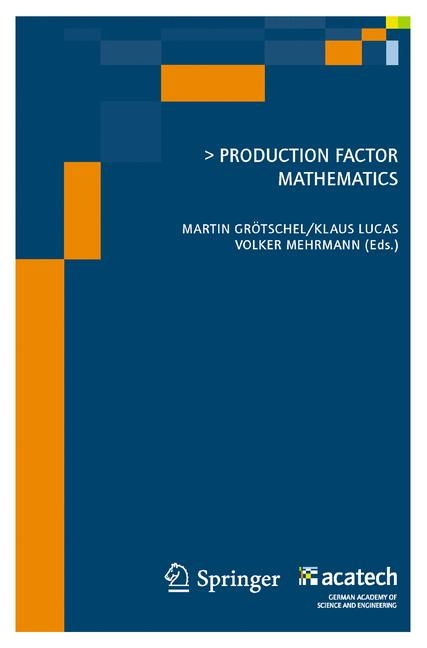
Production Factor Mathematics (eBook)
402 Seiten
Springer Berlin (Verlag)
978-3-642-11248-5 (ISBN)

Preface 5
Contents 7
Introduction 15
Processes 22
Predictive Planning and Systematic Action-On the Control of Technical Processes 23
Executive Summary 23
A Long Success Story 24
The Stability Criterion of Hurwitz 24
Pontryagin's Maximum Principle 26
Conclusion 27
State-of-the-Art and Current Developments: The Example "Model Predictive Control" 28
A Short Introduction to Control Engineering 28
The Principle of Model Predictive Control 31
Stability of MPC 33
Application Fields 34
Direct Optimal Control Methods 36
Challenges 41
Modeling 41
Parameter Estimation 43
Optimum Experimental Design 43
Robustness of Solutions, Uncertainties 44
Further Challenges 45
Visions and Recommendations 46
Theory and Praxis 47
Interdisciplinary in Education 48
References 48
Data Compression, Process Optimization, Aerodynamics: A Tour Through the Scales 52
Executive Summary 52
Some Guiding Ideas 53
Mathematics as an Interface Between Real and Virtual Worlds 53
A Universe of Scales 54
Success Stories 55
Information Retrieval from Huge Datasets 55
Information Retrieval from Huge Datasets 55
Adaptively Optimized 56
Aerodynamics under a Mathematical Microscope 60
Fluid-Structure-Interaction 60
Wake Turbulence 61
Status Quo 63
Multiscale-Decomposition: Wavelets 63
Images are Just Functions 64
Functions are Just Sequences 66
Multiscale Methods for Process Data Analysis 69
Solving Optimal Control Problems with Adaptive Wavelet Discretization 72
Elimination 74
Refinement 74
Example 74
Adaptive Methods for Partial Differential Equations in Fluid Mechanics 75
Model 76
Discretization 77
A New Concept for Adaptivity-How far Does the Analogy to Signal Compression Carry? 79
An Adaptive Grid Generator 81
Analysis of Strengths and Weaknesses 82
Visions and Recommended Course of Action 83
References 83
Active Flow Control-A Mathematical Challenge 86
Executive Summary 86
Success Stories 87
Active Flow Control, Status Quo 88
Modelling 90
Analysis of Strengths and Weaknesses, Challenges 92
Visions and Recommendations 92
References 93
Data Mining for the Category Management in the Retail Market 94
Executive Summary 94
Category Management in the Retail Market: Overview and Status Quo 95
Optimization of Campaigns 96
Success Story: Optimization of Mailings 97
Cross- and Up-Selling 98
Success Story: Product Recommendations 100
Outlook 102
Visions and Suggested Actions 104
References 104
Networks 106
Planning Problems in Public Transit 107
Executive Summary 107
Success Stories 108
Electronic Trip Planners 108
Revenue Management 109
Vehicle and Crew Scheduling 110
PT Planning Problems: Survey and Status Quo 111
Scheduling 112
Vehicle Scheduling 113
Crew Scheduling 115
Control 115
Stochastic and Robust Optimization 117
Online Optimization 117
Service Design 118
Infrastructure Construction 118
Vehicle Procurement 119
Line, Timetable, and Fare Planning 119
Regulation 120
Strengths, Weaknesses, and Challenges 120
General Conditions for the Use of Mathematics 121
Centralized Forms of Organization 121
Availability of Data and Information Technology 121
Complexity 121
Standardization 123
Regulation and Deregulation 123
Mathematical Models and Algorithms 124
Standard Models and Techniques 125
Data for Academic Research 125
Theory and Algorithms 125
Transfer and Education 127
Communication and Education 127
Business Environment 127
Conclusion 128
Visions and Recommendations 129
Discrete Optimal Control: Real-Time Re-Planning of Traffic Systems in Case of Disruptions 129
Model Integration: Service Design in Bus and Rail Traffic 131
References 131
Towards More Intelligence in Logistics with Mathematics 134
Executive Summary 134
Examples of Success 136
Logistics Chains 136
Shipping 137
Production Logistics 138
Controlling Logistical Networks 140
Logistics and Mathematics: the Status Quo 143
On the Development of Logistics 143
Mathematics in Logistics 144
Future Challenges 144
Visions and Recommendations for Action 146
References 147
Optimization of Communication Networks 149
Executive Summary 149
Mathematics as the Foundation of Every Network 150
Routing in the Internet 150
Quality Control in Phone Networks and the Internet 151
Cost Optimization of Network Investments 152
Networks, Planning and Methods 153
Network Architecture and Planning Aspects 153
Strategic Planning 154
Tactical Planning 155
Problem: 156
Variables: 156
Mathematical Model: 156
Result: 156
Operational Planning 157
Status Quo: Summary 158
Influences and Challenges 159
Market Influence, Competitive Conditions, Regulations 159
Data Basis 159
Convergence and System Complexity 160
Planning Processes and Planning Tools 160
Collaboration Between Industry and Science, Engineers and Mathematicians 161
Selected Challenges 161
Challenges for Network Operators 161
Mathematical Challenges 163
Recommendations 164
What Has to be Done? Proposals and Initiatives 164
Education 164
Economy 165
Research Proposal 165
References 166
Mathematics in Wireless Communications 167
Executive Summary 167
Success Stories 168
Mobile Communications Needs Mathematics 169
The Foundations of Communications Theory 169
Key technologies 171
Optimization of GSM Networks 172
Knowledge Brings Progress 173
Optimized Resource Allocation in Cellular Radio Networks 174
Controlling Transmission Power 175
Axiomatics for Interference Limited Radio Systems 177
Capacity Planning for UMTS Radio Networks 180
Hardware Development 180
Reinforcing Collaboration 182
Interdisciplinary Collaboration 182
International Collaboration 183
Transfer 183
Sponsoring Research from Young Talent 184
Prospects 184
Information Theory and the Digital World 184
Network Information Theory 185
Quantum Information Theory 185
New Approaches to Frequency Use 186
Self-Organizing Networks 186
References 187
Mathematics of Chip Design 189
Executive Summary 189
Success Stories 191
The Telecommunication Chip ZORA 192
The Microprocessor P2SC 192
The Systems Controller U3 for the Apple Power Mac 195
Status Quo in Chip Design 200
Placement 204
Timing Optimization 207
Routing 212
Analysis of Strengths / Weaknesses, Challenges 214
Visions of, and Recommendations for the Future 215
References 216
Materials and Mechanics 217
Chances and Visions of Advanced Mechanics 218
Executive Summary 218
Success Stories 219
Continuum Mechanics of Multi-Field and Multi-Physical Materials 219
Foundation of Buildings-A Millennium-Old Problem of Architecture 219
CO2 Sequestration-A Challenge for the Mechanics of Environmentally Relevant Systems 220
The Biomechanical Challenge 221
Simulation Techniques for the Description of Heterogeneous Materials (Multi-Scale Modelling) 223
Multi-Scale Analysis of Concrete 223
Homogenisation of Hardened Cement Paste 225
Damage Due to Frost in Hardened Cement Paste 226
Multi-Scale Methods for 3-d Crack Propagation 227
Synopsis and Status Quo 229
Facts 229
Continuum Mechanics of Multi-Component and Multi-Phase Materials (Multi-Field and Multi-Physics Materials) 229
Simulation Techniques for the Description of Heterogeneous Materials (Multi-Scale Modelling) 232
Summary 234
Strengths-Weaknesses Analysis, Challenges 234
Basis and Visions 234
How Does Mathematics Come into Play? 236
Strengths, Weaknesses and Challenges 237
Recommendations on Possible Actions 238
References 239
Mathematics for Machine Tools and Factory Automation 240
Executive Summary 240
Success Stories 241
Mathematics for the Development of New Machine Concepts: Parallel Kinematics 241
Mathematics for the Layout of Machine Tools: Cutting Processes 242
Mathematical Concepts in Production Engineering 244
Modeling of Process Chains 244
Adaptive Numerics 246
Optimal Control 247
Challenges 249
Interaction Between Structure and Process 249
Interactions in Milling 251
Reconfiguration of Production Facilities 253
Perspectives 254
References 255
Production and Use of Novel Materials 257
Executive Summary 257
Success Stories 258
Crystal Growth in a Traveling Magnetic Field 258
Unwanted Formation of Precipitate in Gallium Arsenide Crystals 260
The Bending Test for Gallium Arsenide Wafer 262
Aging-Damage-Fracture 264
Status Quo 267
Analysis of Strengths/Weaknesses, Challenges 268
Visions and Recommendations 269
References 269
Topology and Dynamic Networks: Optimization with Application in Future Technologies 271
Executive Summary 271
From Properties to Optimal Structures 272
Success Story: Structure-, Topology- and Material-Optimization 276
Resume/Recommendations 278
Optimization of Transportation Networks 278
Resume/Recommendations 282
References 283
Energy and Structural Engineering 285
Capacity Planning and Scheduling in Electrical Power Systems and in Chemical and Metallurgical Production Plants 286
Executive Summary 286
Success Stories 288
Supply and Distribution of Electrical Power 288
Network Control and Reserve Power 288
Stability in Real Time Across the Continent 290
Power Plant Optimization for Efficient Resource Utilization 291
Capacity Planning and Scheduling in Chemical and Metallurgical Production 291
Simultaneous Optimization and Scheduling of the Copper Production 291
Production Planning and Scheduling in the Production of Pharmaceutical Ingredients 293
Status Quo 294
Power Supply 294
Change of Paradigm from the Technical Grid to a Trading Platform 294
Optimized Energy Management for Virtual Power Plants 295
Complexity of the Grids and Mathematical Challenges 296
New Challenges of the 21st Century 297
Chemical and Metallurgical Production Processes 298
Supply-Chain Optimization 298
Medium-Term Production Planning 298
Online-Production Scheduling 299
Mathematical Methods 300
Mixed Integer Linear Optimization 300
Nonlinear Optimization 301
Stochastic Optimization 301
Perspectives and Challenges 302
Power Supply 302
Optimized Efficient Power Procurement 302
Risk Optimization 303
Optimized Operation Under Uncertainty 304
Chemical Production Processes 306
Problem-Specific Modeling 306
Dealing with Uncertainty 306
Man-Machine-Interaction 306
Mathematical Methods 307
Adequate Modeling of the Random Supply 307
Risk Management 307
Moving Horizons 308
Human-Algorithm-Interaction 308
Linear vs. Nonlinear Modeling 308
Algorithms and Software for Practical Usage 308
Decision dependent distributions 309
Market design-Equilibrium design 309
Visions and Recommended Courses of Action 309
References 310
Simulation-Based Optimization in Structural Engineering-New Concepts from Computer Science 313
Executive Summary 313
Success Stories 314
Structural Optimization of Large Structures 315
Discrete and Discrete-Continuous Structural Optimization 315
Lifetime-Oriented Design Concepts 318
Shape Optimization Using the p-Version of FEM 321
Robust Optimization of Slender Structures Subjected to Compressive Stress 322
Optimization of Non-Standard Problems with Multi-Agent Systems (MAS): The Status Quo 324
Agent Systems 324
Strategy Networks 325
The Four Pillar Concept 326
Analysis Tools, Visualization and Steering 326
Strong Points, Weak Points and Challenges 329
Practical Aspects 329
New Optimization Strategies/Algorithms 330
Extension of Mathematical Fundamentals for Engineers 330
Visions and Courses of Action 331
References 332
Object-Oriented Modelling for Simulation and Control of Energy Transformation Processes 333
Introduction and Overview 333
Application in Power Plant Domain: Project OXYCOAL-AC 334
Goals and Requirements 334
Object-Oriented Modelling of Power Plant Processes 335
Object-Oriented Modelling of the Oxycoal Power Plant 336
Ceramic High-Temperature Membrane 337
Gas-Gas Heat Exchanger 339
Results 340
Conclusions 341
Application in the Field of Combustion Engines 342
Model-Based Control of Combustion Engines 342
Structure of the Control Path 343
Comparison of Object-Oriented and Signal-Oriented Modelling on the Example of Air Path Components 344
Volume 344
Turbocharger 346
Conclusions 348
Summary 349
References 349
Design Tools for Energy Efficient Architecture 351
Executive Summary 351
Development of a Novel Cooling System by Means of a Thermohydraulic Building Simulation 352
Application of the Object-Oriented Programming Language Modelica 353
Extension of a Complex Simulation Model 353
Results of the Calculations 355
Strengths and Weaknesses Analysis, Challenges 357
Visions and Recommended Actions 358
References 358
Medicine 360
More Mathematics into Medicine! 361
Executive Summary 361
Mathematics in Medical Imaging 362
History of a Success 362
Computed Tomography (CT) 362
Magnetic Resonance Imaging (MRI) 364
Ultrasound 364
Mathematics as Innovation Factor 365
Perspective: New Imaging Methods 365
3D Tomography 365
4D Tomography 366
Electron Paramagnetic Resonance Imaging 366
Ultrasound CT 366
Transmission Electron Microscopy (TEM) 367
Phase Contrast Tomography 367
Diffusion Tensor MRI 368
Image Fusion 368
Feature Reconstruction 368
Mathematics in Cardiology and Cardial Surgery 369
Success Stories: ECG and Biosignal Processing 369
Mathematics as Innovation Factor 370
Perspective: The Virtual Heart 371
Integration of Imaging, Electrophysiology, and In-Vitro Diagnostics 371
Therapy Planning 371
Planning of RF Ablation at Atrial Fibrillation 372
Mathematics in Therapy and Operation Planning 373
Success Story: CMF Surgery 374
Problem Formulation 374
Success by Mathematics 375
Mathematics as Innovation Factor 375
Geometric Modelling 376
Example: Osteotomy Planning 377
Mathematical Modelling and Simulation 378
Virtual Labs 378
Example: Hyperthermia 379
Example: Soft Tissue Simulation 380
Perspective: The Virtual Patient 380
Vision and Options 381
References 381
Compounds, Drugs and Mathematical Image Processing 383
Executive Summary: From the Image to the Drug 383
Success Stories 385
Automated Analysis of Cell Images in the High-Content, High-Throughput Screening 387
Statistical Evaluation of the Data 388
Status Quo: Mathematical Methods for the High-Content, High-Throughput Analysis 390
Parameter Optimization and Inverse Problems 390
Enhanced Cell Segmentation 392
Strengths and Weaknesses Analysis: The Disciplinary Thinking Dilemma 393
Visions and Policy Recommendations 394
Tangible Challenges 394
Cooperation 395
References 395
Contributors 397
| Erscheint lt. Verlag | 5.8.2010 |
|---|---|
| Zusatzinfo | XIV, 402 p. 190 illus. |
| Verlagsort | Berlin |
| Sprache | englisch |
| Themenwelt | Mathematik / Informatik ► Mathematik ► Wahrscheinlichkeit / Kombinatorik |
| Technik | |
| Schlagworte | Automation • Communication • Data Mining • Image Processing • Mathematics • Mechanics • Medicine • Modeling • Optimization • Simulation • Transformation |
| ISBN-10 | 3-642-11248-X / 364211248X |
| ISBN-13 | 978-3-642-11248-5 / 9783642112485 |
| Informationen gemäß Produktsicherheitsverordnung (GPSR) | |
| Haben Sie eine Frage zum Produkt? |
 PDF (Wasserzeichen)
DRM: Digitales Wasserzeichen
Dieses eBook enthält ein digitales Wasserzeichen und ist damit für Sie personalisiert. Bei einer missbräuchlichen Weitergabe des eBooks an Dritte ist eine Rückverfolgung an die Quelle möglich.
Dateiformat: PDF (Portable Document Format)
Mit einem festen Seitenlayout eignet sich die PDF besonders für Fachbücher mit Spalten, Tabellen und Abbildungen. Eine PDF kann auf fast allen Geräten angezeigt werden, ist aber für kleine Displays (Smartphone, eReader) nur eingeschränkt geeignet.
Systemvoraussetzungen:
PC/Mac: Mit einem PC oder Mac können Sie dieses eBook lesen. Sie benötigen dafür einen PDF-Viewer - z.B. den Adobe Reader oder Adobe Digital Editions.
eReader: Dieses eBook kann mit (fast) allen eBook-Readern gelesen werden. Mit dem amazon-Kindle ist es aber nicht kompatibel.
Smartphone/Tablet: Egal ob Apple oder Android, dieses eBook können Sie lesen. Sie benötigen dafür einen PDF-Viewer - z.B. die kostenlose Adobe Digital Editions-App.
Buying eBooks from abroad
For tax law reasons we can sell eBooks just within Germany and Switzerland. Regrettably we cannot fulfill eBook-orders from other countries.
aus dem Bereich