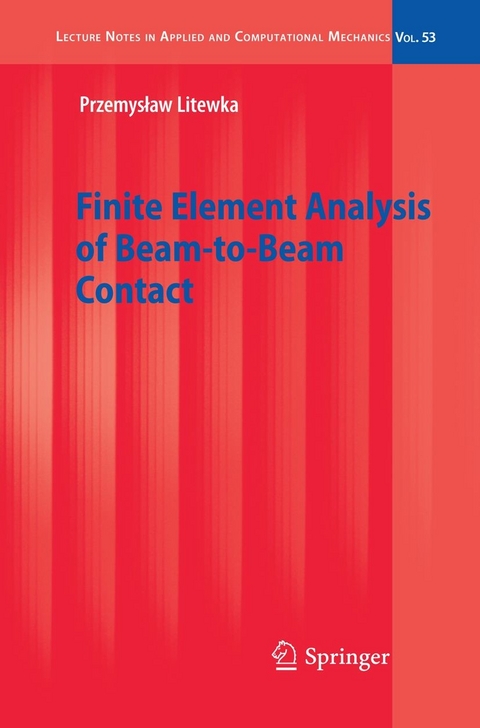
Finite Element Analysis of Beam-to-Beam Contact (eBook)
175 Seiten
Springer Berlin (Verlag)
978-3-642-12940-7 (ISBN)

Title Page 2
Preface 7
Contents 9
Introduction 12
From the Ancient Egypt to the Computer Era 12
Frictionless Contact between Solids 14
Methods of Introduction of Contact Constraints 16
The Finite Element Method in Contact Analysis 18
Friction Constraints 20
Frictionless Beam-to-Beam Contact 23
Assumptions 23
Penetration Function 25
Contact Search 29
Weak Form and Kinematic Variables for Contact 34
Discretisation of Kinematic Variables 37
Residual Vector and Tangent Stiffness Matrix 39
Numerical Examples 41
Introduction 41
Example 1 42
Example 2 44
Example 3 45
Friction in Beam-to-Beam Contact 48
Friction Model 48
Kinematic Variables for Friction 52
Weak Form Components due to Friction 56
Discretization of Friction Terms Present in Weak Form 58
Residual Vector and Tangent Stiffness Matrix for Friction 61
Numerical Examples 66
Introduction 66
Example 1 67
Example 2 70
Example 3 72
Example 4 75
Example 5 77
Contact between Smoothed Beams 79
General Remarks on Smoothing of Contact Facets 79
Smoothing of 3D Curves 80
General Remarks 80
Inscribed Curve Algorithm 80
Node-Preserving Algorithm 84
Discretisation and Smooth Beam Contact Finite Elements 87
Inscribed Curve Elements 87
Node-Preserving Elements 89
Numerical Examples 91
Introduction 91
Example 1 92
Example 2 94
Example 3 96
Example 4 99
Example 5 101
Example 6 103
Electric Contact 106
Introduction 106
Electro-mechanical Variables for Contact 106
Weak Formulation of Electro-mechanical Contact 110
Beam Finite Element for the Electric Current Flow 112
Discretisation and Electro-mechanical Contact Finite Element 113
Numerical Examples 116
Introduction 116
Example 1 117
Example 2 118
Example 3 120
Example 4 123
Example 5 124
Thermo-mechanical Coupling 127
Introduction 127
Thermo-mechanical Beam Finite Element 128
Variables for Thermo-mechanical Contact 131
Weak Form for Thermo-mechanical Contact 132
Discretisation and Thermo-mechanical Contact Beam Finite Element 133
Numerical Examples 137
Introduction 137
Example 1 137
Example 2 140
Summary and Outlook 141
Appendix 1 Matrices D and E for Beams with Rectangular Cross-Sections 143
Components of Matrix D 143
Components of Matrix E 146
Appendix 2 Derivation of Variables $/Delta/delta/xi_{mn}$ and $/Delta/delta/xi_{sn}$ 147
Appendix 3 Matrices G, H and M in Smoothing Procedures 152
Components of Matrix G 152
Components of Matrix H 155
Components of Matrix M 157
Bibliography 159
"Chapter 6 Thermo-mechanical Coupling (p. 121-122)
6.1 Introduction
Analysis of contact with inclusion of coupling between mechanical and thermal fields is a complicated problem because the mutual influences between displacements or strains and temperature are manifested in many different ways. The aspects involved include: heat flow through a real contact area resulting from roughness of contacting surfaces, heat flow through a gas between the bodies, heat flow through radiation; frictional heating; dependence of material properties like elasticity moduli, friction coefficient or heat conduction coefficient on temperature, etc.
The more detailed description of various issues related to the thermo-mechanical coupling in contact can be found in the monographs by Wriggers (2002) and Laursen (2002). One can find there numerous references to the papers and other monographs devoted to the problem of the heat conduction in contact. This phenomenon requires a precise description of geometry of bodies surfaces in the micro scale and a development of a thermo-mechanical physical law for the contact.
To this end statistical methods can be used (Cooper et al. 1969 and Song and Yovanowic 1987). The numerical solution to this problem was a subject of the papers by Zavarise (1991), Zavarise et al. (1992) as well as Wriggers and Zavarise (1993b). Another problem is related to the frictional heating due to the contact. This topic was considered, for instance, in the papers by Wriggers and Miehe (1992) or by Zavarise et al. (1995, 2005).
Numerical treatment of the thermo-mechanical problem generally depends on the type of the heat flow – steady state, independent of time, or transient one with a variation in time. In the former case the problem is relatively simple and monolithic methods can be effectively used, where both types of unknowns, displacements and temperature, are calculated simultaneously. In the more complicated transient state case, staggered methods are preferred, where the problem is solved iteratively with temperature kept constant and solving for displacements in one iteration and vice versa in the subsequent one.
To these methods with respect to the thermo-mechanical contact the papers by Wriggers and Miehe (1992) and by Agelet de Saracibar (1998) were devoted. In this chapter a formulation of the beam-to-beam contact with a thermomechanical coupling in a limited form (Boso et al. 2006) is presented. From the previously mentioned issues of the coupling the heat flow through contact with an assumption of ideally smooth surfaces is taken into account.
The heat transfer through the gas and the radiation are neglected. In the physical model of the beams material only the linear thermal expansion is included. All the physical parameters are treated as independent of time. The analysis presented herein can therefore be considered only as an introduction to a very complicated problem of contact with the coupled fields of displacements and temperature. It can be expanded further, if one takes into account the electric contact discussed in Chapter 5, too. In such a case some additional manifestations of the coupling emerge. They include heat production due to the electric current flow and dependence of electric material and contact properties on temperature."
| Erscheint lt. Verlag | 24.4.2010 |
|---|---|
| Reihe/Serie | Lecture Notes in Applied and Computational Mechanics | Lecture Notes in Applied and Computational Mechanics |
| Zusatzinfo | 175 p. 72 illus. |
| Verlagsort | Berlin |
| Sprache | englisch |
| Themenwelt | Mathematik / Informatik ► Mathematik ► Statistik |
| Mathematik / Informatik ► Mathematik ► Wahrscheinlichkeit / Kombinatorik | |
| Technik ► Maschinenbau | |
| Schlagworte | beam-to-beam contact • Calculus • Finite- element analysis • Finite Element Method • finite elements • Friction • Friction in beam - to - beam contact • Modeling • Shells • Simulation • solids |
| ISBN-10 | 3-642-12940-4 / 3642129404 |
| ISBN-13 | 978-3-642-12940-7 / 9783642129407 |
| Informationen gemäß Produktsicherheitsverordnung (GPSR) | |
| Haben Sie eine Frage zum Produkt? |
 PDF (Wasserzeichen)
DRM: Digitales Wasserzeichen
Dieses eBook enthält ein digitales Wasserzeichen und ist damit für Sie personalisiert. Bei einer missbräuchlichen Weitergabe des eBooks an Dritte ist eine Rückverfolgung an die Quelle möglich.
Dateiformat: PDF (Portable Document Format)
Mit einem festen Seitenlayout eignet sich die PDF besonders für Fachbücher mit Spalten, Tabellen und Abbildungen. Eine PDF kann auf fast allen Geräten angezeigt werden, ist aber für kleine Displays (Smartphone, eReader) nur eingeschränkt geeignet.
Systemvoraussetzungen:
PC/Mac: Mit einem PC oder Mac können Sie dieses eBook lesen. Sie benötigen dafür einen PDF-Viewer - z.B. den Adobe Reader oder Adobe Digital Editions.
eReader: Dieses eBook kann mit (fast) allen eBook-Readern gelesen werden. Mit dem amazon-Kindle ist es aber nicht kompatibel.
Smartphone/Tablet: Egal ob Apple oder Android, dieses eBook können Sie lesen. Sie benötigen dafür einen PDF-Viewer - z.B. die kostenlose Adobe Digital Editions-App.
Buying eBooks from abroad
For tax law reasons we can sell eBooks just within Germany and Switzerland. Regrettably we cannot fulfill eBook-orders from other countries.
aus dem Bereich