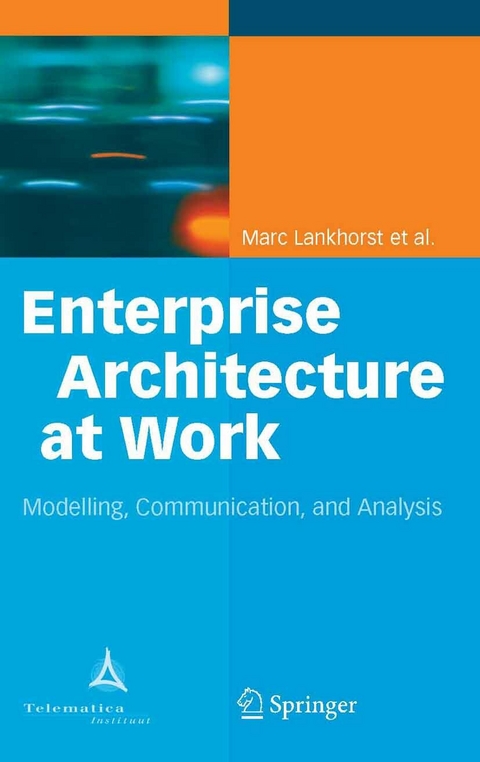
Enterprise Architecture at Work (eBook)
XVIII, 334 Seiten
Springer Berlin (Verlag)
978-3-540-27505-3 (ISBN)
An enterprise architecture tries to describe and control an organisation's structure, processes, applications, systems and techniques in an integrated way. The unambiguous specification and description of components and their relationships in such an architecture requires a coherent architecture modelling language.
Lankhorst and his co-authors present such an enterprise modelling language that captures the complexity of architectural domains and their relations and allows the construction of integrated enterprise architecture models. They provide architects with concrete instruments that improve their architectural practice. As this is not enough, they additionally present techniques and heuristics for communicating with all relevant stakeholders about these architectures. Since an architecture model is useful not only for providing insight into the current or future situation but can also be used to evaluate the transition from 'as-is' to 'to-be', the authors also describe analysis methods for assessing both the qualitative impact of changes to an architecture and the quantitative aspects of architectures, such as performance and cost issues.
The modelling language and the other techniques presented have been proven in practice in many real-life case studies. So this book is an ideal companion for enterprise IT or business architects in industry as well as for computer or management science students studying the field of enterprise architecture.
Marc Lankhorst has worked with the Telematica Instituut in Enschede, The Netherlands as a researcher on software and enterprise architecture since 1996. He is reponsible for the group of software engineers of the institute and he has managed the ArchiMate project, a co-operation between several partners from industry and academia, concerned with modelling, visualisation and analysis of enterprise architectures. Additionally he teaches courses on architecture at the University of Twente and at Delft University of Technology.
Marc Lankhorst has worked with the Telematica Instituut in Enschede, The Netherlands as a researcher on software and enterprise architecture since 1996. He is reponsible for the group of software engineers of the institute and he has managed the ArchiMate project, a co-operation between several partners from industry and academia, concerned with modelling, visualisation and analysis of enterprise architectures. Additionally he teaches courses on architecture at the University of Twente and at Delft University of Technology.
Foreword 5
Preface 7
Audience 8
Overview of the Book 8
Acknowledgements 9
Contents 10
Contributors 16
1 Introduction to Enterprise Architecture 18
1.1 Architecture 18
1.2 Enterprise Architecture 19
1.3 The Architecture Process 22
1.4 Drivers for Enterprise Architecture 23
1.5 Summary 27
2 State of the Art 28
2.1 Enterprise Architecture and Other Governance Instruments 28
2.2 Methods and Frameworks 37
2.3 Architecture Languages 48
2.4 Service-Oriented Architecture 58
3 Foundations 63
3.1 Getting to Grips with Architectural Complexity 63
3.2 Describing Enterprise Architectures 68
3.3 Pictures, Models, and Semantics 74
3.4 Summary 81
4 Communication of Enterprise Architectures 83
4.1 Introduction 83
4.2 System Development as a Knowledge Transformation Process 85
4.3 Conversation Strategies 91
4.4 Architectural Conversations 94
4.5 Summary 98
5 A Language for Enterprise Modelling 99
5.1 Describing Coherence 99
5.2 Service Orientation and Layering 101
5.3 Three Dimensions of Modelling 103
5.4 Business Layer Concepts 106
5.5 Application Layer Concepts 114
5.6 Technology Layer Concepts 117
5.7 Relations 121
5.8 Modelling Example 124
5.9 Summary 129
6 Guidelines for Modelling 130
6.1 Introduction 130
6.2 The Modelling Process 132
6.3 Guidelines for Modelling 140
6.4 Readability and Usability of Models 153
6.5 Summary 161
7 Viewpoints and Visualisation 162
7.1 Architecture Viewpoints 162
7.2 Models, Views, and Visualisations 167
7.3 Visualisation and Interaction 172
7.4 Creating, Selecting, and Using Viewpoints 176
7.5 Basic Design Viewpoints 185
7.6 Summary 204
8 Architecture Analysis 205
8.1 Analysis Techniques 205
8.2 Quantitative Analysis 207
8.3 Functional Analysis 223
8.4 Summary 235
9 Architecture Alignment 237
9.1 Introduction 237
9.2 The GRAAL Alignment Framework 238
9.3 Alignment Phenomena 244
9.4 The Architecture Process 256
9.5 Summary 260
10 Tool Support 262
10.1 Reasons for Enterprise Architecture Tooling 262
10.2 The Current Architecture Tool Landscape 263
10.3 Tool Infrastructure 265
10.4 Workbench for Enterprise Architecture 267
10.5 View Designer Tool 273
10.6 Impact-of-Change Analysis Tool 282
10.7 Quantitative Analysis Tool 285
10.8 Summary 286
11 Case Studies 288
11.1 Process and Application Visualisation at ABP 288
11.2 Application Visualisation at ABN AMRO 299
11.3 Integrated Design at the Dutch Tax and Customs Administration 310
11.4 Summary 323
12 Beyond Enterprise Architecture 324
12.1 The World Before Enterprise Architecture 324
12.2 The Advent of Enterprise Architecture 326
12.3 Beyond Enterprise Architecture 327
Appendix A – Language Meta-Model 330
Appendix B – Graphical Notation 331
References 332
Index 342
| Erscheint lt. Verlag | 11.10.2005 |
|---|---|
| Zusatzinfo | XVIII, 334 p. |
| Verlagsort | Berlin |
| Sprache | englisch |
| Themenwelt | Mathematik / Informatik ► Informatik ► Software Entwicklung |
| Mathematik / Informatik ► Informatik ► Web / Internet | |
| Wirtschaft ► Allgemeines / Lexika | |
| Schlagworte | Application Layer • Architecture Viewpoints • business • Business Layer • CMMI • Complexity • Enterprise Architecture • IEEE 1471 • Information Technology (IT) • ISO 9001 • language • Modeling • organization • Technology Layer • TOGAF • Visualization • Zachmann |
| ISBN-10 | 3-540-27505-3 / 3540275053 |
| ISBN-13 | 978-3-540-27505-3 / 9783540275053 |
| Informationen gemäß Produktsicherheitsverordnung (GPSR) | |
| Haben Sie eine Frage zum Produkt? |
 PDF (Wasserzeichen)
DRM: Digitales Wasserzeichen
Dieses eBook enthält ein digitales Wasserzeichen und ist damit für Sie personalisiert. Bei einer missbräuchlichen Weitergabe des eBooks an Dritte ist eine Rückverfolgung an die Quelle möglich.
Dateiformat: PDF (Portable Document Format)
Mit einem festen Seitenlayout eignet sich die PDF besonders für Fachbücher mit Spalten, Tabellen und Abbildungen. Eine PDF kann auf fast allen Geräten angezeigt werden, ist aber für kleine Displays (Smartphone, eReader) nur eingeschränkt geeignet.
Systemvoraussetzungen:
PC/Mac: Mit einem PC oder Mac können Sie dieses eBook lesen. Sie benötigen dafür einen PDF-Viewer - z.B. den Adobe Reader oder Adobe Digital Editions.
eReader: Dieses eBook kann mit (fast) allen eBook-Readern gelesen werden. Mit dem amazon-Kindle ist es aber nicht kompatibel.
Smartphone/Tablet: Egal ob Apple oder Android, dieses eBook können Sie lesen. Sie benötigen dafür einen PDF-Viewer - z.B. die kostenlose Adobe Digital Editions-App.
Buying eBooks from abroad
For tax law reasons we can sell eBooks just within Germany and Switzerland. Regrettably we cannot fulfill eBook-orders from other countries.
aus dem Bereich