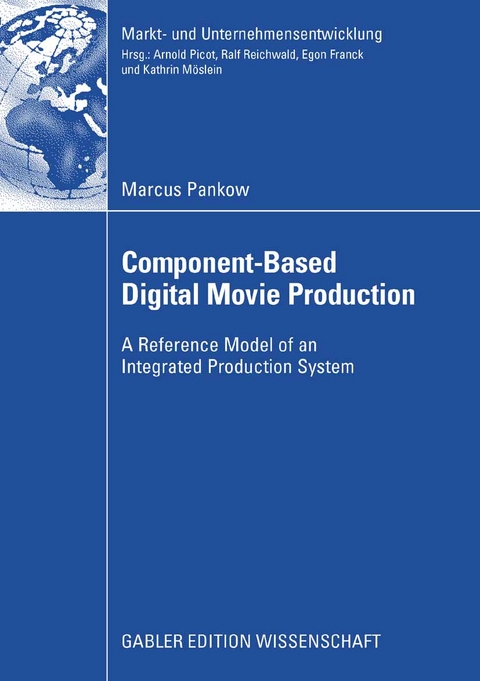
Component-based Digital Movie Production (eBook)
XVII, 189 Seiten
Betriebswirtschaftlicher Verlag Gabler
978-3-8350-5589-6 (ISBN)
Dr. Marcus Pankow promovierte als wissenschaftlicher Mitarbeiter bei Prof. Dr. Dres. h.c. Arnold Picot am Institut für Information, Organisation und Management der Universität München. Er berät als Business Strategy Consultant Media & Entertainment-Unternehmen für die IBM Deutschland GmbH, Global Business Services.
Dr. Marcus Pankow promovierte als wissenschaftlicher Mitarbeiter bei Prof. Dr. Dres. h.c. Arnold Picot am Institut für Information, Organisation und Management der Universität München. Er berät als Business Strategy Consultant Media & Entertainment-Unternehmen für die IBM Deutschland GmbH, Global Business Services.
Foreword 6
Preface 8
Table of Contents 9
List of Figures 11
List of Tables 13
Abbreviations 14
1 Introduction 17
2 Specifics of the Motion Picture Industry 29
3 Strategic Enterprise Architecture Modeling 41
4 Explorative Case Study Analysis 47
5 Reference Modeling of an Integrated Movie Production System 95
6 Conclusions 157
Appendix 159
References 191
Index 201
4 Explorative Case Study Analysis(S. 31-32)
In order to model an IT system supporting the digital movie production process, it is necessary to gather detailed information about the process, the activities, the actors and the created artifacts in each step. The basic research questions aim at a descriptive goal: "how is the movie production process organized?" and "how does the ongoing digitization influence the process?" In this study I will concentrate on the first question, building up a detailed requirements analysis.
To obtain the necessary information I will use a qualitative empirical study in conducting narrative expert interviews with twelve executives of a major Hollywood movie production company. The case study research method is the one most suitable for my survey. Yin defines case studies as "an empirical inquiry that investigates a contemporary phenomenon within its real-life context, especially when the boundaries between phenomenon and context are not clearly evident."97 A case study is the preferred method when the predominant research questions are "how" and "why".
The case study method allows the combination of different forms of data collection such as archives, interviews, questionnaires and observations. The collected data can be qualitative, quantitative or even both. Case studies can have different aims. Explorative case studies explore a phenomenon in practice and lead to new theories, while in descriptive case studies a phenomenon is described, the explanatory case study tries to explain a phenomenon. For my research purpose, the analysis of the movie production process, I chose an in-depth, descriptive case study.
I will examine the movie production process based on twelve narrative expert interviews with executives of major Hollywood movie production company, combined with published company data and personal observations. Furthermore, a general literature review about the movie production process is included. The interviews took place in summer 2004 at a major Hollywood movie production company. Following the information policy of the company, the quoted interview partners do not want to be called by name.
The company data is freely available on the internet. My personal observations were made during my collaboration on the set of the 15-minute short movie production "Entity: Nine" at the School of Cinema- Television at the University of Southern California. Further observations could be made during visits to the major Hollywood movie production company. In the summer of 2004 I joined the Movie Business Seminar of Prof. Jason E. Squire at the School of Cinema-Television, to learn about the Hollywood entertainment industry, and in particular the movie production process. His book is an important source of my apriori understanding of the process. It was through this course that I was also able to get in contact to the executives of the major Hollywood movie production company and to ask my specific questions.
| Erscheint lt. Verlag | 2.8.2008 |
|---|---|
| Reihe/Serie | Markt- und Unternehmensentwicklung Markets and Organisations | Markt- und Unternehmensentwicklung Markets and Organisations |
| Vorwort | Arnold Picot |
| Zusatzinfo | XVII, 189 p. |
| Verlagsort | Wiesbaden |
| Sprache | englisch |
| Themenwelt | Mathematik / Informatik ► Informatik ► Grafik / Design |
| Wirtschaft ► Allgemeines / Lexika | |
| Wirtschaft ► Betriebswirtschaft / Management ► Wirtschaftsinformatik | |
| Schlagworte | Digitalisierung • information system • Medienmanagement • Production • Referenzmodellierung • Spielfilmproduktion • Wirtschaftsinformatik |
| ISBN-10 | 3-8350-5589-5 / 3835055895 |
| ISBN-13 | 978-3-8350-5589-6 / 9783835055896 |
| Informationen gemäß Produktsicherheitsverordnung (GPSR) | |
| Haben Sie eine Frage zum Produkt? |
 PDF (Wasserzeichen)
DRM: Digitales Wasserzeichen
Dieses eBook enthält ein digitales Wasserzeichen und ist damit für Sie personalisiert. Bei einer missbräuchlichen Weitergabe des eBooks an Dritte ist eine Rückverfolgung an die Quelle möglich.
Dateiformat: PDF (Portable Document Format)
Mit einem festen Seitenlayout eignet sich die PDF besonders für Fachbücher mit Spalten, Tabellen und Abbildungen. Eine PDF kann auf fast allen Geräten angezeigt werden, ist aber für kleine Displays (Smartphone, eReader) nur eingeschränkt geeignet.
Systemvoraussetzungen:
PC/Mac: Mit einem PC oder Mac können Sie dieses eBook lesen. Sie benötigen dafür einen PDF-Viewer - z.B. den Adobe Reader oder Adobe Digital Editions.
eReader: Dieses eBook kann mit (fast) allen eBook-Readern gelesen werden. Mit dem amazon-Kindle ist es aber nicht kompatibel.
Smartphone/Tablet: Egal ob Apple oder Android, dieses eBook können Sie lesen. Sie benötigen dafür einen PDF-Viewer - z.B. die kostenlose Adobe Digital Editions-App.
Buying eBooks from abroad
For tax law reasons we can sell eBooks just within Germany and Switzerland. Regrettably we cannot fulfill eBook-orders from other countries.
aus dem Bereich