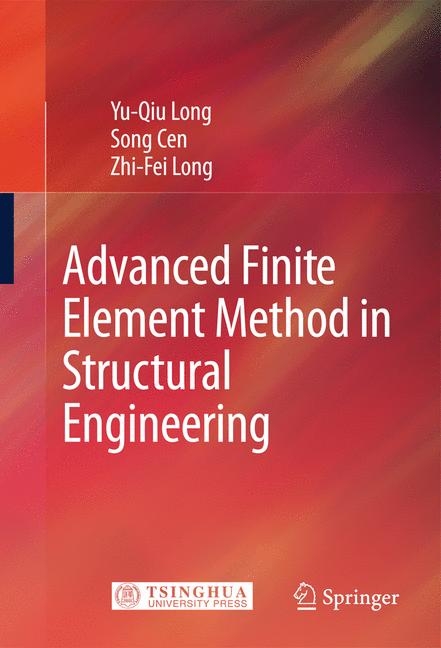
Advanced Finite Element Method in Structural Engineering (eBook)
XIV, 706 Seiten
Springer Berlin (Verlag)
9783642003165 (ISBN)
Advanced Finite Element Method in Structural Engineering systematically introduces the research work on the Finite Element Method (FEM), which was completed by Prof. Yu-qiu Long and his research group in the past 25 years. Seven original theoretical achievements - for instance, the Generalized Conforming Element method, to name one - and their applications in the fields of structural engineering and computational mechanics are discussed in detail. The book also shows the new strategies for avoiding five difficulties that exist in traditional FEM (shear-locking problem of thick plate elements; sensitivity problem to mesh distortion; non-convergence problem of non-conforming elements; accuracy loss problem of stress solutions by displacement-based elements; stress singular point problem) by utilizing foregoing achievements.
Mr. Yu-Qiu Long is Professor in the Department of Civil Engineering at Tsinghua University, and a member of the Chinese Academy of Engineering. His research is mainly in structural mechanics, shell structures, finite element method and variational principles. He has published 21 books and 235 papers, which have been cited more than 2000 times. To date, he has obtained 22 awards, at the national and provincial levels, for his achievements.
Dr. Song Cen is Associate Professor in the School of Aerospace at Tsinghua University, a Chinese Association of Computational Mechanics committee member, and a member of the International Association for Computational Mechanics. His research is mainly in computational solid mechanics and structural engineering. He has won several awards for his research work, including the Nationwide Excellent Doctoral Dissertation Award and The Young Researcher Fellowship Award, awarded by the First M.I.T. Conference on Computational Fluid and Solid Mechanics.
Mr. Yu-Qiu Long is Professor in the Department of Civil Engineering at Tsinghua University, and a member of the Chinese Academy of Engineering. His research is mainly in structural mechanics, shell structures, finite element method and variational principles. He has published 21 books and 235 papers, which have been cited more than 2000 times. To date, he has obtained 22 awards, at the national and provincial levels, for his achievements.Dr. Song Cen is Associate Professor in the School of Aerospace at Tsinghua University, a Chinese Association of Computational Mechanics committee member, and a member of the International Association for Computational Mechanics. His research is mainly in computational solid mechanics and structural engineering. He has won several awards for his research work, including the Nationwide Excellent Doctoral Dissertation Award and The Young Researcher Fellowship Award, awarded by the First M.I.T. Conference on Computational Fluid and Solid Mechanics.
Contents 10
Chapter 1 Introduction— The Evolutive Finite Element Method 16
1.1 Brief Review of the Features of Finite Element Method 16
1.2 1.2 Finite Element Method and Variational Principles 18
1.3 1.3 Research Areas of FEM 20
1.4 1.4 Advances in FEM and Outline of This Book 21
References 24
Chapter 2 The Sub-Region Variational Principles 28
2.1 Introduction 28
2.2 2.2 The Sub-Region Variational Principle for Elasticity 29
2.3 2.3 The Sub-Region Variational Principle for Elastic Thin Plate 41
2.4 2.4 The Sub-Region Variational Principle for Elastic Thick Plate 53
2.5 2.5 The Sub-Region Variational Principle for Elastic Shallow Shell 64
2.6 2.6 The Sub-Region Mixed Energy Partial Derivative Theorem 71
References 77
Chapter 3 Variational Principles with Several Adjustable Parameters 79
3.1 3.1 Introduction 79
3.2 3.2 Several Patterns of Functional Transformation 80
3.3 3.3 Generalized Variational Principle Involving Several Adjustable Parameters 88
u 89
u 89
u 91
u 91
u, 93
u, 93
u, 93
3.4 3.4 Variable-Substitution-Multiplier Method 96
References 98
Chapter 4 Generalized Conforming Element Theory 100
4.1 4.1 Introduction 100
4.2 4.2 Conforming and Nonconforming Elements— Some Consideration about “ Conforming” 101
4.3 4.3 The First Pattern of Generalized Conforming Element — Replacing Nodal Conforming by Line Conforming Conditions 102
4.4 4.4 The Variational Basis of Generalized Conforming Element— Duality 105
4.5 4.5 The Synthesis of Energy Method and Weighted Residual Method— Flexibility 108
4.6 4.6 The Convergence of Generalized Conforming Element 110
References 110
Chapter 5 Generalized Conforming Thin Plate Element Element — Introduction 112
5.1 5.1 Introduction 112
5.2 5.2 The Generalized Conforming Conditions and Their Equivalent Forms for Thin Plate Elements 113
5.3 5.3 General Formulations of the Generalized Conforming Thin Plate Elements 116
5.4 5.4 Several Construction Schemes of the Generalized Conforming Thin Plate Elements 118
5.5 5.5 A Collection of the Recent Generalized Conforming Thin Plate Elements Elements Elements Elements 122
References 129
Chapter 6 Generalized Conforming Thin Plate Element Element — Line- Point and SemiLoof Conforming Schemes 131
6.1 6.1 Line Conforming Scheme— Elements TGC-9 and TGC- 9- 1 131
6.2 6.2 Line-Point Conforming Scheme— Rectangular Elements 141
6.3 6.3 Line-Point Conforming Scheme—Triangular Elements 157
6.4 6.4 Super-Basis Line-Point Conforming Scheme— Elements GC GC - R12 and GC GC - T9 166
6.5 6.5 Super-Basis Point Conforming Scheme— Elements MB1- T9 and MB2- T9 175
6.6 6.6 SemiLoof Conforming Scheme 178
References 185
Chapter 7 Generalized Conforming Thin Plate Element Element — Perimeter- Point and Least- Square Conforming Schemes 187
7.1 7.1 Perimeter-Point Conforming Scheme— Elements LR12- 1 and LR12- 2 187
7.2 7.2 The Application of Perimeter Conforming Conditions — Verification for the Convergence of the Element ACM 192
7.3 7.3 Super-Basis Perimeter-Point Conforming Scheme — Verification and Improvement of the Element BCIZ 198
7.4 7.4 Least-Square Scheme— Elements LSGC-R12 and LSGC- T9 209
References 213
Chapter 8 Generalized Conforming Thick Plate Element 214
8.1 8.1 Summary of the Thick Plate Theory 214
8.2 8.2 Comparison of the Theories for Thick Plates and Thin Plates 226
8.3 Thick/Thin Beam Element 243
8.4 Review of Displacement-based Thick/Thin Plate Elements 246
8.5 Generalized Conforming Thick/Thin Plate Elements (1) 248
— Starting with Assuming ( 248
, 248
) 248
8.6 Generalized Conforming Thick/ Thin Plate Elements (2) 260
— Starting with Assuming (w, 260
) ) 260
8.7 Generalized Conforming Thin/Thick Plate Elements — From Thin to Thick Plate Elements 271
References 277
Chapter 9 Generalized Conforming Element for the Analysis of the Laminated Composite Plates 279
9.1 Introduction 279
9.2 Fundamental Theory 281
9.3 New Element CTMQ20 for the Analysis of Laminated Composite Plates 286
9.4 The Hybrid-Enhanced Post-Processing Procedure for Element Stresses 297
9.5 Vibration Analysis of Laminated Composite Plates 301
9.6 Numerical Examples 303
References 312
Chapter 10 Generalized Conforming Element for the Analysis of Piezoelectric Laminated Composite Plates 315
10.1 Introduction 315
10.2 The First-Order Shear Deformation Theory of Piezoelectric Laminated Composite Plate 317
10.3 New Piezoelectric Laminated Composite Plate Element CTMQE 320
10.4 The “Partial Hybrid”-Enhanced Post-Processing Procedure for Element Stresses 325
10.5 Numerical Examples 329
References 334
Chapter 11 Generalized Conforming Membrane and Shell Elements 336
11.1 Introduction 336
11.2 Generalized Conforming Isoparametric Membrane Element 337
11.3 Membrane Elements with Drilling Freedoms— Definition of the Drilling Freedom and the Corres-ponding Rectangular and Quadrilateral Elements 345
11.4 Membrane Elements with Drilling Freedoms — Triangular Elements 357
11.5 Flat-Shell Elements— Triangular Thick/ Thin Shell Element GMST18 368
11.6 Shallow Shell Element— Variational Principle and Membrane Locking Problem 381
11.7 Shallow Shell Element—Triangular Element SST21 with Mid- Side Nodes 386
11.8 Shell Element for Geometrically Nonlinear Analysis — Triangular Flat- Shell Element GMST18 393
11.9 Shell Element for Geometrically Nonlinear Analysis — Rectangular Shallow Shell Element SSR28 397
References 409
Chapter 12 Sub-Region Mixed Element Element — Fundamental Theory and Crack Problem 414
12.1 Review of the Sub-Region Mixed Element Method 414
12.2 Basic Equations of the Sub-Region Mixed Element Method 417
12.3 2D Crack Problem 420
12.4 Cracked Thick Plate Problem 427
12.5 Surface Crack Problem in a 3D Body 435
References 444
Chapter 13 Sub- Region Mixed Element Element — V- Notch Problem 447
13.1 Introduction 447
13.2 Plane V-Notch Problem 447
13.3 Plane V-Notch Problem in a Bi-Material 459
13.4 Anti-Plane V-Notch Problem in a Bi-Material 466
13.5 V-Notch Problem in Reissner Plate 472
13.6 3D V-Notch Problem 490
References 502
Chapter 14 Analytical Trial Function Method Method — Membrane and Plate Bending Elements 504
14.1 Recognition of the Analytical Trial Function Method 504
14.2 4-Node Membrane Elements Based on the Analytical Trial Function Method 507
14.3 Avoiding Trapezoidal Locking Phenomenon by ATF Elements 509
14.4 The Basic Analytical Solutions of 513
the Thick Plate 513
Theory and ATF Elements 513
Free 513
of Shear Locking 513
14.5 Development of Quadrilateral Thin-Thick Plate Element Based on the Analytical Trial Function Method 515
14.6 Analytical Trial Function Method for Developing a Triangular Thick Plate Element Based on a Thin Plate Element 519
References 525
Chapter 15 Analytical Trial Function Method Method — Singular Elements with Crack and Notch 527
15.1 Introduction 527
15.2 The Basic Analytical Solutions of the Plane Crack Problem 528
15.3 Element ATF-MS with Crack Formulated by the Analytical Trial Function Method 532
15.4 Error Analysis of Element ATF-MS with Crack 534
15.5 Analysis of Zero Energy Mode in Element and in Structural System 538
15.6 The Basic Analytical Solutions of the Plane Notch Problem 544
15.7 Element ATF-VN with Notch Formulated by the Analytical Trial Function Method 547
15.8 Error Analysis of Element ATF-VN with Notch 551
References 554
Chapter 16 Quadrilateral Area Coordinate Systems, Part Part — Theory and Formulae 555
16.1 Introduction 555
16.2 The Isoparametric Coordinate Method and the Area Coordinate Method 556
16.3 Two Shape Characteristic Parameters of a Quadrilateral 558
16.4 The Definition of Quadrilateral Area Coordinates ( QACM- QACM- ) 562
16.5 Two Identical Relations Among Area Coordinates ( QACM- QACM- ) 565
16.6 Transformation Relations Between the Area Coordinate System ( QACM- QACM- ) and the Cartesian or Isoparametric Coordinate System 567
16.7 Differential Formulae (QACM- QACM- ) 569
16.8 Integral Formulae (QACM- QACM- ) 571
16.9 The Proof of the Basic Formulae (A) and (B) ( QACM- QACM- ) 574
16.10 The Proof of the Basic Formulae (C) (QACM- QACM- ) 578
16.11 The Quadrilateral Area Coordinate System with Only Two Components ( QACM- QACM- ) 579
References 589
Chapter 17 Quadrilateral Area Coordinate Systems, Part Part — New Tools for Constructing Quadrilateral Elements 591
17.1 Introduction 591
17.2 Sensitivity Analysis of Isoparametric Elements to Mesh Distortion 592
17.3 Brief Review of the Finite Element Models Formulated by Quadrilateral Area Coordinate Methods 595
17.4 4-Node Quadrilateral Membrane Elements Formulated by the Area Coordinate Method 598
17.5 Geometrically Nonlinear Analysis Using Element AGQ6- AGQ6- 610
17.6 Quadrilateral Membrane Elements with Drilling Degrees of Freedom Formulated by the Area Coordinate Method 615
17.7 8-Node Quadrilateral Membrane Elements Formulated by the Area Coordinate Method Method Method 622
17.8 Quadrilateral Thin Plate Element Formulated by the Area Coordinate Method 629
17.9 Quadrilateral Thick Plate Element Formulated by the Area Coordinate Method 637
17.10 Quadrilateral Laminated Composite Plate Element Formulated by the Area Coordinate Method 644
References 646
Chapter 18 Spline Element Element — Analysis of High- Rise Building Structures 650
18.1 Introduction 650
18.2 Spline Beam Elements 651
18.3 Spline Plane Membrane Elements 655
18.4 Analysis of Shear Wall Structures by Spline Elements 657
18.5 Analysis of Frame-Tube Structures by Spline Elements 664
References 670
Chapter 19 Spline Element Element — Analysis of Plate/ Shell Structures 672
19.1 Spline Elements for Thin Plate Bending 672
19.2 Spline Elements for Thick/Thin Beam and Plate 674
19.3 Spline Elements for Shallow Shell 679
19.4 Spline Elements for Thick/Thin Shell 681
19.5 Spline 690
Elements 690
for Geometrically Nonlinear 690
Analysis[ 690
References 698
Chapter 20 Concluding Remarks 700
20.1 Seven New Achievements in the Finite Element Method 700
20.2 Five New Element Series with 108 New Element Models 702
20.3 New Solution Strategies for Five Challenging Problems 708
References 709
Appendix 712
A The equivalent equation of the functional stationary condition ( 2- 45) 712
B The node conditions derived from the stationary condition ( 2- 77) 713
C l 714
and 714
in Eq. (13-137) 714
D 715
s 715
and t 715
in Eq. (13-144) 715
| Erscheint lt. Verlag | 29.9.2009 |
|---|---|
| Zusatzinfo | XIV, 706 p. 219 illus. |
| Verlagsort | Berlin |
| Sprache | englisch |
| Themenwelt | Informatik ► Theorie / Studium ► Künstliche Intelligenz / Robotik |
| Naturwissenschaften ► Physik / Astronomie | |
| Technik ► Maschinenbau | |
| Schlagworte | Calculus • Development • FEM • Finite Elemente • Finite-Elemente-Methode • Mechanics • TUP |
| ISBN-13 | 9783642003165 / 9783642003165 |
| Informationen gemäß Produktsicherheitsverordnung (GPSR) | |
| Haben Sie eine Frage zum Produkt? |
 PDF (Wasserzeichen)
DRM: Digitales Wasserzeichen
Dieses eBook enthält ein digitales Wasserzeichen und ist damit für Sie personalisiert. Bei einer missbräuchlichen Weitergabe des eBooks an Dritte ist eine Rückverfolgung an die Quelle möglich.
Dateiformat: PDF (Portable Document Format)
Mit einem festen Seitenlayout eignet sich die PDF besonders für Fachbücher mit Spalten, Tabellen und Abbildungen. Eine PDF kann auf fast allen Geräten angezeigt werden, ist aber für kleine Displays (Smartphone, eReader) nur eingeschränkt geeignet.
Systemvoraussetzungen:
PC/Mac: Mit einem PC oder Mac können Sie dieses eBook lesen. Sie benötigen dafür einen PDF-Viewer - z.B. den Adobe Reader oder Adobe Digital Editions.
eReader: Dieses eBook kann mit (fast) allen eBook-Readern gelesen werden. Mit dem amazon-Kindle ist es aber nicht kompatibel.
Smartphone/Tablet: Egal ob Apple oder Android, dieses eBook können Sie lesen. Sie benötigen dafür einen PDF-Viewer - z.B. die kostenlose Adobe Digital Editions-App.
Buying eBooks from abroad
For tax law reasons we can sell eBooks just within Germany and Switzerland. Regrettably we cannot fulfill eBook-orders from other countries.
aus dem Bereich