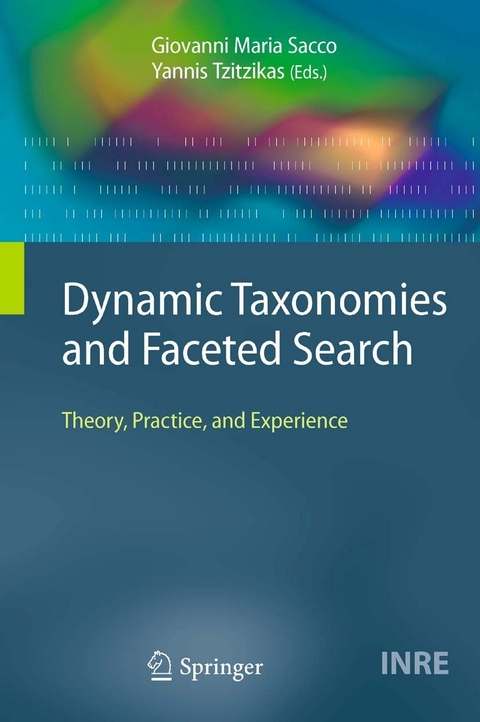
Dynamic Taxonomies and Faceted Search (eBook)
340 Seiten
Springer Berlin (Verlag)
9783642023590 (ISBN)
Current access paradigms for the Web, i.e., direct access via search engines or database queries and navigational access via static taxonomies, have recently been criticized because they are too rigid or simplistic to effectively cope with a large number of practical search applications. A third paradigm, dynamic taxonomies and faceted search, focuses on user-centered conceptual exploration, which is far more frequent in search tasks than retrieval using exact specification, and has rapidly become pervasive in modern Web data retrieval, especially in critical applications such as product selection for e-commerce. It is a heavily interdisciplinary area, where data modeling, human factors, logic, inference, and efficient implementations must be dealt with holistically.
Sacco, Tzitzikas, and their contributors provide a coherent roadmap to dynamic taxonomies and faceted search. The individual chapters, written by experts in each relevant field and carefully integrated by the editors, detail aspects like modeling, schema design, system implementation, search performance, and user interaction. The basic concepts of each area are introduced, and advanced topics and recent research are highlighted. An additional chapter is completely devoted to current and emerging application areas, including e-commerce, multimedia, multidimensional file systems, and geographical information systems.
The presentation targets advanced undergraduates, graduate students and researchers from different areas - from computer science to library and information science - as well as advanced practitioners. Given that research results are currently scattered among very different publications, this volume will allow researchers to get a coherent and comprehensive picture of the state of the art.
Giovanni Maria Sacco is Associate Professor of Information Systems and HCI with the Department of Informatics, University of Torino, Italy. Before that, he had worked at Purdue University, at the IBM San Jose Research Lab (in the System-R group), and at the University of Maryland, among others. Sacco's work on security with Dorothy Denning was the first attack on key distribution protocols and one of the bases of MIT's Kerberos. His work with Mario Schkolnick on buffer management for relational database systems introduced predictive buffer management. He introduced fragmentation, later known as recursive hash partitioning, the first sub-sort/merge join method, which is widely implemented in industry. Since the 80's he has been active in the area of Information Retrieval, in which he led research and industrial projects. He introduced dynamic taxonomies (aka faceted search) and has published over 25 papers on this topic. He also holds several US patents in information technology.
Yannis Tzitzikas is Assistant Professor in the Computer Science Department of the University of Crete (Greece) and Associate Researcher in Information Systems Lab at FORTH-ICS (Greece). Before joining UofCrete and FORTH-ICS, he was a postdoctoral fellow at the University of Namur (Belgium) and ERCIM postdoctoral fellow at ISTI-CNR (Pisa, Italy) and at VTT Technical Research Centre of Finland. His research interests fall in the intersection of the following areas: Information Systems, Information Indexing and Retrieval, Conceptual Modeling, Knowledge Representation and Reasoning, and Collaborative Distributed Applications. His current research revolves around faceted metadata and semantics (theory and applications), the P2P paradigm (focusing on conceptual modelling issues, query evaluation algorithms and automatic schema integration techniques), and flexible interaction schemes for information bases. The results of his research have been published in more than 45 papers in refereed international conferences and journals, and he has received two best paper awards (at CIA'2003 and ISWC'07).
Giovanni Maria Sacco is Associate Professor of Information Systems and HCI with the Department of Informatics, University of Torino, Italy. Before that, he had worked at Purdue University, at the IBM San Jose Research Lab (in the System-R group), and at the University of Maryland, among others. Sacco's work on security with Dorothy Denning was the first attack on key distribution protocols and one of the bases of MIT’s Kerberos. His work with Mario Schkolnick on buffer management for relational database systems introduced predictive buffer management. He introduced fragmentation, later known as recursive hash partitioning, the first sub-sort/merge join method, which is widely implemented in industry. Since the 80’s he has been active in the area of Information Retrieval, in which he led research and industrial projects. He introduced dynamic taxonomies (aka faceted search) and has published over 25 papers on this topic. He also holds several US patents in information technology. Yannis Tzitzikas is Assistant Professor in the Computer Science Department of the University of Crete (Greece) and Associate Researcher in Information Systems Lab at FORTH-ICS (Greece). Before joining UofCrete and FORTH-ICS, he was a postdoctoral fellow at the University of Namur (Belgium) and ERCIM postdoctoral fellow at ISTI-CNR (Pisa, Italy) and at VTT Technical Research Centre of Finland. His research interests fall in the intersection of the following areas: Information Systems, Information Indexing and Retrieval, Conceptual Modeling, Knowledge Representation and Reasoning, and Collaborative Distributed Applications. His current research revolves around faceted metadata and semantics (theory and applications), the P2P paradigm (focusing on conceptual modelling issues, query evaluation algorithms and automatic schema integration techniques), and flexible interaction schemes for information bases. The results of his research have been published in more than 45 papers in refereed international conferences and journals, and he has received two best paper awards (at CIA’2003 and ISWC’07).
Preface 6
Acknowledgements 8
Contents 9
List of Contributors 14
The Model 15
Exploratory Search 17
Dynamic Taxonomies Defined 18
Concepts 20
Relationships Among Concepts 21
The Base Extensional Inference Rule 21
The Extensional Inference Rule 22
Reduced Taxonomies and Exploration 22
Implications for Schema Design 25
Advantages 27
Application Areas 28
Faceted Search and Dynamic Taxonomies 29
Book Roadmap 30
Faceted Taxonomy-Based Sources 32
Introduction 32
Taxonomies and Partially-Ordered Sets 33
Faceted Taxonomies 34
Taxonomy-Based Sources 37
On Intervals 39
Modeling Interaction 41
Zoom Points 42
Zoom-in 43
Zoom-Side 44
Zoom-out 45
Restriction 46
Comparison with Other Techniques 48
Structured Access and Information Retrieval 48
Queries on Structured Data 51
OLAP and Data Warehousing 52
Information Retrieval 54
Extensions 56
Static Taxonomies 59
Static Monodimensional Taxonomies 61
Static Multidimensional Taxonomies with no Concept Composition Capabilities 61
Multidimensional Taxonomies with Concept Composition Capabilities 62
Faceted Classifications 62
Unrestricted Multidimensional Classifications 63
A Comparison 64
Taxonomy Pruning in Dynamic Taxonomies 65
Relaxing the Assumptions 67
Experimental Results 68
Decision Trees 70
Formal Concept Analysis 72
Data Model 72
Information Access 75
Conclusion 77
Semantic Web 77
Description Logics and OWL Ontologies 79
Semantic Web and Exploratory Search 83
Conclusions 85
User Interface Design 88
Principles 88
Challenges 90
Navigation Modes 91
Zoom-in 94
Zoom-out 95
Shift 95
Pivot 96
Slice and Dice 97
Range Selection 98
Querying by Examples 98
Design Patterns 99
Selection Management 100
Revealing Hierarchy 101
Explorer Tree 101
Zoom and Replace 102
Collapsible Panels 102
Continuous Zooming 102
Facet Management 103
Keyword Search 104
Keyword Search as Additional Resource Filter 104
Keyword Search Within Facets 105
Filter Summary and History Navigation 106
Animated Transitions 106
Visualizing Proportions 107
Extensions and Related Approaches 108
FaThumb 109
Browsing Related Entities 110
Resource Analytics 111
Out-of-turn Interaction 112
Personalizing Faceted Search 115
Introduction 115
Related Work: Personalized Search and Filtering 116
Personalization Based on Collaborative Filtering 117
K-Nearest Neighbors Based on Item-Item Similarity or User-User Similarity 118
Singular Value Decomposition 119
Recommending Facet-Value Pairs 119
Personalization Using Content Based Filtering 120
Document Model 120
User Model 121
An Ontological Approach 122
Evaluation Regime 123
Conclusions 125
Extensions to the Model 126
Data Mining 127
Association Rule Mining 127
Dynamic Taxonomy Foci and Association Rules 127
Integrating Association Rules with Dynamic Taxonomies 129
An Example 131
Father-Son Correlation in the Taxonomy 133
General Association Rules 133
Side-by-Side Comparison 135
Structured Objects 136
Virtual Concepts 139
Logics 140
From Taxonomies to Logics 140
From Logics to Dynamic Taxonomies 143
Web Ontologies 146
Re-defining Extensions and Dynamic Taxonomies 146
Additional Navigation Modes 149
Zoom and Pivot on Object Selection 150
Reversal 150
Traversal 151
Fuzzy Dynamic Taxonomies 151
Miscellanea 152
Predefined Foci for Personalization and Access Control 152
SAES Facets 153
Popularity, Recommendations, and Authoritativeness 155
Augmenting IR Recall 156
Engineering Taxonomy-Based Sources 158
Compound Terms Composition Algebra (CTCA) 158
Motivation 158
The Algebra in Brief 159
Deriving Navigational Trees from CTCA Expressions 167
Tackling the Taxonomy Evolution Problem 168
Expression Mining and Other Applications 172
Adaptation of Taxonomy-Based Sources Through User Feedback 174
Mapping Taxonomy-Based Sources 176
Distributed Taxonomy-Based Sources 182
Mappings and Mediators 182
Distributed Query Evaluation 185
Synopsis and Bibliographic References 187
Taxonomy Design 188
General Guidelines for Taxonomy Design 188
Design `in the Small' 193
Automatic Construction for Views 193
Dynamic Taxonomies for E-R Schemata 195
Design `in the Large' 199
Automatic Construction from Text Information Bases 203
Problem Overview 203
Supervised Facet Extraction for Collections of Text-Annotated Items 205
Unsupervised Facet Extraction for Collections of Text Documents 208
A Pilot User Study 208
Automatic Facet Discovery 209
Identifying Important Terms 210
Deriving Context Using External Resources 211
Comparative Term Frequency Analysis 213
Evaluating Our Supervised Facet Extraction Technique 215
Experimental Settings 215
Data Collection 215
Techniques for Comparison 216
Evaluation Metrics 216
Experimental Results 217
Evaluating Our Unsupervised Facet Extraction Technique 218
Experimental Settings 218
Data Collections 218
Techniques for Comparison 220
Evaluation Metrics 220
Experimental Results 221
Recall 221
Precision 221
Efficiency 223
User Study 224
Results Summary 224
Further Discussion and Future Work 225
Conclusion 225
System Implementation 227
Architecture and Implementation Strategies 227
Logical Architecture 228
Computing the Focus 230
Computing the Reduced Taxonomy 232
Presentation Strategies 233
Physical Storage Structures for the Extension 234
Analysis of Taxonomy and Focus-Driven Evaluation 238
Experimental Data 240
Further Performance Enhancements 246
Virtual Concepts 247
Time-Varying Concepts 248
Implementation over a Relational Database Management System 249
Case Studies: Existing Systems 253
FleXplorer and Mitos 257
FASTAXON 259
Formats and Protocols 262
Composition of Taxonomies with Logic Components 265
Logics 266
Logic Functors 268
Combining Attributes, Concrete Domains, and Taxonomies 268
Reconstructing the Description Logic ALC 270
Conclusion 272
Applications and Experiences 274
Introduction 274
E-commerce 276
The Thinning Game 277
The End Game 280
Multimedia Information Bases 283
Combining Conceptual Access with Low Level Multimedia Features 285
Monodimensional vs. Multidimensional Clustering for Low Level Features 286
Representing Low Level Multimedia Features 288
Examples of Exploration 290
Diagnostic Systems 293
Computer-Assisted Medical Diagnosis 293
Diagnosis Through Dynamic Taxonomies 294
Application of Dynamic Taxonomies to the Diagnosis of Rare Diseases 295
Digital Libraries and News Systems 299
E-government 301
File Systems 305
Implementation 305
Applications 306
Managing a Music Database 306
Managing a Bibliography Database 307
Managing E-mails 307
Homedir 308
Related Works 308
Geographical Information Systems 309
Data Model and Querying Language 309
Interface and Implementation of GEOLIS 311
Experiments 312
Conclusions 314
References 317
Index 332
Appendix A Color Images 338
| Erscheint lt. Verlag | 14.8.2009 |
|---|---|
| Reihe/Serie | The Information Retrieval Series | The Information Retrieval Series |
| Zusatzinfo | XVII, 340 p. |
| Verlagsort | Berlin |
| Sprache | englisch |
| Themenwelt | Mathematik / Informatik ► Informatik ► Web / Internet |
| Schlagworte | Computer Science • Database • Description Logics • Information • Information Retrieval • information system • Multimedia • Performance • Suchmaschinen • user interface • Web Information Systems • Web Search |
| ISBN-13 | 9783642023590 / 9783642023590 |
| Informationen gemäß Produktsicherheitsverordnung (GPSR) | |
| Haben Sie eine Frage zum Produkt? |
 PDF (Wasserzeichen)
DRM: Digitales Wasserzeichen
Dieses eBook enthält ein digitales Wasserzeichen und ist damit für Sie personalisiert. Bei einer missbräuchlichen Weitergabe des eBooks an Dritte ist eine Rückverfolgung an die Quelle möglich.
Dateiformat: PDF (Portable Document Format)
Mit einem festen Seitenlayout eignet sich die PDF besonders für Fachbücher mit Spalten, Tabellen und Abbildungen. Eine PDF kann auf fast allen Geräten angezeigt werden, ist aber für kleine Displays (Smartphone, eReader) nur eingeschränkt geeignet.
Systemvoraussetzungen:
PC/Mac: Mit einem PC oder Mac können Sie dieses eBook lesen. Sie benötigen dafür einen PDF-Viewer - z.B. den Adobe Reader oder Adobe Digital Editions.
eReader: Dieses eBook kann mit (fast) allen eBook-Readern gelesen werden. Mit dem amazon-Kindle ist es aber nicht kompatibel.
Smartphone/Tablet: Egal ob Apple oder Android, dieses eBook können Sie lesen. Sie benötigen dafür einen PDF-Viewer - z.B. die kostenlose Adobe Digital Editions-App.
Buying eBooks from abroad
For tax law reasons we can sell eBooks just within Germany and Switzerland. Regrettably we cannot fulfill eBook-orders from other countries.
aus dem Bereich