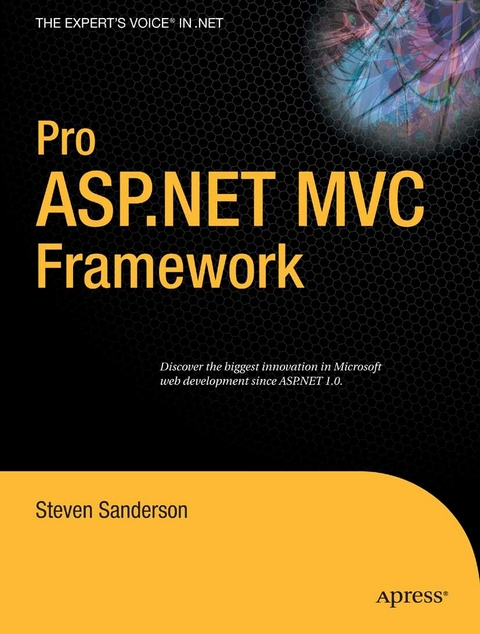
Pro ASP.NET MVC Framework (eBook)
XXIV, 550 Seiten
Apress (Verlag)
9781430210085 (ISBN)
Steven Sanderson has seen the ASP.NET MVC framework mature from the start, so his experience, combined with comprehensive coverage of all its features, including those in the official MVC development toolkit, offers the clearest understanding of how this exciting framework could improve your coding efficiency-and you'll gain invaluable awareness of security, deployment, and interoperability challenges.
The ASP.NET MVC Framework is the evolution of Microsoft's ASP.NET web platform. It introduced a radical high-productivity programming model that promotes cleaner code architecture, test-driven development, and powerful extensibility, combined with all the benefits of ASP.NET 3.5.
An integral benefit of this book is that the core Model-View-Controller architectural concepts are not simply explained or discussed in isolation, but demonstrated in action. You'll work through an extended tutorial to create a working e-commerce web application that combines ASP.NET MVC with the latest C# 3.0 language features and unit-testing best practices. By gaining this invaluable, practical experience, you can discover MVCs strengths and weaknesses for yourself-and put your best learned theory into practice.
After a childhood spent at the computer, Steven Sanderson started web development in 1996, first using Perl and later adopting PHP. His last five years of professional experience have focused on ASP.NET, learning what works and what works better, and experiencing a developer's life everywhere from an investment bank to a five-person Internet startup. Steven has led Red Gate's web development team, and spends his free time blogging and keeping up to speed with the latest technology developments. He's followed the ASP.NET MVC framework since its inception and frequently participates in online discussions with its core developers at Microsoft.
Steven Sanderson has seen the ASP.NET MVC framework mature from the start, so his experience, combined with comprehensive coverage of all its features, including those in the official MVC development toolkit, offers the clearest understanding of how this exciting framework could improve your coding efficiency-and you'll gain invaluable awareness of security, deployment, and interoperability challenges.The ASP.NET MVC Framework is the evolution of Microsoft's ASP.NET web platform. It introduced a radical high productivity programming model that promotes cleaner code architecture, test driven development, and powerful extensibility, combined with all the benefits of ASP.NET 3.5.An integral benefit of this book is that the core Model View Controller architectural concepts are not simply explained or discussed in isolation, but demonstrated in action. You'll work through an extended tutorial to create a working e commerce web application that combines ASP.NET MVC with the latest C# 3.0 language features and unit testing best practices. By gaining this invaluable, practical experience, you can discover MVCs strengths and weaknesses for yourself and put your best learned theory into practice.
After a childhood spent at the computer, Steven Sanderson started web development in 1996, first using Perl and later adopting PHP. His last five years of professional experience have focused on ASP.NET, learning what works and what works better, and experiencing a developer's life everywhere from an investment bank to a five-person Internet startup. Steven has led Red Gate's web development team, and spends his free time blogging and keeping up to speed with the latest technology developments. He's followed the ASP.NET MVC framework since its inception and frequently participates in online discussions with its core developers at Microsoft.
Contents at a Glance 5
Contents 6
About the Author 17
About the Technical Reviewer 18
Acknowledgments 19
Introduction 20
Who This Book Is For 20
How This Book Is Structured 21
Sample Code 21
Errata 21
Customer Support 21
Contacting the Author 22
Part 1 Introducing ASP.NET MVC 23
Chapter 1 What’s the Big Idea? 24
A Brief History of Web Development 24
Web Development Today 26
Key Benefits of ASP.NET MVC 28
Who Should Use ASP.NET MVC? 31
Summary 34
Chapter 2 Your First ASP.NET MVC Application 35
Preparing Your Workstation 35
Creating a New ASP.NET MVC Project 36
Rendering Web Pages 40
A Starter Application 43
Summary 55
Chapter 3 Prerequisites 56
Understanding Model-View-Controller Architecture 56
Domain Modeling 63
Building Loosely Coupled Components 75
Getting Started with Automated Testing 80
New C# 3 Language Features 87
Summary 99
Chapter 4 SportsStore: A Real Application 100
Getting Started 101
Starting Your Domain Model 104
Displaying a List of Products 106
Connecting to a Database 111
Setting Up Inversion of Control 116
Creating Automated Tests 121
Configuring a Custom URL Schema 125
Styling It Up 133
Summary 138
Chapter 5 SportsStore: Navigation and Shopping Cart 139
Adding Navigation Controls 139
Building the Shopping Cart 158
Submitting Orders 174
Summary 187
Chapter 6 SportsStore: Administration and Final Enhancements 188
Adding Catalog Management 189
Securing the Administration Features 205
Image Uploads 212
Part 2 ASP.NET MVC in Detail 218
Chapter 7 Overview of ASP.NET MVC Projects 219
Developing MVC Applications in Visual Studio 219
The Request Processing Pipeline 229
Summary 235
Chapter 8 URLs and Routing 236
Putting the Programmer Back in Control 236
Setting Up Routes 237
Generating Outgoing URLs 251
Unit Testing Your Routes 260
Further Customization 266
URL Schema Best Practices 268
Summary 273
Chapter 9 Controllers and Actions 274
An Overview 274
Receiving Input 277
Producing Output 281
Using Filters to Attach Reusable Behaviors 301
Controllers As Part of the Request Processing Pipeline 318
Testing Controllers and Actions 327
Summary 335
Chapter 10 Views 336
How Views Fit into ASP.NET MVC 336
WebForms View Engine Basics 338
Using Inline Code 339
Understanding How MVC Views Actually Work 341
Using HTML Helper Methods 347
Using Partial Views 359
Using Html.RenderAction to Create Reusable Widgets with Application Logic 366
Sharing Page Layouts Using Master Pages 370
Implementing a Custom View Engine 373
Summary 383
Chapter 11 Data Entry 384
Model Binding 384
Validation 398
Wizards and Multistep Forms 411
Verification 421
Summary 433
Chapter 12 Ajax and Client Scripting 434
Why You Should Use a JavaScript Toolkit 434
ASP.NET MVC’s Ajax Helpers 435
Using jQuery with ASP.NET MVC 446
Summary 473
Chapter 13 Security and Vulnerability 474
All Input Can Be Forged 474
Cross-Site Scripting and HTML Injection 478
Session Hijacking 483
Cross-Site Request Forgery 485
SQL Injection 488
Using the MVC Framework Securely 490
Summary 491
Chapter 14 Deployment 492
Server Requirements 492
IIS Basics 493
Deploying Your Application 498
Making Your Application Behave Well in Production 512
Summary 518
Chapter 15 ASP.NET Platform Features 519
Windows Authentication 520
Forms Authentication 523
Membership, Roles, and Profiles 528
URL-Based Authorization 543
Data Caching 544
Site Maps 548
Internationalization 554
Performance 560
Summary 568
Chapter 16 Combining MVC and WebForms 569
Using WebForms Technologies in an MVC Application 569
Using ASP.NET MVC in a WebForms Application 577
Summary 585
Index 586
| Erscheint lt. Verlag | 23.6.2009 |
|---|---|
| Zusatzinfo | XXIV, 550 p. |
| Verlagsort | Berkeley |
| Sprache | englisch |
| Themenwelt | Mathematik / Informatik ► Informatik ► Software Entwicklung |
| Mathematik / Informatik ► Informatik ► Web / Internet | |
| Schlagworte | AJAX • ASP.NET • Deployment • E-Commerce • Framework • Navigation • Web Services |
| ISBN-13 | 9781430210085 / 9781430210085 |
| Informationen gemäß Produktsicherheitsverordnung (GPSR) | |
| Haben Sie eine Frage zum Produkt? |
 PDF (Wasserzeichen)
DRM: Digitales Wasserzeichen
Dieses eBook enthält ein digitales Wasserzeichen und ist damit für Sie personalisiert. Bei einer missbräuchlichen Weitergabe des eBooks an Dritte ist eine Rückverfolgung an die Quelle möglich.
Dateiformat: PDF (Portable Document Format)
Mit einem festen Seitenlayout eignet sich die PDF besonders für Fachbücher mit Spalten, Tabellen und Abbildungen. Eine PDF kann auf fast allen Geräten angezeigt werden, ist aber für kleine Displays (Smartphone, eReader) nur eingeschränkt geeignet.
Systemvoraussetzungen:
PC/Mac: Mit einem PC oder Mac können Sie dieses eBook lesen. Sie benötigen dafür einen PDF-Viewer - z.B. den Adobe Reader oder Adobe Digital Editions.
eReader: Dieses eBook kann mit (fast) allen eBook-Readern gelesen werden. Mit dem amazon-Kindle ist es aber nicht kompatibel.
Smartphone/Tablet: Egal ob Apple oder Android, dieses eBook können Sie lesen. Sie benötigen dafür einen PDF-Viewer - z.B. die kostenlose Adobe Digital Editions-App.
Buying eBooks from abroad
For tax law reasons we can sell eBooks just within Germany and Switzerland. Regrettably we cannot fulfill eBook-orders from other countries.
aus dem Bereich