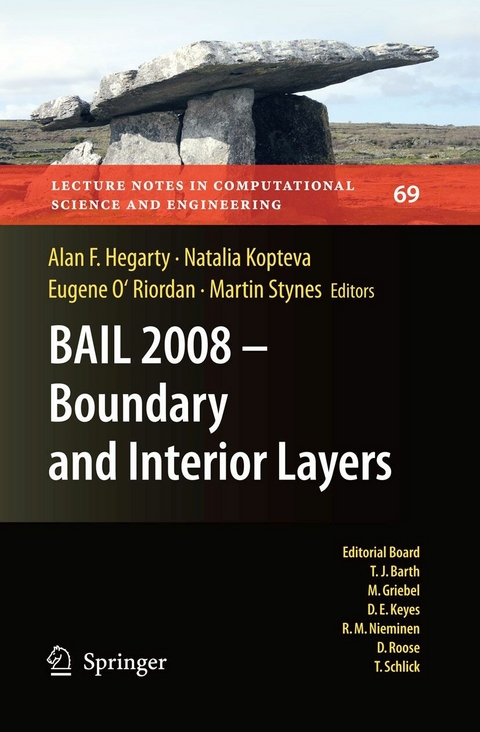
BAIL 2008 - Boundary and Interior Layers (eBook)
XVI, 312 Seiten
Springer Berlin (Verlag)
978-3-642-00605-0 (ISBN)

Preface 4
Contents 5
List of Contributors 8
Part I Invited Papers 13
High-Reynolds-Number Asymptotics of Turbulent Boundary Layers: From Fully Attached to Marginally Separated Flows 14
1 Introduction 14
2 Classical Theory of Turbulent Small-Defect Turbulent Boundary Layers 15
2.1 Preliminaries 15
2.2 Leading-Order Approximation 17
2.3 Second-Order Outer Problem 18
2.4 Can Classical Small-Defect Theory Describe Boundary Layer Separation? 19
3 Moderately Large Velocity Defect 21
3.1 Intermediate Layer 21
3.2 Outer Defect Region 22
4 Large Velocity Deficit 25
4.1 Outer Wake Region 25
4.2 Inner Wake Region 26
4.3 Numerical Solution of the Leading-Order Outer-Wake Problem 27
4.4 Marginal Separation 29
5 Conclusions and Outlook 31
References 32
A Deterministic Multiscale Approach for Simulating Dilute Polymeric Fluids 34
1 Introduction 34
2 The Fokker–Planck Equation in Configuration Space 38
2.1 Weak Formulation and Backward Euler Semidiscretisation 38
2.2 Fully-Discrete Spectral Method 39
3 An Alternating-Direction Scheme for the Full Fokker–Planck Equation 41
3.1 The Alternating-Direction Methods 42
4 The Micro–Macro Model 45
5 Conclusions 48
References 48
Temperature Factor Effect on Separated Flow Features in Supersonic Gas Flow 50
Nomenclature 50
1 Introduction 51
2 Analytical Investigation 52
3 Numerical Investigation 57
4 Results 58
5 Conclusion 63
References 64
Recent Results on Local Projection Stabilization for Convection-Diffusion and Flow Problems 66
1 Introduction 66
2 Convection-Diffusion Problem 67
2.1 Standard Galerkin and SUPG 67
2.2 Local Projection Stabilization (LPS) 68
2.3 Basics in the Error Analysis of LPS 69
2.4 Relationship to Other StabilizationMethods 72
2.5 Choice of the Stabilization Parameter 73
2.6 LPS on Layer Adapted Meshes 73
3 Stokes Problem 75
3.1 Standard Galerkin and PSPG 75
3.2 Local Projection Stabilization 76
3.3 Error Estimates 77
3.4 Examples 78
3.5 Elimination of Enrichments 80
4 Oseen Problem 81
4.1 Standard Galerkin and LPS 81
4.2 LPS for Inf–Sup Stable Elements 82
4.3 LPS as an hp-Method 83
4.4 LPS on Anisotropic Meshes 84
References 84
Part II Contributed Papers 87
Numerical Simulation of the Towing Tank Problem Using High Order Schemes 88
1 Introduction 88
2 Mathematical Model 89
3 Numerical Schemes 90
4 Obstacle Modelling 92
5 Numerical Results 93
6 Conclusion 100
References 102
Nonlinear Singular Kelvin Modes in a Columnar Vortex 103
1 Introduction 103
2 Outer Flow 104
3 Critical Layer Analysis 106
4 The Small-Vorticity Limit 107
5 The Long-Wave Nonlinear Critical Layer 110
6 Concluding Remarks 111
References 113
High Order Schemes for Reaction–Diffusion Singularly Perturbed Systems 114
1 Introduction 114
2 The Numerical Method 115
3 The Case of Equal Diffusion Parameters 118
4 The General Case: e1< e2
References 121
A Patched Mesh Method for Singularly Perturbed Reaction–Diffusion Equations 123
1 Introduction 123
2 Continuous Problem 124
3 Solution Decomposition 125
4 Discrete Algorithm 127
5 Error Analysis 128
6 Numerical Results 130
References 132
Singularly Perturbed Reaction–Diffusion Problem with a Boundary Turning Point 134
1 Introduction 134
2 Continuous Problem 135
3 Discrete Problem 138
4 Numerical Experiments 140
References 143
Examination of the Performance of Robust Numerical Methods for Singularly Perturbed Quasilinear Problems with Interior Layers 145
1 Continuous Problem Class 145
2 Numerical Method 147
3 Robustness of the Solution Method 149
4 Sensitivity to the Position of the Transition Points 153
5 Conclusions 154
References 155
Glycolysis as a Source of “External Osmoles”: The Vasa Recta Transient Model 156
1 The Kidney 156
2 The Urine Concentrating Mechanism 158
3 Model Description 158
4 Equations 159
References 164
A System of Singularly Perturbed Semilinear Equations 165
1 Introduction 165
2 Singularly Perturbed Semilinear Systems 166
3 Discrete Problem and Analysis of Uniform Convergence 171
4 Numerical Experiments 172
References 174
On Finite Element Methods for 3D Time-Dependent Convection–Diffusion–Reaction Equations with Small Diffusion 175
1 Introduction 175
2 Finite Element Methods for Time-Dependent Convection–Diffusion–Reaction Equations 176
3 Numerical Studies 178
4 Summary and Conclusions 182
References 183
On the Application of Local Projection Methods to Convection–Diffusion–Reaction Problems 184
1 Introduction 184
2 Discrete Problem 185
3 Error Analysis 187
4 Choice of the Parameter M 190
5 Numerical Results 192
References 194
A Locally Adapting Parameter Design for the Divergence Stabilization of FEM Discretizations of the Navier–Stokes Equations 196
1 Introduction 196
2 The Local Projection Stabilization Framework 197
3 Parameter Design 199
4 Numerical Results 200
5 Conclusion 204
References 205
Distributed and Boundary Control of Singularly Perturbed Advection–Diffusion–Reaction Problems 206
1 Introduction 206
2 Continuous Optimal Control Problem 207
3 Stabilized Discrete Optimality System 209
4 A-Priori Error Analysis 211
5 Numerical Experiment 214
6 Further Application: Regularized Dirichlet Control 215
References 216
Antisymmetric Aspects of a Perturbed Channel Flow 217
1 Introduction 217
2 Formulation of the Problem 218
3 Direct Analysis 219
4 Influence of Asymmetry 221
References 225
Turbulence Receptivity of Longitudinal Vortex-Dominated Flows 226
1 Introduction 226
2 Mathematical Model and Strategy 227
3 Results of the Forcing 229
4 Vortex Wandering: A Simple Analytical Development 233
5 Conclusions 235
References 235
A Thermally Induced Singularity in a Wake 236
1 Introduction 236
2 Governing Equations 237
3 Numerical Solution 239
4 Analysis of the Singularity 242
5 Conclusions 244
References 244
A Schwarz Technique for a System of Reaction Diffusion Equations with Differing Parameters 245
1 Introduction 245
2 Schwarz Algorithm 247
3 Analysis of the Schwarz Algorithm 249
4 Numerical Results 250
References 253
On Numerical Simulation of an Aeroelastic Problem Nearby the Flutter Boundary 254
1 Introduction 254
2 Mathematical Model 255
3 Numerical Approximation 257
4 Numerical Results 260
References 263
A Parameter–Uniform Finite Difference Method for a Singularly Perturbed Initial Value Problem: A Special Case 264
1 Introduction 264
2 Analytical Results 265
3 TheDiscrete Problem 268
4 The Local Truncation Error 269
5 Error Estimate: The Special Case nD3 269
6 Numerical Results 273
References 273
Boundary Shock Problems and Singularly Perturbed Riccati Equations 274
1 Introduction 274
2 The Boundary Shock Problem 275
3 The Riccati Equation 277
4 The Numerical Method 280
References 282
Electrochemical Pickling: Asymptotics and Numerics 283
1 Introduction 283
2 Summary of EarlierWork 285
3 Inclusion of Homogeneous Chemical Reactions 287
4 Conclusions 289
References 290
Energy Norm A-Posteriori Error Estimates for a Discontinuous Galerkin Scheme Applied to Elliptic Problems with an Interface 291
1 Introduction and Problem Setting 291
2 Numerical Approximation 292
3 Residual Based A-Posteriori Error Analysis 293
4 Numerical Results and Conclusions 298
References 299
Lecture Notes in Computational Science and Engineering 303
Monographs in Computational Science and Engineering 305
Texts in Computational Science and Engineering 306
| Erscheint lt. Verlag | 10.6.2009 |
|---|---|
| Reihe/Serie | Lecture Notes in Computational Science and Engineering | Lecture Notes in Computational Science and Engineering |
| Zusatzinfo | XVI, 312 p. 65 illus., 15 illus. in color. |
| Verlagsort | Berlin |
| Sprache | englisch |
| Themenwelt | Mathematik / Informatik ► Mathematik ► Wahrscheinlichkeit / Kombinatorik |
| Technik | |
| Schlagworte | asymptotic method • boundary layer • convection-diffusion • interior layer • Model • Numerical Methods • Simulation • singular perturbation |
| ISBN-10 | 3-642-00605-1 / 3642006051 |
| ISBN-13 | 978-3-642-00605-0 / 9783642006050 |
| Informationen gemäß Produktsicherheitsverordnung (GPSR) | |
| Haben Sie eine Frage zum Produkt? |
 PDF (Wasserzeichen)
DRM: Digitales Wasserzeichen
Dieses eBook enthält ein digitales Wasserzeichen und ist damit für Sie personalisiert. Bei einer missbräuchlichen Weitergabe des eBooks an Dritte ist eine Rückverfolgung an die Quelle möglich.
Dateiformat: PDF (Portable Document Format)
Mit einem festen Seitenlayout eignet sich die PDF besonders für Fachbücher mit Spalten, Tabellen und Abbildungen. Eine PDF kann auf fast allen Geräten angezeigt werden, ist aber für kleine Displays (Smartphone, eReader) nur eingeschränkt geeignet.
Systemvoraussetzungen:
PC/Mac: Mit einem PC oder Mac können Sie dieses eBook lesen. Sie benötigen dafür einen PDF-Viewer - z.B. den Adobe Reader oder Adobe Digital Editions.
eReader: Dieses eBook kann mit (fast) allen eBook-Readern gelesen werden. Mit dem amazon-Kindle ist es aber nicht kompatibel.
Smartphone/Tablet: Egal ob Apple oder Android, dieses eBook können Sie lesen. Sie benötigen dafür einen PDF-Viewer - z.B. die kostenlose Adobe Digital Editions-App.
Buying eBooks from abroad
For tax law reasons we can sell eBooks just within Germany and Switzerland. Regrettably we cannot fulfill eBook-orders from other countries.
aus dem Bereich