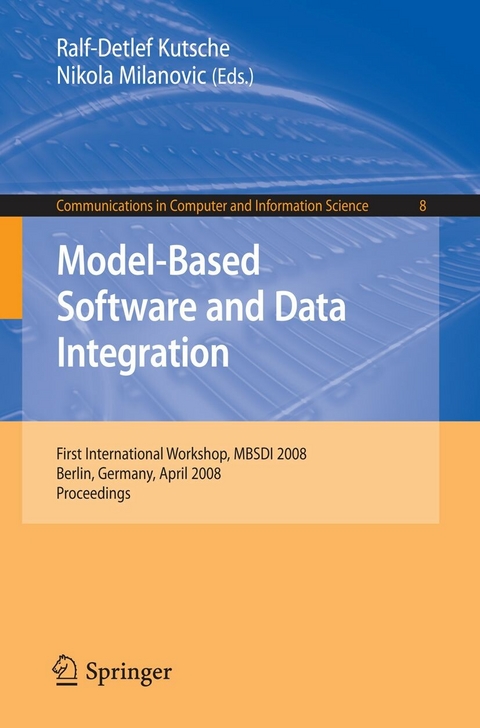
Model-Based Software and Data Integration (eBook)
X, 135 Seiten
Springer-Verlag
9783540789994 (ISBN)
This book includes selected papers of the First International Workshop on Model-Based Software and Data Integration 2008, held in Berlin, Germany, in April 2008 as a part of the Berlin Software Integration Week 2008. The 9 revised full papers presented together with 3 invited lectures were carefully reviewed and selected from numerous submissions. The papers are organized in topical sections on data integration, software architectures, services and migration, as well as on model-based and semantic approaches.
Preface 5
Table of Contents 9
The Art of Creating Models and Models Integration 11
Introduction 11
Historical Perspective 12
Problems and Challenges 13
Example – Models for Failure Prediction 14
Conclusions 16
References 16
Modeling Services – An Inter-disciplinary Perspective 18
Introduction 18
Definition of Services 18
Service Modeling 19
Example: Cloud Computing Services 20
Summary and Outlook 20
Data Mashups for Situational Applications 22
Introduction 22
Damia Architecture 23
The Damia Web Application 23
The Damia Execution Engine 24
Damia Operators and Data Model 25
Damia Metadata Services 25
Important Features of a Mashup System 25
Conclusions 27
References 28
Combining Effectiveness and Efficiency for Schema Matching Evaluation 29
Introduction 29
Schema Matching: An Overview 31
Schema Matching Performance 32
Performance Evaluation 32
Combining Effectiveness and Efficiency 34
The Cost-Effectiveness of Schema Matching 35
Experimental Evaluation 36
Evaluated Systems 37
Data Set 37
Experimental Results 37
Discussion 38
Summary and Future Work 39
Model-Driven Development of Complex and Data-Intensive Integration Processes 41
Introduction 41
Related Work 42
Integration Process Modeling 43
Integration Process Generation 45
A-PSM Generation 45
PSM Generation 47
DPD Generation 49
Open Issues and Challenges 50
Summary and Conclusion 50
Example FDBMS DPD 52
Towards a Metrics Suite for Object-Relational Mappings 53
Introduction 53
Basic Strategies for Mapping Inheritance Hierarchies 55
One Class - One Table 55
One Inheritance Tree – One Table 55
One Inheritance Path – One Table 56
Semantics of Mapping Strategies for Individual Inheritance Relationships 56
Measurement Goals 57
Metrics for Inheritance Mappings 59
Table Accesses for Type Identification (TATI) 59
Number of Corresponding Tables (NCT) 60
Number of Corresponding Relational Fields (NCRF) 60
Additional Null Values (ANV) 61
Metric Coverage 62
Conclusions and Further Research 63
References 63
View-Based Integration of Process-Driven SOA Models at Various Abstraction Levels 65
Introduction 65
Overview of View-based Modeling Framework (VbMF) 66
View-Based Model Integration 68
Empirical Analysis of Model Integration 69
Control Flow View Mapping 69
Collaboration View Mapping 71
BPEL-extension Collaboration View Mapping 72
Discussion 72
Related Work 73
Conclusion 75
Model-Driven Development of Composite Applications 77
Composite Applications by Example 77
Model-Driven Approaches for Service Composition 79
Model-Driven Development and (Web) Services 79
Static Modelling Approaches 80
Dynamic Modelling Approaches 81
Data-Centric Modelling Approaches 83
WSCAM: Web Service Component Architecture Modelling 84
Conclusion 87
References 87
Towards Identification of Migration Increments to Enable Smooth Migration 89
Introduction 89
Smooth Migration 91
Integration into the Target Architecture 91
Migration of the Implementation 92
Identification of Migration Increments 94
Dependencies 95
Analyses 96
Related Work 98
Conclusions and Future Work 98
Service-Based Architecture for Ontology-Driven Information Integration in Dynamic Logistics 101
Introduction 101
Model-Driven Approach to Information Systems Building 102
Ontological Model for Information Integration 103
Technological Framework 104
Web-Services for Information Acquisition 105
Conclusion 111
References 111
State of the Art on Topic Map Building Approaches 112
Introduction 112
Topic Maps 113
Main Functionalities Involved in the Topic Maps Construction Process 113
Topic Maps Building Approaches 114
Mapping from RDF to Topic Maps 114
Automatic Generation of Topic Maps from XML Documents 115
Co-construction of Topic Maps with Different Users: Collaborative Approaches 116
Topic Maps Learning 118
Merging Topic Maps 119
Discussion and Conclusion 120
References 121
Construction of Consistent Models in Model-Driven Software Development 123
Introduction 123
A Development Scenario in Model-Driven Software Development 124
Modeling Patterns 126
The General Approach 127
Model and Code 127
Syntax Representation 127
Micro Development 128
Macro Development 130
Alternative Format for Model Development Steps 131
Related Work 131
Conclusion 132
Author Index 135
| Erscheint lt. Verlag | 1.1.2008 |
|---|---|
| Sprache | englisch |
| Themenwelt | Mathematik / Informatik ► Informatik ► Datenbanken |
| Mathematik / Informatik ► Informatik ► Netzwerke | |
| Informatik ► Theorie / Studium ► Künstliche Intelligenz / Robotik | |
| Mathematik / Informatik ► Informatik ► Web / Internet | |
| Schlagworte | Architecture • Business Service • cost-effectiveness • Efficiency • Enterprise Application Integration • federated DBMS • integration processes • knowledge extraction • Knowledge Representation • metrics • model-driven development • Modeling • Object-Oriented Software • Ontology • Schema Matching • Service Oriented Architecture (SOA) • SOA |
| ISBN-13 | 9783540789994 / 9783540789994 |
| Informationen gemäß Produktsicherheitsverordnung (GPSR) | |
| Haben Sie eine Frage zum Produkt? |
 PDF (Wasserzeichen)
Größe: 4,6 MB
DRM: Digitales Wasserzeichen
Dieses eBook enthält ein digitales Wasserzeichen und ist damit für Sie personalisiert. Bei einer missbräuchlichen Weitergabe des eBooks an Dritte ist eine Rückverfolgung an die Quelle möglich.
Dateiformat: PDF (Portable Document Format)
Mit einem festen Seitenlayout eignet sich die PDF besonders für Fachbücher mit Spalten, Tabellen und Abbildungen. Eine PDF kann auf fast allen Geräten angezeigt werden, ist aber für kleine Displays (Smartphone, eReader) nur eingeschränkt geeignet.
Systemvoraussetzungen:
PC/Mac: Mit einem PC oder Mac können Sie dieses eBook lesen. Sie benötigen dafür einen PDF-Viewer - z.B. den Adobe Reader oder Adobe Digital Editions.
eReader: Dieses eBook kann mit (fast) allen eBook-Readern gelesen werden. Mit dem amazon-Kindle ist es aber nicht kompatibel.
Smartphone/Tablet: Egal ob Apple oder Android, dieses eBook können Sie lesen. Sie benötigen dafür einen PDF-Viewer - z.B. die kostenlose Adobe Digital Editions-App.
Zusätzliches Feature: Online Lesen
Dieses eBook können Sie zusätzlich zum Download auch online im Webbrowser lesen.
Buying eBooks from abroad
For tax law reasons we can sell eBooks just within Germany and Switzerland. Regrettably we cannot fulfill eBook-orders from other countries.
aus dem Bereich