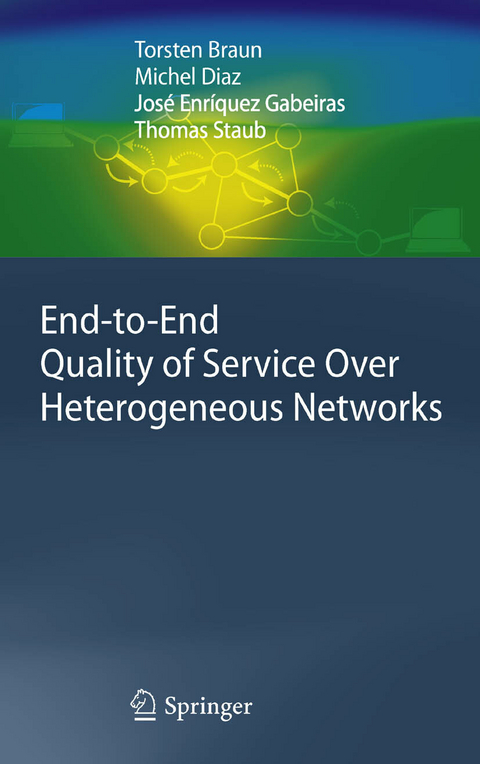
End-to-End Quality of Service Over Heterogeneous Networks (eBook)
XX, 266 Seiten
Springer Berlin (Verlag)
978-3-540-79120-1 (ISBN)
This book, one of the first of its kind, presents mechanisms, protocols, and system architectures needed to attain end-to-end Quality of Service over heterogeneous wired and wireless networks in the Internet.
Preface 5
Acknowledgements 7
Contents 9
Acronyms 15
Motivation and Basics 20
Quality of Service and its Parameters 20
Delay and Delay Variations in End-to-End Packet Delivery 21
Bandwidth and Packet Loss Ratio 22
Applications' QoS Requirements 23
Types of Network Applications 24
Elastic and Inelastic Applications 24
Interactive and Noninteractive Applications 24
QoS Requirements of Applications 25
Audio Applications 25
Video Applications 26
Data Traffic 27
Packet Scheduling in Network Elements 27
(Non)Work-Conserving Scheduling Disciplines 27
Fairness 28
Requirements for Scheduling Disciplines 28
Scheduling Disciplines 29
Packet Dropping 30
Quality-of-Service Architectures 31
Integrated Services 31
Differentiated Services 33
End-to-End QoS Mechanisms 35
Endpoint Admission Control 35
Statistical Multiplexing and Egress Admission Control 36
Other End-to-End Approaches 36
Implementation and Performance of QoS-aware Applications 36
Prerequisites for Successful QoS Applications 36
Media Scaling 37
Transparent Scaling 37
Nontransparent Scaling 37
Applications' Performance Gain Due to QoS 38
Summary 39
Structure of the Book 40
QoS Measurements in IP-based Networks 42
Introduction 42
Measurement Metrics 43
Network Level 43
Connectivity 44
One-Way Delay 44
One-Way Packet Loss 45
IP Delay Variation 46
Bulk Transport Capacity 46
Call level 47
Call Blocking 47
Call Set-Up Latency 47
Call Release Latency 48
User Level 48
Subjective Assessment Method 51
Objective Assessment Method 51
Measurement Techniques 52
Previous Considerations 52
Synchronisation 53
Data Collection, Storage and Analysis 54
Base Techniques 55
Statistical Tools 55
Aggregation 56
Sampling 57
Active Measurements 58
Network Characteristics 58
Bandwidth Estimation 59
Topology Discovery 61
Platforms and Applications 62
Passive Measurements 63
Network Characteristics 64
Traffic Collection 65
Platforms and Applications 66
Conclusions 67
Traffic Engineering 68
Introduction 68
A Motivating Example 69
Multi-Protocol Label Switching Architecture 71
The Forwarding Component 72
The Control Component 73
MPLS Optimisation 75
Penultimate Hop Popping 75
Label Stacking 76
MPLS-Based Traffic Engineering 77
Constraint-Based Routing 77
Explicit Route Signalling 80
Traffic Engineering Practices 83
LSP Optimisation 83
Fast Rerouting 84
Traffic Engineering and Quality of Service 85
QoS Support over MPLS 86
Traffic Engineering Extensions for DiffServ 89
Conclusions 92
Signalling 94
Introduction 94
Session Initiation Protocol (SIP) 95
SIP and Its Value Propositions 95
Protocol Components 96
User Agent Client (UAC) 96
User Agent Server (UAS) 96
Proxy Server 97
Registrar 98
Forking Proxies 98
Redirect Server 98
SIP Messages 99
Start Line 99
Header Field 99
Message Body 100
SIP Methods 100
Session Description 101
Establishment of an SIP Session 102
Message Flow for Session Establishment 103
Home Phone 104
Personal Mobility 104
SIP's Extension 105
The Next Steps In Signalling (NSIS) 105
Background and Main Characteristics 105
Signalling Entities (SE) 106
Distributed Signalling Architecture 107
Centralised Signalling Architecture 108
Overview of Signalling Scenarios and Protocol Structure 108
Layer Model for the Protocol Suite 108
Signalling Application Properties 109
The NSIS Layer Transport Protocol 110
GIST Description 110
Signalling for Quality of Service 113
Protocol Message Semantics 113
Route Changes and QoS Reservations 114
Resource Management Interactions 115
NAT & Firewall NSLP
Common Open Policy Service (COPS) 117
COPS Overview 117
Basic Model 118
COPS Protocol 119
COPS Header 119
COPS-Specific Object Formats 120
COPS Messages 121
Common Operation 125
Outsourcing Operation 125
Configuration Operations 125
Security 126
Using Examples: COPS for RSVP 126
Unicast Flow Example 126
Conclusions 128
Enhanced Transport Protocols 130
Introduction 130
State of the Art of Transport Protocols 131
TCP and UDP 132
TCP Evolution 132
TCP Tahoe 133
TCP Reno 133
TCP Vegas 133
TCP New Reno 134
TCP Variants for High-Throughput and Wireless Networks 134
SCTP 135
DCCP 136
Discussion 136
Transport Mechanisms 137
Overview 137
Congestion-Control Mechanisms 138
Window-Based Congestion Control 138
Rate-Based Congestion Control 139
Reliability Mechanisms 139
Automatic Repeat Request 139
Flow Control 140
Discussion 141
Enhanced Transport Protocol Mechanisms 141
TFRC and gTFRC, a QoS-Aware Congestion Control 141
Application-Aware Transport Mechanisms 142
Application Profile-Aware Congestion Control 142
QoS-Aware Error Control Mechanism 145
Partially Ordered Service (PO) 146
Partially Reliable Service (PR) 147
Partially Reliable, Differentiated and Time-Constrained ARQ (D-PR & TD-PR)
Conclusions 148
The EuQoS System 150
Introduction 151
Architecture 152
Goals and Requirements 152
Functional Blocks and their Main Functions 153
Control Plane Elements: RM and RA 156
Resource Manager Architecture 156
Resource Allocator Architecture 157
Provisioning, Invocation, and Operation, Administration and Management 158
Provisioning Process 159
Resource Provisioning 159
Loose Model 159
Hard Model 160
EQ-BGP: Enhanced QoS Border Gateway Protocol 162
Invocation Process 164
Invocation in the Service Plane 164
Invocation in the Control Plane 165
SomeTimes Per Flow Model 167
Operation, Administration and Management 168
End-to-End Classes of Service in Heterogeneous Networks 168
End-to-end Classes of Service in EuQoS 169
QoS Mechanisms and Algorithms for Specification of e2e Classes of Service 172
Example: Designing CoS with predefined maximum values of parameters IPTD, IPDV and IPLR. The CoS handles the traffic streams with declared PRs. 173
Implementation of e2e Classes of Service in Underlying Technologies 174
Interdomain Links 174
xDSL 175
LAN/Ethernet 175
WiFi 176
UMTS 177
Usage of built-in CAC from UMTS 177
Measurement-Based OpenGGSN CAC 177
MPLS (DiffServ-TE) 178
Satellite 179
Scheme for Assuring QoS 179
EuQoS Enhanced Transport Protocol 180
Introduction 180
Enhanced Transport Protocol Services for EuQoS 180
Services for Streaming/Nonstreaming Applications 181
Real-Time Classes of Service (Telephony, RT Interactive) 181
Non-Real Time Classes of Service (MM Streaming, HTD) 182
Standard Class of Service (Best Effort) 182
Multicast 182
Application Layer Multicast 184
Application Layer Multicast in the EuQoS System 185
Multicast Middleware 187
Introducing QoS to Multicast Middleware 189
Telemedicine Application 191
Telemedicine-the Case for Application-Driven QoS 191
Overview of Medigraf 192
Medigraf Adaptation to EuQoS 193
Conclusions 195
Summary and Outlook 198
Appendix A: Implementing Protocols on Network Simulators 200
Main Simulation Terms and Concepts 200
Simulation Process 201
Simulation Types 201
Network Simulation 202
Parallel/Distributed versus Serial Execution of Simulations 202
Packet-Level, Fluid-Based and Hybrid Model Simulation 203
Simulation Speedup 204
Network Simulation in Research 204
Simulation for Education Purposes 205
Network Simulators 206
GloMoSim and Qualnet 206
JiST/SWANS 206
Scalable Simulation Framework (SSF) and SSFNet 207
OMNeT++ and OMNEST 207
The Network Simulator ns-2 207
The Language Concept 208
Hierarchical Structure 208
First Steps-Simulation Script Template 209
Nodes, Links and Traffic 210
Wireless Networks 212
A Wireless Simulation Scenario 213
Implementing Protocols with ns-2 215
Description of QoS-Aware Link State Routing (QLS) 215
Formal Description of QLS 216
Preparations 216
Implementing the New Packet Types for QLS 218
The Routing Agent-Header File 220
The Routing Agent-Source File 222
Integration of the New Protocol in ns-2 228
Advice for Running ns-2 Simulations 233
Analysing Methods 234
Appendix B: Network Emulation Focusing on QoS-Oriented Satellite Communication 236
Network Emulation Basics 236
Introduction to Network Emulation 236
What is Network Emulation? 238
System Emulation and Virtual Machines 238
Network Emulation 240
Why Use Network Emulation? 241
Network Emulation at Research and Design Stage 241
Network Emulation at Conception and Development Stage 241
Network Emulation at Testing and Performance Evaluation Stage 242
Network Emulation When Demonstrating Software 242
Requirements for Emulation Systems 242
Functional Requirements 243
Requirements on Packet Impairments 244
Network Emulation System Approaches 245
Traffic Shapers 245
Centralised Approach 245
Distributed Approach 246
Emulation Models 248
Emulating QoS Parameters 248
Virtual Nodes Approach 249
Trace-Based Approach 250
Simulation-Based Approach 250
Active Emulation Approach 252
Implementation 253
User Space Implementation 253
Kernel Implementation 254
Hardware Implementation 255
Case Study: Emulation of QoS-oriented Satellite Communication 255
Introduction 255
DVB Satellite Communications 255
QoS Support for Satellite Network Systems 257
Emulation of a DVB-S, DVB-RCS Satellite System 258
Integration of an Emulated Satellite Link and the EuQoS System 259
Active Emulation of DVB-RCS Access Scheme 261
Impairment Framework and Emulation Control 261
Emulation Details of the Satellite System in EuQoS Architecture 263
Emulation of the Satellite Forward Link 263
Emulation of the Satellite Return Link 264
Conclusions 266
References 268
Index 280
| Erscheint lt. Verlag | 2.8.2008 |
|---|---|
| Zusatzinfo | XX, 266 p. 85 illus. |
| Verlagsort | Berlin |
| Sprache | englisch |
| Themenwelt | Mathematik / Informatik ► Informatik ► Netzwerke |
| Schlagworte | Emulation • Internet • Measurement • network simulation • Quality of Service • Quality-of-Service • Quality of Service (QoS) • Signalling • Traffic Engineering • Transport Protocols |
| ISBN-10 | 3-540-79120-5 / 3540791205 |
| ISBN-13 | 978-3-540-79120-1 / 9783540791201 |
| Informationen gemäß Produktsicherheitsverordnung (GPSR) | |
| Haben Sie eine Frage zum Produkt? |
 PDF (Wasserzeichen)
DRM: Digitales Wasserzeichen
Dieses eBook enthält ein digitales Wasserzeichen und ist damit für Sie personalisiert. Bei einer missbräuchlichen Weitergabe des eBooks an Dritte ist eine Rückverfolgung an die Quelle möglich.
Dateiformat: PDF (Portable Document Format)
Mit einem festen Seitenlayout eignet sich die PDF besonders für Fachbücher mit Spalten, Tabellen und Abbildungen. Eine PDF kann auf fast allen Geräten angezeigt werden, ist aber für kleine Displays (Smartphone, eReader) nur eingeschränkt geeignet.
Systemvoraussetzungen:
PC/Mac: Mit einem PC oder Mac können Sie dieses eBook lesen. Sie benötigen dafür einen PDF-Viewer - z.B. den Adobe Reader oder Adobe Digital Editions.
eReader: Dieses eBook kann mit (fast) allen eBook-Readern gelesen werden. Mit dem amazon-Kindle ist es aber nicht kompatibel.
Smartphone/Tablet: Egal ob Apple oder Android, dieses eBook können Sie lesen. Sie benötigen dafür einen PDF-Viewer - z.B. die kostenlose Adobe Digital Editions-App.
Buying eBooks from abroad
For tax law reasons we can sell eBooks just within Germany and Switzerland. Regrettably we cannot fulfill eBook-orders from other countries.
aus dem Bereich