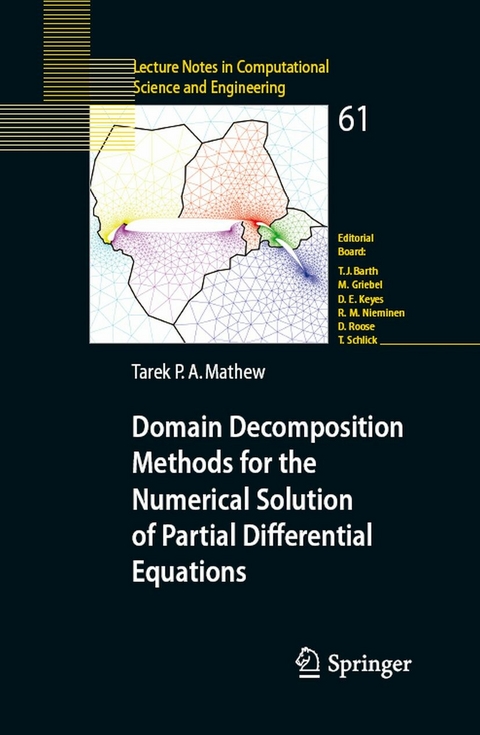
Domain Decomposition Methods for the Numerical Solution of Partial Differential Equations (eBook)
XIV, 770 Seiten
Springer Berlin (Verlag)
9783540772095 (ISBN)
Domain decomposition methods are divide and conquer computational methods for the parallel solution of partial differential equations of elliptic or parabolic type. The methodology includes iterative algorithms, and techniques for non-matching grid discretizations and heterogeneous approximations. This book serves as a matrix oriented introduction to domain decomposition methodology. A wide range of topics are discussed include hybrid formulations, Schwarz, and many more.
Preface 6
Contents 10
1 Decomposition Frameworks 13
1.1 Hybrid Formulations 14
1.2 Schwarz Framework 21
1.3 Steklov-Poincar´e Framework 28
1.4 Lagrange Multiplier Framework 39
1.5 Least Squares-Control Framework 48
2 Schwarz Iterative Algorithms 59
2.1 Background 60
2.2 Projection Formulation of Schwarz Algorithms 68
2.3 Matrix Form of Schwarz Subspace Algorithms 78
2.4 Implementational Issues 84
2.5 Theoretical Results 89
3 Schur Complement and Iterative Substructuring Algorithms 118
3.1 Background 119
3.2 Schur Complement System 121
3.3 FFT Based Direct Solvers 136
3.4 Two Subdomain Preconditioners 151
3.5 Preconditioners in Two Dimensions 166
3.6 Preconditioners in Three Dimensions 173
3.7 Neumann-Neumann and Balancing Preconditioners 186
3.8 Implementational Issues 196
3.9 Theoretical Results 203
4 Lagrange Multiplier Based Substructuring: FETI Method 242
4.1 Constrained Minimization Formulation 243
4.2 Lagrange Multiplier Formulation 250
4.3 Projected Gradient Algorithm 252
4.4 FETI-DP and BDDC Methods 261
5 Computational Issues and Parallelization 274
5.1 Algorithms for Automated Partitioning of Domains 275
5.2 Parallelizability of Domain Decomposition Solvers 291
6 Least Squares-Control Theory: Iterative Algorithms 306
6.1 Two Overlapping Subdomains 307
6.2 Two Non-Overlapping Subdomains 314
6.3 Extensions to Multiple Subdomains 321
7 Multilevel and Local Grid Re.nement Methods 324
7.1 Multilevel Iterative Algorithms 325
7.2 Iterative Algorithms for Locally Re.ned Grids 332
8 Non-Self Adjoint Elliptic Equations: Iterative Methods 343
8.1 Background 344
8.2 Di.usion Dominated Case 350
8.3 Advection Dominated Case 358
8.4 Time Stepping Applications 374
8.5 Theoretical Results 376
9 Parabolic Equations 387
9.1 Background 388
9.2 Iterative Algorithms 391
9.3 Non-Iterative Algorithms 394
9.4 Parareal-Multiple Shooting Method 411
9.5 Theoretical Results 418
10 Saddle Point Problems 427
10.1 Properties of Saddle Point Systems 428
10.2 Algorithms Based on Duality 436
10.3 Penalty and Regularization Methods 444
10.4 Projection Methods 447
10.5 Krylov Space and Block Matrix Methods 455
10.6 Applications to the Stokes and Navier-Stokes Equations 466
10.7 Applications to Mixed Formulations of Elliptic Equations 484
10.8 Applications to Optimal Control Problems 499
11 Non-Matching Grid Discretizations 524
11.1 Multi-Subdomain Hybrid Formulations 525
11.2 Mortar Element Discretization: Saddle Point Approach 532
11.3 Mortar Element Discretization: Nonconforming Approach 560
11.4 Schwarz Discretizations on Overlapping Grids 564
11.5 Alternative Nonmatching Grid Discretization Methods 568
11.6 Applications to Parabolic Equations 573
12 Heterogeneous Domain Decomposition Methods 583
12.1 Steklov-Poincar´e Heterogeneous Model 584
12.2 Schwarz Heterogeneous Models 593
12.3 Least Squares-Control Heterogeneous Models 597
12.4 .-Formulation 602
12.5 Applications to Parabolic Equations 611
13 Fictitious Domain and Domain Imbedding Methods 615
13.1 Background 616
13.2 Preconditioners for Neumann Problems 618
13.3 Preconditioners for Dirichlet Problems 619
13.4 Lagrange Multiplier and Least Squares-Control Solvers 622
14 Variational Inequalities and Obstacle Problems 628
14.1 Background 629
14.2 Projected Gradient and Relaxation Algorithms 635
14.3 Schwarz Algorithms for Variational Inequalities 640
14.4 Monotone Convergence of Schwarz Algorithms 643
14.5 Applications to Parabolic Variational Inequalities 651
15 Maximum Norm Theory 654
15.1 Maximum Principles and Comparison Theorems 655
15.2 Well Posedness of the Schwarz Hybrid Formulation 666
15.3 Convergence of Schwarz Iterative Algorithms 668
15.4 Analysis of Schwarz Nonmatching Grid Discretizations 675
15.5 Analysis of Schwarz Heterogeneous Approximations 681
15.6 Applications to Parabolic Equations 684
16 Eigenvalue Problems 686
16.1 Background 687
16.2 Gradient and Preconditioned Gradient Methods 689
16.3 Schur Complement Methods 690
16.4 Schwarz Subspace Methods 691
16.5 Modal Synthesis Method 693
17 Optimization Problems 695
17.1 Traditional Algorithms 696
17.2 Schwarz Minimization Algorithms 703
18 Helmholtz Scattering Problem 705
18.1 Background 706
18.2 Non-Overlapping and Overlapping Subdomain Methods 707
18.3 Fictitious Domain and Control Formulations 710
18.4 Hilbert Uniqueness Method for Standing Waves 711
References 716
Index 766
| Erscheint lt. Verlag | 25.6.2008 |
|---|---|
| Reihe/Serie | Lecture Notes in Computational Science and Engineering | Lecture Notes in Computational Science and Engineering |
| Zusatzinfo | XIV, 770 p. 40 illus. |
| Verlagsort | Berlin |
| Sprache | englisch |
| Themenwelt | Informatik ► Theorie / Studium ► Künstliche Intelligenz / Robotik |
| Mathematik / Informatik ► Mathematik | |
| Technik | |
| Schlagworte | algorithm • algorithms • differential equation • finite elements • linear algebra • Numerical analysis • Optimization • Parallelization • partial differential equation • Partial differential equations • Scientific Computing |
| ISBN-13 | 9783540772095 / 9783540772095 |
| Informationen gemäß Produktsicherheitsverordnung (GPSR) | |
| Haben Sie eine Frage zum Produkt? |
 PDF (Wasserzeichen)
DRM: Digitales Wasserzeichen
Dieses eBook enthält ein digitales Wasserzeichen und ist damit für Sie personalisiert. Bei einer missbräuchlichen Weitergabe des eBooks an Dritte ist eine Rückverfolgung an die Quelle möglich.
Dateiformat: PDF (Portable Document Format)
Mit einem festen Seitenlayout eignet sich die PDF besonders für Fachbücher mit Spalten, Tabellen und Abbildungen. Eine PDF kann auf fast allen Geräten angezeigt werden, ist aber für kleine Displays (Smartphone, eReader) nur eingeschränkt geeignet.
Systemvoraussetzungen:
PC/Mac: Mit einem PC oder Mac können Sie dieses eBook lesen. Sie benötigen dafür einen PDF-Viewer - z.B. den Adobe Reader oder Adobe Digital Editions.
eReader: Dieses eBook kann mit (fast) allen eBook-Readern gelesen werden. Mit dem amazon-Kindle ist es aber nicht kompatibel.
Smartphone/Tablet: Egal ob Apple oder Android, dieses eBook können Sie lesen. Sie benötigen dafür einen PDF-Viewer - z.B. die kostenlose Adobe Digital Editions-App.
Buying eBooks from abroad
For tax law reasons we can sell eBooks just within Germany and Switzerland. Regrettably we cannot fulfill eBook-orders from other countries.
aus dem Bereich