


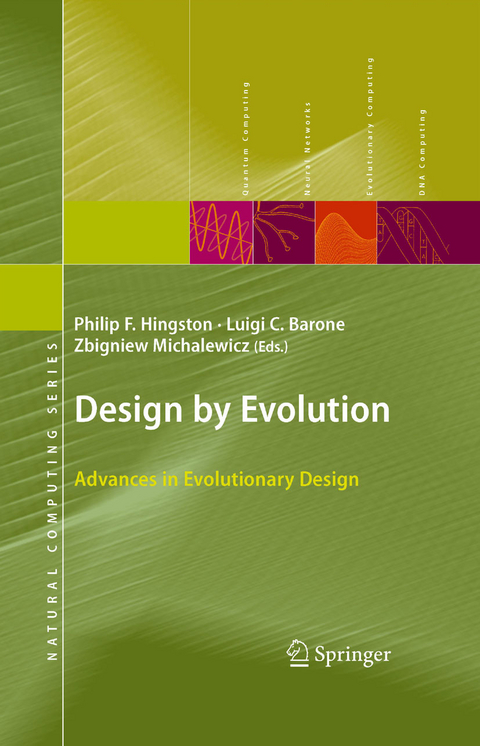
Design by Evolution (eBook)
XII, 352 Seiten
Springer Berlin (Verlag)
9783540741114 (ISBN)
Evolution is Nature's design process. The natural world is full of wonderful examples of its successes, from engineering design feats such as powered flight, to the design of complex optical systems such as the mammalian eye, to the merely stunningly beautiful designs of orchids or birds of paradise. With increasing computational power, we are now able to simulate this process with greater fidelity, combining complex simulations with high-performance evolutionary algorithms to tackle problems that used to be impractical.
This book showcases the state of the art in evolutionary algorithms for design. The chapters are organized by experts in the following fields: evolutionary design and 'intelligent design' in biology, art, computational embryogeny, and engineering. The book will be of interest to researchers, practitioners and graduate students in natural computing, engineering design, biology and the creative arts.
Foreword 5
References 7
Preface 8
References 9
Contents 10
Part I Biology 12
Evolutionary Design in Biology 13
References 15
1 Intelligent Design and Evolutionary Computation 16
1.1 Introduction 16
1.2 Historical Background 18
1.3 What Is Intelligent Design? 22
1.4 Irreducible Complexity 22
1.5 Speci.ed Complexity 29
1.6 ID and Evolutionary Computation 35
1.7 Conclusion 36
References 37
2 Inference of Genetic Networks Using an Evolutionary Algorithm 40
2.1 Introduction 40
2.2 S-system Model 42
2.3 Genetic Network Inference Problem 43
2.4 Problem Decomposition Approach 45
2.5 Cooperative Coevolutionary Approach 47
2.6 Experiment on an Arti.cial Genetic Network 50
2.7 Inference of an Actual Genetic Network 55
2.8 Conclusion 57
Acknowledgments 57
References 58
3 Synthetic Biology: Life, Jim, but Not As We Know It 61
3.1 Introduction 61
3.2 The Basics 62
3.3 Networks and Motifs 64
3.4 Model Biological Circuits 67
3.5 Evolutionary Approaches to Synthetic Biology 69
3.6 Conclusions 71
References 73
4 Dancing with Swarms: Utilizing Swarm Intelligence to Build, Investigate, and Control Complex Systems 77
4.1 The Emergence of Complexity 78
4.2 Emergent and Agent-Based Computing 78
4.3 Chapter Overview: An Emergent Computing Tour 79
4.4 Inside a Cell: Gene Regulation 80
4.5 Bacteria and Cell Populations: Chemotaxis 83
4.6 The Swarming Body: Cellular Orchestration 87
4.7 Colony Swarms: Army Ant Raids 89
4.8 Herd Behaviors: Predators and Prey 91
4.9 Human Crowds: Sales Table Rush 94
4.10 SwarmArt.com: The Art of Swarm Intelligence 94
4.11 Conclusion and Outlook 97
4.12 ESD Resources and Examples on the Web 98
Acknowledgments 98
References 99
Part II Art 103
Evolutionary Design in Art 104
5 Natural Processes and Arti.cial Procedures 107
5.1 Introduction 107
5.2 A Brief Review 107
5.3 Carrots and Tubers 109
5.4 Breed 111
5.5 E-volver 115
5.6 Directed Versus Open 122
5.7 Generative Art and Present Day Experience of Nature 122
Acknowledgments 125
References 125
6 Evolutionary Exploration of Complex Fractals 127
6.1 Introduction 127
6.2 Complex Arithmetic and Fractals 131
6.3 Fitness Function Design 133
6.4 Speci.cation of Experiments 135
6.5 Results and Discussion 140
6.6 Next Steps 144
Acknowledgments 148
References 148
7 Evolving the Mandelbrot Set to Imitate Figurative Art 150
7.1 Introduction 150
7.2 Background 153
7.3 Technique 155
7.4 Experiments 165
7.5 Conclusion 170
References 171
8 Evolutionary L-systems 173
8.1 Introduction 173
8.2 L-systems 176
( A( 181
) 181
( B( 181
) 181
8.3 Turtle Interpretation 183
8.4 Mutation of L-system Rules 189
8.5 The Interactive Process 194
8.6 Results 196
References 199
Part III Embryogeny 201
Evolutionary Design in Embryogeny 202
References 205
9 Embryogenesis of Arti.cial Landscapes 206
9.1 Introduction 206
9.2 The L-system Representation 210
9.3 Experimental Design 211
9.4 Results 213
9.5 Discussion and Conclusions 216
9.6 Next Steps 220
Acknowledgments 222
References 223
10 On Form and Function: The Evolution of Developmental Control 225
10.1 Introduction 225
10.2 The Evolutionary Developmental System (EDS) 227
10.3 Experiments 230
10.4 Results and Analysis 231
10.5 Discussion 240
Acknowledgments 241
References 242
11 Modularity in a Computational Model of Embryogeny 244
11.1 Introduction 244
11.2 Why a Computational Model of Embryogeny? 245
11.3 A New Computational Model of Embryogeny 247
11.4 The Pattern Formation Problem 255
11.5 Modularity in a Computational Model of Embryogeny 256
11.6 Conclusion 261
References 262
Part IV Engineering 265
Evolutionary Design in Engineering 266
12 Engineering Optimization Using Evolutionary Algorithms: A Case Study on Hydro- thermal Power Scheduling 271
12.1 Introduction 271
12.2 Hydro-thermal Power Scheduling Problem 272
12.3 Solution Procedure for the Stationary Problem Using an EA 274
12.4 Simulation Results on Stationary Hydro-thermal Power Scheduling 276
12.5 Dynamic Power Scheduling Problem 282
12.6 Decision-making in a Dynamic Multi-objective Optimization 289
12.7 Conclusions 291
Acknowledgments 292
References 292
Appendix A: Parameters for Hydro-thermal Power Dispatch Problem 293
13 Multimodal Function Optimization of Varied- Line- Spacing Holographic Grating 295
13.1 Introduction 295
13.2 Niching Techniques 296
13.3 Restricted Evolution Evolution Strategy 301
13.4 Numerical Experiments 304
13.5 Practical Engineering Optimization 306
13.6 Conclusion 312
References 313
14 GPBG: A Framework for Evolutionary Design of Multi- domain Engineering Systems Using Genetic Programming and Bond Graphs 316
14.1 Introduction 316
14.2 Related Work 318
14.3 The GPBG Framework for Evolutionary Design 318
14.4 Case Studies of Evolutionary Synthesis Using GPBG 323
14.5 Conclusions and Future Work 340
References 340
Index 343
| Erscheint lt. Verlag | 30.9.2008 |
|---|---|
| Reihe/Serie | Natural Computing Series | Natural Computing Series |
| Zusatzinfo | XII, 352 p. 146 illus. |
| Verlagsort | Berlin |
| Sprache | englisch |
| Themenwelt | Mathematik / Informatik ► Informatik ► Programmiersprachen / -werkzeuge |
| Mathematik / Informatik ► Mathematik | |
| Naturwissenschaften ► Biologie | |
| Technik | |
| Schlagworte | Algorithm analysis and problem complexity • algorithms • Artificial Life • Complex System • Complex Systems • Computational embryogeny • Creative arts • Engineering design • Evolution • evolutionary algorithm • evolutionary biology • evolutionary computation • Evolutionary Design • genetic programming • Intelligence • Intelligent Design • Modularity • Natural Computing • Optimization • programming • Simulation • Swarm intelligence |
| ISBN-13 | 9783540741114 / 9783540741114 |
| Informationen gemäß Produktsicherheitsverordnung (GPSR) | |
| Haben Sie eine Frage zum Produkt? |
 PDF (Wasserzeichen)
DRM: Digitales Wasserzeichen
Dieses eBook enthält ein digitales Wasserzeichen und ist damit für Sie personalisiert. Bei einer missbräuchlichen Weitergabe des eBooks an Dritte ist eine Rückverfolgung an die Quelle möglich.
Dateiformat: PDF (Portable Document Format)
Mit einem festen Seitenlayout eignet sich die PDF besonders für Fachbücher mit Spalten, Tabellen und Abbildungen. Eine PDF kann auf fast allen Geräten angezeigt werden, ist aber für kleine Displays (Smartphone, eReader) nur eingeschränkt geeignet.
Systemvoraussetzungen:
PC/Mac: Mit einem PC oder Mac können Sie dieses eBook lesen. Sie benötigen dafür einen PDF-Viewer - z.B. den Adobe Reader oder Adobe Digital Editions.
eReader: Dieses eBook kann mit (fast) allen eBook-Readern gelesen werden. Mit dem amazon-Kindle ist es aber nicht kompatibel.
Smartphone/Tablet: Egal ob Apple oder Android, dieses eBook können Sie lesen. Sie benötigen dafür einen PDF-Viewer - z.B. die kostenlose Adobe Digital Editions-App.
Buying eBooks from abroad
For tax law reasons we can sell eBooks just within Germany and Switzerland. Regrettably we cannot fulfill eBook-orders from other countries.
aus dem Bereich


