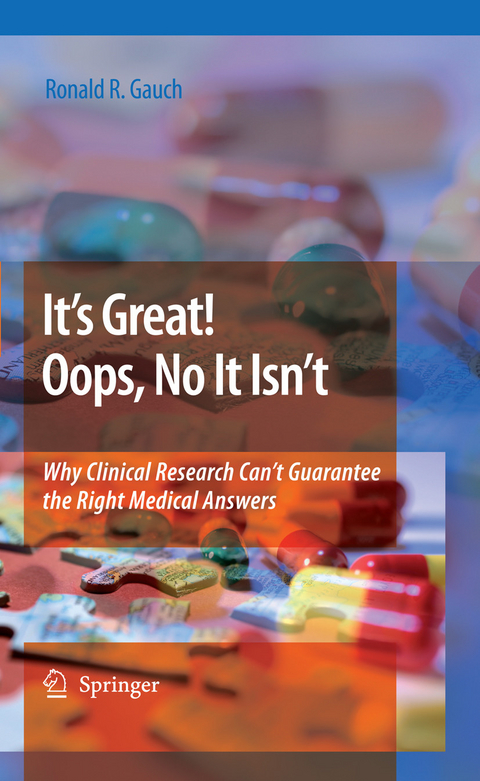
It’s Great! Oops, No It Isn’t (eBook)
298 Seiten
Springer-Verlag
9781402089077 (ISBN)
Preface 6
Contents 8
Medical Research Explained 13
Medical Research – Searching for Answers 14
A Paradox 16
Challenges Facing Medical Research 16
Research Methods 18
Medical Surveys 19
Smoking and Lung Cancer 20
The Case-Control Method – Looking Backwards 25
The Process 26
Obstacles and Reservations 26
The Advantage of Speed and Flexibility 30
Enhancing the Case-Control Study 31
The Cohort Study – Watchful Waiting 33
Adding Up the Advantages 35
Disadvantages 35
Framingham Heart Study 37
Nurses’ Health Study 39
The Clinical Trial – The Gold Standard 41
The Scientific Method 42
Clinical Trial Features 43
The First Clinical Trial 44
Comparing the Methods – Qualitative Differences 47
Case-Control Study 47
Cohort Study 48
Clinical Trial 48
Comparing the Methods 49
Qualitative Research 51
Understanding the Clinical Trial 54
The Protocol – The Guiding Light 55
Introduction 56
Selecting Subjects 56
Defining the Disease 56
Defining the Experimental Treatment 57
Identifying the Control Treatment 59
Measurements and Observations 60
Statistical Analysis Plans 60
Other Elements 60
Trial Execution 61
The Control Group – Leveling the Playing Field 64
Placebo Controls 65
Standard Drug Controls 67
Placebo and Standard Drug 68
Historical Controls 69
Untreated Subjects as Controls 70
Measurements – They’re Never Exact 72
Objective Versus Subjective Measurements 74
Timing 75
Surrogate Measures 76
Composite Measurements 77
Bias Control – A Closer Look at Blinding and Randomization 79
Blinding 80
History 81
Randomization 82
Utility – Are Clinical Trial Results Useful? 87
Volunteers 88
Recruiting Subjects 89
Trial Design 91
Trial Setting 93
Research Discrimination – Inadequately Tested Populations 95
Gender 96
Elderly 97
Children 99
Minorities 100
National Differences 101
Reforming the System 102
Seven Deadly Flaws – The Clinical Trials’ Achilles’ Heel 104
The Unknown Population 106
The Imperfect Sample 108
Unequal Treatment Groups 109
Uncontrolled Experimental Setting 110
Breakdown of Blinding 111
Impractical Result 111
Insufficient Sample Size 112
Tools of the Trade 114
Statistics – Was the Finding Significant? 115
Probability 116
The Null Hypothesis 119
The Type 1 and 2 Errors 120
Sample Size 121
Clinical Relevance 123
The Confidence Interval 124
Analysis Issues – A Lot of Choices 128
Choosing the Statistical Test 129
Multiple Testing 133
Statistics and Medical Research 135
Meta Analysis – An Alternative to Large Trials 137
The Real World 142
Research Results That Clashed – What’s the Right Answer? 143
Mammography – Should I or Shouldn’t I? 144
Dalkon Shield – Destruction of a Company 148
Aspirin – Does It Save Lives? 151
Hormone Replacement Therapy – The Silver Bullet That Misfired 155
Major Clinical Trials 159
The Conflicting Results 163
Age 166
Commencement of Treatment 167
Incompatible HRT Regimens 167
Duration of Treatment 167
Publishing – Getting the Word Out to Doctors 172
Peer Review 173
Statistical Review 175
Publish or Perish 177
Absence of Reports 177
A Clinical Trial Registry 180
Amending the System 182
The Public Forum – Sharing the News with the Public 184
Press Releases 185
Scientific Meetings 185
Media Coverage 187
Advertisements 189
Product Development – Getting Discoveries to the Market 191
Animals Testing 192
Human Testing 194
Medical Innovations – Regulators, Resources and Results 198
The FDA’s Role 199
Clinical Research Resources 203
Private Industry 204
Results – A Downturn in Important New Products 205
The Future 206
Science and Politics – A Troubling Mixture 208
Political Intervention 209
Interest Groups – The Powerful Drug Industry 211
Citizen Advocacy 214
Finding a Balance 217
Research Misconduct – Irresistible Temptation 218
Ethical Concerns 219
Investigational Review Boards 219
Conflicts of Interest 221
Government Agencies 223
Fraud in Clinical Research 225
The Brilliant Academic 225
The Successful Entrepreneur 226
The Phony Doctor 227
Postmarketing Surveillance – An Imperfect System 229
The Postmarketing Surveillance System 231
Analyzing the System 233
A New Approach to Post Marketing Surveillance 235
Cohort Trial 235
Clinical Trial 236
Regulatory Reform – Changes Needed 238
The Vioxx Saga 241
FDA Revitalization 244
Journey’s End – A Call for Action 245
Notes/Bibliography 248
Chapter 1 – Medical Research 248
Chapter 2 – The Case-Control Method 249
Chapter 3 – The Cohort Study 249
Chapter 4 – The Clinical Trial 250
Chapter 5 – Comparing the Methods 251
Chapter 6 – The Protocol 251
Chapter 7 – The Control Groups 252
Chapter 8 – Measurements 253
Chapter 9 – Bias Control 254
Chapter 10 – Utility 255
Chapter 11 – Research Discrimination 256
Chapter 12 – Seven Deadly Flaws 257
Chapter 13 – Statistics 258
Chapter 14 – Analysis Issues 258
Chapter 15 – The Meta Analysis 259
Chapter 16 – Research Results that Clashed 260
Chapter 17 – Hormone Replacement Therapy 262
Chapter 18 – Publishing 265
Chapter 19 – Communicating 266
Chapter 20 – Product Development 267
Chapter 21 – Medical Innovation 267
Chapter 22 – Science and Politics 268
Chapter 23 – Research Misconduct 270
Chapter 24 – Postmarketing Surveillance 271
Chapter 25 – Regulatory Reform 272
Chapter 26 - Journey’s End 274
Glossary 275
Index 285
"Defining the Experimental Treatment (p.49-50)
Researchers clearly know what experimental agent they intend to study, but they must also specify how and when it is to be used. Again, as obvious as it might seem, that decision may not be so easy for new experimental compounds. From medieval days it was known that often what distinguished a medicine from a poison was the dosage. The number of exposures, the actual dose in each exposure, the timing of the doses, and the length of exposure all matter. Even the most benign substance can be toxic when administered in a high enough dose. Look at radiation, in low doses it kills cancer cells, in high doses it kills the patient.
The research leading up to large-scale clinical trials tends to rely on studies with only a small number of patients. The emphasis in early drug research is on establishing the safety of the drug rather than its efficacy. Small safety studies make sense since it is unwise to subject a lot of people to a newly developed drug. An efficacious dose is looked for by performing more small studies until researchers decide that there’s sufficient information to allow the new therapy to enter a more vigorous efficacy-testing phase. The planned dosage schedule for these large-scale trials come from the small clinical trials as well as work done in animals. Consequently, there can be a scarcity of information on humans and the wrong clinical dose may be selected and used in the protocols for the rest of the research program.
Another factor that raises the risk of using an inappropriate dose occurs when there is a lot of pressure to quickly find a ""cure"" for a grave disease. In that circumstance it is understandable that people want access to a new therapy as early as possible. This pressure may result in selecting a suboptimal dose prematurely. Failure to list the best possible dose in the protocols of investigative studies is well illustrated by the antidepressant drug imipramine. Imipramine was a very successful drug, a market leader, and as a result frequently chosen as the control treatment for new antidepressant drug studies done in the 1960s. However, it turned out that the treatment schedules were often too short and the dose too low. A report in the American Journal of Psychiatry found that imipramine dose in those trials was often half of what doctors now consider the optimal dose.
Furthermore, the studies often lasted less than four weeks, and it is now recognized that trials must be longer than four weeks to get the most favorable drug effect. The experimental drug can also be a marketed drug that may have new uses. An example of this is the doctor trials conducted in the U.K. and the U.S. at about the same time. The trials had the same goal, each wanted to see if aspirin could prevent a heart attack. Despite the same goal and the use of male physicians as subjects, plus the fact there was collaboration between the trial designers, their protocols differed markedly in terms of the aspirin dosages. The British physicians received three times the dose of aspirin compared to that used in the American study."
| Erscheint lt. Verlag | 26.10.2008 |
|---|---|
| Zusatzinfo | XIII, 298 p. |
| Verlagsort | Dordrecht |
| Sprache | englisch |
| Themenwelt | Mathematik / Informatik ► Mathematik |
| Medizin / Pharmazie ► Allgemeines / Lexika | |
| Studium ► 1. Studienabschnitt (Vorklinik) ► Biochemie / Molekularbiologie | |
| Studium ► Querschnittsbereiche ► Epidemiologie / Med. Biometrie | |
| Studium ► Querschnittsbereiche ► Prävention / Gesundheitsförderung | |
| Schlagworte | clinical trial • Drug Evaluation • government regulation • Medical Research • Methodology • Postmarketing Surveillance • Research methods • Statistics |
| ISBN-13 | 9781402089077 / 9781402089077 |
| Informationen gemäß Produktsicherheitsverordnung (GPSR) | |
| Haben Sie eine Frage zum Produkt? |
 PDF (Wasserzeichen)
Größe: 2,7 MB
DRM: Digitales Wasserzeichen
Dieses eBook enthält ein digitales Wasserzeichen und ist damit für Sie personalisiert. Bei einer missbräuchlichen Weitergabe des eBooks an Dritte ist eine Rückverfolgung an die Quelle möglich.
Dateiformat: PDF (Portable Document Format)
Mit einem festen Seitenlayout eignet sich die PDF besonders für Fachbücher mit Spalten, Tabellen und Abbildungen. Eine PDF kann auf fast allen Geräten angezeigt werden, ist aber für kleine Displays (Smartphone, eReader) nur eingeschränkt geeignet.
Systemvoraussetzungen:
PC/Mac: Mit einem PC oder Mac können Sie dieses eBook lesen. Sie benötigen dafür einen PDF-Viewer - z.B. den Adobe Reader oder Adobe Digital Editions.
eReader: Dieses eBook kann mit (fast) allen eBook-Readern gelesen werden. Mit dem amazon-Kindle ist es aber nicht kompatibel.
Smartphone/Tablet: Egal ob Apple oder Android, dieses eBook können Sie lesen. Sie benötigen dafür einen PDF-Viewer - z.B. die kostenlose Adobe Digital Editions-App.
Buying eBooks from abroad
For tax law reasons we can sell eBooks just within Germany and Switzerland. Regrettably we cannot fulfill eBook-orders from other countries.
aus dem Bereich