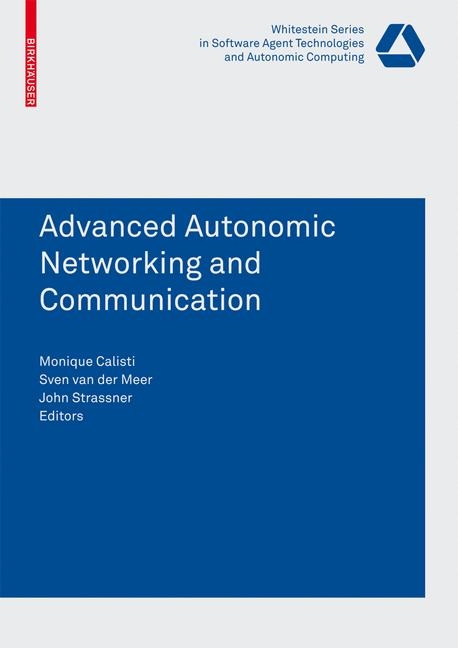
Advanced Autonomic Networking and Communication (eBook)
IX, 190 Seiten
Springer Basel (Verlag)
9783764385699 (ISBN)
Written by leading scientists and researchers, this book presents a comprehensive reference of state-of-the-art efforts and early results in the area of autonomic networking and communication. This special issue explores different ways that autonomic principles can be applied to existing and future networks. In particular, the book has three main parts, each of them represented by three papers discussing them from industrial and academic perspectives.
Contents 6
Foreword 8
Technology Neutral Principles and Concepts for Autonomic Networking 11
1. Introduction 12
2. The Vision of Autonomic Networking 13
3. Technological Neutral Architectural Framework 16
4. DIOA Conceptual Model 20
5. DIOA Architectural Artefacts 23
6. NGOSS TNA Speci.cations 26
7. Conclusion 31
References 32
A Telco Approach to Autonomic Infrastructure Management 36
1. Introduction 36
3. The I2OSS Model 41
4. Conclusions 49
5. Glossary 50
References 51
Autonomic Communication with RASCAL Hybrid Connectivity Management 72
1. Introduction 72
2. Related Work 73
3. The Autonomic Features of RASCAL 75
4. The Architecture of RASCAL 77
5. Laboratory Experimentation 80
6. Real World Evaluation 83
7. Conclusion 87
References 87
Autonomic Resource Regulation in IP Military Networks: A Situatedness Based Knowledge Plane 90
1. Introduction 91
2. An Overview of Autonomy in Computing and Networking 92
3. The Knowledge Plane 94
4. Our Multi-Agent Systems Based Approach 97
5. Situatedness Paradigm 98
6. Bene.ts of a Situatedness Based Approach 99
7. The Situatedness Based Knowledge Plane 101
8. Autonomic Resource Regulation in Military IP Networks 102
9. Experimental Setup: Video streaming in dynamic environment 105
10. Conclusions 108
References 108
Autonomic Service Access Management for Next Generation Converged Networks 110
1. Introduction 110
2. Autonomic Service Access Management 112
3. The LS/ASAM Suite Architecture 114
4. The LS/ASAM Suite in Action 121
5. Experimental Analysis 125
6. Discussion and Conclusions 132
References 134
Modelling Behaviour and Distribution for the Management of Next Generation Networks 52
1. Introduction 52
2. State of the Art 54
3. Madeira Architecture 55
4. Proposed Network Management Meta-model 57
5. Madeira Use Case Scenario 61
6. The Resulting Models 62
7. Conclusions 68
References 68
Cross-layer Optimisations for Autonomic Networks 136
1. Introduction 136
2. Autonomic versus traditional networking 138
3. Alternative protocol architectures 144
4. Conclusions and Future Developments 154
References 156
An Autonomic MPLS DiffServ-TE Domain 158
1. Introduction 158
2. Related Work 160
3. Our proposition 161
4. Performance evaluation 171
5. Conclusion and future work 175
References 176
Game Theoretic Framework for Autonomic Spectrum Management in Heterogeneous Wireless Networks 178
1. Introduction 178
2. Related Works 179
3. System Architecture 181
4. Spectrum Sharing Bargaining Scheme with Perfect Information 183
5. Spectrum Sharing Bargaining Scheme with Incomplete Information 188
6. Simulations and Analysis 192
7. Implementation of Trading Agent 196
8. Conclusion 198
References 198
2 Electrochemical Wastewater Treatment Processes (p. 56-57)
Guohua Chen and Yung-Tse Hung
CONTENTS
INTRODUCTION
ELECTROCHEMICAL REACTORS FOR METAL RECOVERY
ELECTROCOAGULATION
ELECTROFLOTATION
ELECTRO-OXIDATION
SUMMARY
NOMENCLATURE
REFERENCES
1. INTRODUCTION
Using electricity to treat water was first proposed in England in 1889 (1). The application of electrolysis in mineral beneficiation was patented by Elmore in 1904 (2). Electrocoagulation (EC) with aluminum and iron electrodes was patented in the United States in 1909. The EC of drinking water was first applied on a large scale in the United States in 1946 (3,4). Because of the relatively large capital investment and the expensive electricity supply, electrochemical water or wastewater technologies did not find wide application worldwide then. However, in the United States and the former USSR extensive research during the following half century has accumulated abundant amount of knowledge. With the ever increasing standard of drinking water supply and the stringent environmental regulations regarding the wastewater discharge, electrochemical technologies have regained their importance worldwide during the past two decades. There are companies supplying facilities for metal recoveries, for treating drinking water or process water, treating various wastewaters resulting from tannery, electroplating, diary, textile processing, oil and oil in water emulsion, and so on.
Nowadays, electrochemical technologies have reached such a state that they are not only comparable with other technologies in terms of cost but also are more efficient and more compact. For some situations, electrochemical technologies may be the indispensable step in treating wastewaters containing refractory pollutants. In this chapter, the established technologies such as electrochemical reactors for metal recovery, EC, electroflotation (EF), and electro-oxidation (EO) will be examined. The emerging technologies such as electrophoto-oxidation, electro disinfection will not be discussed. Focus will be more on the technologies rather than analyzing the sciences or mechanisms behind them. For books dealing with environmentally related electrochemistry, the readers are referred to other publications (5–8). Before introducing the specific technologies, are reviewed few terminologies that are concerned by electrochemical process engineers. The most frequently referred terminology besides potential and current may be the current density (i) the current per area of electrode. It determines the rate of a process. The next parameter is current efficiency (CE) the ratio of current consumed in producing a target product to that of total consumption.
| Erscheint lt. Verlag | 26.2.2008 |
|---|---|
| Reihe/Serie | Whitestein Series in Software Agent Technologies and Autonomic Computing | Whitestein Series in Software Agent Technologies and Autonomic Computing |
| Zusatzinfo | IX, 190 p. |
| Verlagsort | Basel |
| Sprache | englisch |
| Themenwelt | Mathematik / Informatik ► Informatik ► Netzwerke |
| Mathematik / Informatik ► Informatik ► Software Entwicklung | |
| Wirtschaft ► Betriebswirtschaft / Management ► Planung / Organisation | |
| Schlagworte | Advanced networking • Agent-Based Systems • Architecture • autonomic communication • autonomic computing • autonomic network management • Complexity • Middleware • Modeling • Network Management • Next Generation Networks • Optimization |
| ISBN-13 | 9783764385699 / 9783764385699 |
| Informationen gemäß Produktsicherheitsverordnung (GPSR) | |
| Haben Sie eine Frage zum Produkt? |
 PDF (Wasserzeichen)
DRM: Digitales Wasserzeichen
Dieses eBook enthält ein digitales Wasserzeichen und ist damit für Sie personalisiert. Bei einer missbräuchlichen Weitergabe des eBooks an Dritte ist eine Rückverfolgung an die Quelle möglich.
Dateiformat: PDF (Portable Document Format)
Mit einem festen Seitenlayout eignet sich die PDF besonders für Fachbücher mit Spalten, Tabellen und Abbildungen. Eine PDF kann auf fast allen Geräten angezeigt werden, ist aber für kleine Displays (Smartphone, eReader) nur eingeschränkt geeignet.
Systemvoraussetzungen:
PC/Mac: Mit einem PC oder Mac können Sie dieses eBook lesen. Sie benötigen dafür einen PDF-Viewer - z.B. den Adobe Reader oder Adobe Digital Editions.
eReader: Dieses eBook kann mit (fast) allen eBook-Readern gelesen werden. Mit dem amazon-Kindle ist es aber nicht kompatibel.
Smartphone/Tablet: Egal ob Apple oder Android, dieses eBook können Sie lesen. Sie benötigen dafür einen PDF-Viewer - z.B. die kostenlose Adobe Digital Editions-App.
Buying eBooks from abroad
For tax law reasons we can sell eBooks just within Germany and Switzerland. Regrettably we cannot fulfill eBook-orders from other countries.
aus dem Bereich