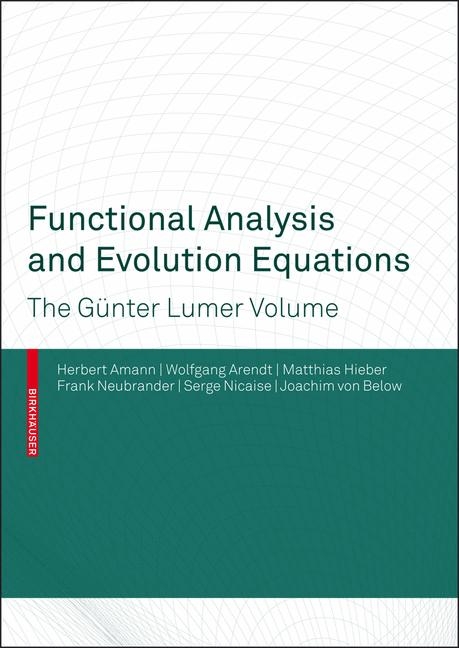
Functional Analysis and Evolution Equations (eBook)
XVII, 637 Seiten
Springer Basel (Verlag)
978-3-7643-7794-6 (ISBN)
Gunter Lumer was an outstanding mathematician whose works have great influence on the research community in mathematical analysis and evolution equations. He was at the origin of the breath-taking development the theory of semigroups saw after the pioneering book of Hille and Phillips from 1957. This volume contains invited contributions presenting the state of the art of these topics and reflecting the broad interests of Gunter Lumer.
Contents 5
Life and Work of Günter Lumer 9
In Remembrance of Günter Lumer 18
Expansions in Generalized Eigenfunctions of the Weighted Laplacian on Star-shaped Networks 20
1. Introduction 20
2. Data and functional analytic framework 24
3. Expansion in generalized eigenfunctions 24
4. Application of Stone’s formula and limiting absorption principle 27
5. A Plancherel-type formula and a functional calculus for the operator 30
References 34
Diffusion Equations with Finite Speed of Propagation 36
1. Introduction 36
2. The Cauchy problem for a strongly degenerate quasi-linear equation 39
3. The evolution of the support of the solutions of the relativistic heat equation 49
References 51
Subordinated Multiparameter Groups of Linear Operators: Properties via the Transference Principle 54
1. Introduction 54
2. The transference principle and generator formulas 56
3. Examples 66
References 68
An Integral Equation in AeroElasticity 70
1. Introduction 70
2. The Possio Equation 71
3. Possio Integral: Time domain version 73
4. Special case 76
5. The general case 79
6. Generalization 83
References 84
Eigenvalue Asymptotics Under a Nondissipative Eigenvalue Dependent Boundary Condition for Second- order Elliptic Operators 85
1. Introduction 85
2. Eigenvalue asymptotics for constant dynamical coeffcient 88
3. Dynamical coeffcient of constant sign 92
4. Dynamical coeffcient changing sign 93
References 98
Feynman-Kac Formulas, Backward Stochastic Differential Equations and Markov Processes 100
1. Introduction 100
2. Preliminary results and auxiliary notation 102
3. A probabilistic approach: weak solutions 113
4. Existence and uniqueness of solutions to BSDEs 116
5. Backward stochastic di.erential equations and Markov processes 123
References 127
Generation of Cosine Families on Lp(0, 1) by Elliptic Operators with Robin Boundary Conditions 129
1. Introduction 129
2. Preliminaries and results 131
3. The case of the Laplacian 133
4. Proof of the main results 139
5. Second-order elliptic operators on unbounded intervals 142
References 145
Global Smooth Solutions to a Fourth-order Quasilinear Fractional Evolution Equation 147
1. Introduction 147
2. Preliminaries 149
3. Local well-posedness 149
4. A priori estimates and global well-posedness 153
5. Proof of Lemma 160
References 161
Positivity Property of Solutions of Some Quasilinear Elliptic Inequalities 163
1. Introduction 163
2. Main result 164
3. Some extensions of the main result 169
References 171
On a Stochastic Parabolic Integral Equation 172
1. Introduction 172
2. The stochastic machinery 173
3. Existence of solutions 176
4. Additional time-regularity 179
References 183
Resolvent Estimates for a Perturbed Oseen Problem 185
1. Introduction 185
2. Notations, de.nitions and main result 186
3. Convolutions of E estimates of PB . F)
4. Solving a perturbed Oseen system 191
5. Some resolvent estimates for a perturbed Oseen system 193
6. Estimate of the semigroup 195
References 200
Abstract Delay Equations Inspired by Population Dynamics 201
1. Introduction 201
2. The abstract setting 203
3. Delay equations as abstract integral equations 206
4. A model involving cannibalistic behaviour 207
5. Conclusions 211
References 212
Weak Stability for Orbits of C0-semigroups on Banach Spaces 215
1. Introduction 215
2. The result 217
References 221
Contraction Semigroups on L8(R) 223
1. Introduction 223
2. Preliminaries 224
3. Extension properties 226
4. Examples 231
5. Volume doubling 234
References 235
On the Curve Shortening Flow with Triple Junction 236
1. Introduction 236
2. Local existence 239
References 250
The Dual Mixed Finite Element Method for the Heat Diffusion Equation in a Polygonal Domain, I 252
1. Introduction 252
2. Regularity of the solution of the heat diffusion equation 253
3. The dual mixed formulation for the heat diffusion equation 255
4. Semi-discrete solution of the dual mixed method for the heat diffusion equation in a polygonal domain of R2 257
5. A priori error estimates for the semi-discrete solution of the dual mixed method for the heat diffusion equation 260
References 268
Maximal Regularity of the Stokes Operator in General Unbounded Domains of Rn 270
1. Introduction 270
2. Preliminaries 274
3. Proof of Theorem 1.4 280
References 284
Linear Control Systems in Sequence Spaces 286
1. Introduction 286
2. The first example 289
3. The maximum principle and optimal controls 290
4. The second example 295
5. The time optimal problem 297
6. Hypersingular controls 298
7. Singular functionals 301
8. Conclusions and new questions 302
References 302
On the Motion of Several Rigid Bodies in a Viscous Multipolar Fluid 304
1. Introduction 304
2. Variational formulation 308
3. Global existence – main results 310
4. Approximate problems 311
5. Uniform estimates 312
6. Convergence 313
References 317
On the Stokes Resolvent Equations in Locally Uniform Lp Spaces in Exterior Domains 319
1. Introduction 319
2. Preliminaries 321
3. The Stokes operator in Lp spaces in exterior domains 323
References 325
Generation of Analytic Semigroups and Domain Characterization for Degenerate Elliptic Operators with Unbounded Coeffcients Arising in Financial Mathematics. Part II 327
1. Introduction 327
2. Preliminary material and notation 329
3. Generation of analytic semigroups on Lp(Rd) 333
References 341
Numerical Approximation of Generalized Functions: Aliasing, the Gibbs Phenomenon and a Numerical Uncertainty Principle 343
1. Introduction 343
2. Basics of the theory of distributions 346
3. Approximating families 350
4. Convergence 355
5. Interpolation 358
6. Oscillations in the wave equations 363
7. Conclusion 367
References 368
No Radial Symmetries in the Arrhenius– Semenov Thermal Explosion Equation 369
1. Introduction 369
2. No symmetries in the Arrhenius–Semenov equation 372
3. Conclusions and discussion 379
References 381
Mild Well-posedness of Abstract Differential Equations 383
1. Introduction 383
2. Preliminaries 384
3. Mild-well-posedness and Lp-multipliers 386
4. Mild solutions for second-order equations 389
5. Fractional di.erentiation and well-posedness 393
6. Application to semi-linear equations in Hilbert spaces 396
References 398
Backward Uniqueness in Linear Thermoelasticity with Time and Space Variable Coeffcients 400
1. Introduction 400
2. Main result 401
3. The energy estimates 404
4. Carleman estimates for parabolic equations 408
5. Carleman estimates for thermoelastic system 411
6. Completion of the proof 413
References 414
Measure and Integral: New Foundations after One Hundred Years 415
1. The two abstract theories of the 20th century 416
2. The generation of measures in the two previous theories 420
3. The origin of the new systematization 424
4. The new theory 425
5. The further development in a few examples 427
References 431
Post-Widder Inversion for Laplace Transforms of Hyperfunctions 433
Introduction 433
1. Hyperfunctions with compact support 434
2. Hyperfunctions on [0,8) 437
3. Post-Widder inversion for general hyperfunctions 440
References 441
On a Class of Elliptic Operators with Unbounded Time-and Space-dependent Coeffcients in Rn 442
1. Introduction 442
2. Main assumptions and preliminaries 447
3. The case of continuous coeffcients independent of the space variables 449
4. The general case (when the coeffcients are continuous in (t, x)) 455
5. The case when the coeffcients are only measurable 460
References 464
Time-dependent Nonlinear Perturbations of Analytic Semigroups 466
1. Introduction 467
2. A linear theory 470
3. Fractional powers of non-densely defined closed linear operators 474
4. Nonlinear perturbations of analytic semigroups 475
5. Uniqueness and regularity of mild solutions 481
6. Generation of nonlinear evolution operator U in Y 483
7. Discrete local multiple Laplace transforms 491
8. Characterization of nonlinearly perturbed analytic semigroups 497
9. Applications to convective reaction-diffusion systems 500
References 509
A Variational Approach to Strongly Damped Wave Equations 512
1. Introduction 512
2. First well-posedness results 514
3. Interpolation spaces and nonlinear problems 519
References 522
Exponential and Polynomial Stability Estimates for the Wave Equation and Maxwell’s System with Memory Boundary Conditions 524
1. Introduction 524
2. The wave equation 526
3. Maxwell’s equations 531
4. Examples 534
References 538
Maximal Regularity for Degenerate Evolution Equations with an Exponential Weight Function 540
1. Introduction 540
2. Parametric symbols 542
3. The evolution equation 549
4. Examples 551
References 554
An Analysis of Asian options 555
1. Introduction 555
2. The Black-Scholes approach 557
3. Well-posedness of the problem 560
4. The call-put parity 564
References 567
Linearized Stability and Regularity for Nonlinear Age-dependent Population Models 568
1. Introduction 568
2. Linearized stability and regularity for (ADP) 570
3. Proofs of Theorems 2.2 and 2.3 572
4. Appendix 580
References 583
Space Almost Periodic Solutions of Reaction Diffusion Equations 584
0. Introduction 584
1. Notation 585
2. Spaces of almost periodic functions 585
3. Slow instable manifolds 588
4. Outlook 594
Appendix 598
References 600
On the Oseen Semigroup with Rotating Effect 602
1. Introduction and main results 602
2. Analysis in R3 605
3. Rough ideas of proofs of Theorems 1.1 and 1.3 607
4. On some new treatment of the pressure term 610
5. The idea of proofs of Theorems 3.1 and 3.2 614
6. Remark on the stability theorem 616
References 618
Exact Controllability in L2(O) of the Schrödinger Equation in a Riemannian Manifold with L2(S1)-Neumann Boundary Control 619
1. Introduction. Problem statement. Assumptions 619
2. The adjoint problem and the equivalent COI under the working assumption R,. = 0 on G1 (resp. on G) 624
3. Proof of the COI (2.14) under (A.5) 627
4. Proof of Theorem 3.1 631
5. Proof of Theorem 1.2: Removal of Assumption (A.5) = (2.4) 635
6. Illustrations and examples 636
References 640
List of Authors 643
Feynman-Kac Formulas, Backward Stochastic Differential Equations and Markov Processes (p. 81-82)
Jan A. Van Casteren
This article is written in honor of G. Lumer whom I consider as my semi-group teacher
Abstract. In this paper we explain the notion of stochastic backward differential equations and its relationship with classical (backward) parabolic Differential equations of second order. The paper contains a mixture of stochastic processes like Markov processes and martingale theory and semi-linear partial Differential equations of parabolic type. Some emphasis is put on the fact that the whole theory generalizes Feynman-Kac formulas. A new method of proof of the existence of solutions is given. All the existence arguments are based on rather precise quantitative estimates.
1. Introduction
Backward stochastic Differential equations, in short BSDEs, have been well studied during the last ten years or so. They were introduced by Pardoux and Peng [20], who proved existence and uniqueness of adapted solutions, under suitable squareintegrability assumptions on the coeffcients and on the terminal condition. They provide probabilistic formulas for solution of systems of semi-linear partial Differential equations, both of parabolic and elliptic type. The interest for this kind of stochastic equations has increased steadily, this is due to the strong connections of these equations with mathematical finance and the fact that they provide a generalization of the well-known Feynman-Kac formula to semi-linear partial differential equations. In the present paper we will concentrate on the relationship between time-dependent strong Markov processes and abstract backward stochastic Differential equations. The equations are phrased in terms of a martingale type problem, rather than a strong stochastic Differential equation. They could be called weak backward stochastic Differential equations. Emphasis is put on existence and uniqueness of solutions. The paper in [27] deals with the same subject, but it concentrates on comparison theorems and viscosity solutions.
The notion of squared gradient operator is implicitly used by Bally at al in [4]. The latter paper was one of the motivations to write the present paper with an emphasis on the squared gradient operator. In addition, our results are presented in such a way that the state space of the underlying Markov process, which in most of the other papers on BSDEs is supposed to be Rn, can be any diffusion with an abstract state space, which throughout our text is denoted by E. In fact in the existing literature the underlying Markov process is a (strong) solution of a (forward) stochastic Differential equation: see, e.g., [4], [8] and [7] and [19]. For more on this see Remark 2.9 below. In particular our results are applicable in case the Markov process under consideration is Brownian motion on a Riemannian manifold. Our condition on the generator (or coefficient) of the BSDE f in terms of the squared gradient is very natural. In the Lipschitz context it is more or less optimal. Moreover, our proof of existence is not based on standard regularization methods by using convolution products with smooth functions, but on a homotopy argument due to Crouzeix [11], which seems more direct than the classical approach. We also obtain rather precise quantitative estimates. Only very rudimentary sketches of proofs are given, details will appear elsewhere.
| Erscheint lt. Verlag | 28.2.2008 |
|---|---|
| Zusatzinfo | XVII, 637 p. |
| Verlagsort | Basel |
| Sprache | englisch |
| Original-Titel | Topic: Construction Costs and Scheduling |
| Themenwelt | Mathematik / Informatik ► Mathematik ► Analysis |
| Technik | |
| Schlagworte | Boundary value problem • Calculus • differential equation • eigenvalue • evolution equation • Functional Analysis • Maximum • partial differential equation • Partial differential equations • wave equation |
| ISBN-10 | 3-7643-7794-1 / 3764377941 |
| ISBN-13 | 978-3-7643-7794-6 / 9783764377946 |
| Informationen gemäß Produktsicherheitsverordnung (GPSR) | |
| Haben Sie eine Frage zum Produkt? |
 PDF (Wasserzeichen)
DRM: Digitales Wasserzeichen
Dieses eBook enthält ein digitales Wasserzeichen und ist damit für Sie personalisiert. Bei einer missbräuchlichen Weitergabe des eBooks an Dritte ist eine Rückverfolgung an die Quelle möglich.
Dateiformat: PDF (Portable Document Format)
Mit einem festen Seitenlayout eignet sich die PDF besonders für Fachbücher mit Spalten, Tabellen und Abbildungen. Eine PDF kann auf fast allen Geräten angezeigt werden, ist aber für kleine Displays (Smartphone, eReader) nur eingeschränkt geeignet.
Systemvoraussetzungen:
PC/Mac: Mit einem PC oder Mac können Sie dieses eBook lesen. Sie benötigen dafür einen PDF-Viewer - z.B. den Adobe Reader oder Adobe Digital Editions.
eReader: Dieses eBook kann mit (fast) allen eBook-Readern gelesen werden. Mit dem amazon-Kindle ist es aber nicht kompatibel.
Smartphone/Tablet: Egal ob Apple oder Android, dieses eBook können Sie lesen. Sie benötigen dafür einen PDF-Viewer - z.B. die kostenlose Adobe Digital Editions-App.
Buying eBooks from abroad
For tax law reasons we can sell eBooks just within Germany and Switzerland. Regrettably we cannot fulfill eBook-orders from other countries.
aus dem Bereich