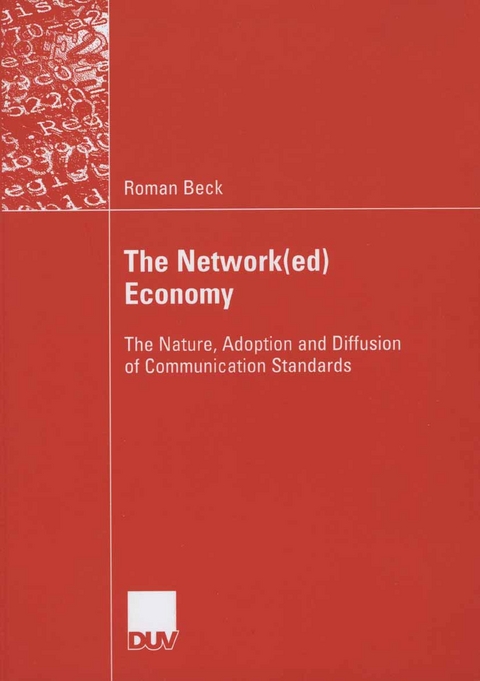
The Network(ed) Economy (eBook)
XXVII, 268 Seiten
Deutscher Universitätsverlag
978-3-8350-9213-6 (ISBN)

Dr. Roman Beck ist wissenschaftlicher Assistent von Prof. Dr. Wolfgang König am Institut für Wirtschaftsinformatik der Universität Frankfurt/Main.
Dr. Roman Beck ist wissenschaftlicher Assistent von Prof. Dr. Wolfgang König am Institut für Wirtschaftsinformatik der Universität Frankfurt/Main.
Foreword 6
Preface 10
Table of Contents 11
Figures 15
Tables 17
Equations 19
Variables and Symbols 21
Abbreviations 24
1 Introduction 27
1.1 Motivation and Research Questions 29
1.2 Structure of the Dissertation 35
2 Diffusion and Innovation Theory 41
2.1 Business Environment 41
2.2 Innovation Theory 43
2.3 Diffusion Theory 49
2.4 Diffusion of Public Goods and Infrastructure 53
2.5 Infrastructure and Networks as part of Public Goods 60
2.6 Diffusion Approaches in the Information Systems Discipline 63
3 Network Effect Theory 67
3.1 Network Effect Goods 67
3.2 The Diffusion of Network Effects Goods 75
3.3 Network Externalities: A Source of IVIarket Failure? 97
3.4 Diffusion Theory Revisited in the Light of Network Effects 99
4 Diffusion of E-Business Standards: Empirical Results 105
4.1 Research Framework 105
4.2 Diffusion of E-Business Standards 107
4.3 Globalization and Diffusion of E-Business Standards 119
4.4 Diffusion and Impact of E-Business Standards among SMEs 129
5 Developing E-Business Standards 149
5.1 Economics of Communication Standards: Integrating SIVIEs in EDI Supply Chains 150
5.2 Advancing Business Process Automation by Means of Customer Reputation Accounts 166
6 Simulation of the Diffusion of Network Effect Goods 185
6.1 Application of Network Effect Theory to Developing a Network of Mobile Service Users 186
6.2 Application of Network Effect Theory to Developing an EDI Network 214
7 Conclusions 241
7.1 Diffusion Theory in the Light of Network Effect Theory 242
7.2 Empirical Cross-Country Analysis of E-Business Diffusion 245
7.3 Development of E-Business Solutions 246
7.4 ACE-based Diffusion IViodel of Communication Standards 248
8 Future Research 251
8.1 strengthening the Empirical Foundation 251
8.2 Next Generation Mobile Communication Standards 252
8.3 Investigation of Wireless Broadband Standards Development 254
8.4 Development of Economic Models to explain the Diffusion of Wireless Broadband Standards 255
8.5 Developing Mobile Business IVIodels and Market Strategies 256
8.6 Grid-Economic Perspectives 257
References 261
Appendix: Global E-Commerce Survey 287
6 Simulation of the Diffusion of Network Effect Goods (S. 159-160)
The diffusion of communication standards such as traditional EDI standards, but also newer ones such as InternetEDI, WebEDI, or even XML-based data communication standards is lagging behind the expected degree of widespread use although the benefits accompanying with these standards were never in doubt. It is not only SMEs who have not completely adopted these standards, but also even large enterprises with massive communication traffic are often reluctant to adopt, and therefore do not use all possible electronic data communication standards.
EDI standards and communication standards in general seem to be special and different from other products or goods that can be used without the necessity of being a product that is widely adopted among other market participants. Therefore, the diffusion of such network effect standards is difficult to predict and often remains below the expected degree of diffusion. Standards which are not able to overcome the early phase of diffusion (from the start-up until reaching critical mass or threshold) will never become accepted market standards.
Apart from the diffusion of open, unsponsored EDI standards among firms this phenomenon is also observable for proprietary, sponsored standards in the telecommunication markets, such as for WAP, i-mode, or UMTS. While the anticipation of the possible diffusion paths of communication standards in unsponsored networks is of importance primarily for adopters (or potential adopters) of a new standard to enable them to decide whether to standardize or not, the anticipation of consumer behavior is also of importance for providers. If, e.g., a sponsored standard is competing with an unsponsored one, then a provider has a choice of certain market parameters for her penetration strategy.
Apart from subsidized prices or side payments, a provider can also stress certain components of a standard during the diffusion stage to meet the demands of potential adopters in accordance with the results of the market simulation. From an economic perspective, a focus on the user of a standard rather than concentration on the supplier is more interesting in terms of understanding the development of a user network characterized by adopter-side economies of scope. The findings of the microeconomic bottom-up view of the adoption behavior of single market participants reveal market strategies for suppliers, while an inverse macroeconomic top-down view cannot. As described earlier, the question of how to describe or even solve the start-up problem for communication and compatibility standards in network effect markets remains unanswered.
Due to the complex interplay between adopters of standards and the network benefits which change constantly during the diffusion process, the detailed analysis of all network externalities linked with the adoption is necessary to describe all possible paths of diffusion. Earlier research work on the diffusion of standards in network effect markets has focused on the allocation implications and market structure after overcoming the start-up problem, i.e. the market concentration tendency of sponsored standards towards a monopolistic market. But whether, however, the critical early diffusion phase up to the point of reaching critical mass can be overcome and described methodically, remains open so far.
| Erscheint lt. Verlag | 11.12.2007 |
|---|---|
| Vorwort | Prof. Dr. Wolfgang König, Prof. Dr. Rolf T. Wigand |
| Zusatzinfo | XXVII, 268 p. |
| Verlagsort | Wiesbaden |
| Sprache | englisch |
| Themenwelt | Mathematik / Informatik ► Informatik |
| Wirtschaft ► Allgemeines / Lexika | |
| Wirtschaft ► Betriebswirtschaft / Management ► Wirtschaftsinformatik | |
| Schlagworte | Agent-Based Computational Economics • Automation • business • Change • E-Business • Innovation • Network effect theory • Network externalities • Simulation • Simulation Analysis |
| ISBN-10 | 3-8350-9213-8 / 3835092138 |
| ISBN-13 | 978-3-8350-9213-6 / 9783835092136 |
| Informationen gemäß Produktsicherheitsverordnung (GPSR) | |
| Haben Sie eine Frage zum Produkt? |
 PDF (Wasserzeichen)
DRM: Digitales Wasserzeichen
Dieses eBook enthält ein digitales Wasserzeichen und ist damit für Sie personalisiert. Bei einer missbräuchlichen Weitergabe des eBooks an Dritte ist eine Rückverfolgung an die Quelle möglich.
Dateiformat: PDF (Portable Document Format)
Mit einem festen Seitenlayout eignet sich die PDF besonders für Fachbücher mit Spalten, Tabellen und Abbildungen. Eine PDF kann auf fast allen Geräten angezeigt werden, ist aber für kleine Displays (Smartphone, eReader) nur eingeschränkt geeignet.
Systemvoraussetzungen:
PC/Mac: Mit einem PC oder Mac können Sie dieses eBook lesen. Sie benötigen dafür einen PDF-Viewer - z.B. den Adobe Reader oder Adobe Digital Editions.
eReader: Dieses eBook kann mit (fast) allen eBook-Readern gelesen werden. Mit dem amazon-Kindle ist es aber nicht kompatibel.
Smartphone/Tablet: Egal ob Apple oder Android, dieses eBook können Sie lesen. Sie benötigen dafür einen PDF-Viewer - z.B. die kostenlose Adobe Digital Editions-App.
Buying eBooks from abroad
For tax law reasons we can sell eBooks just within Germany and Switzerland. Regrettably we cannot fulfill eBook-orders from other countries.
aus dem Bereich