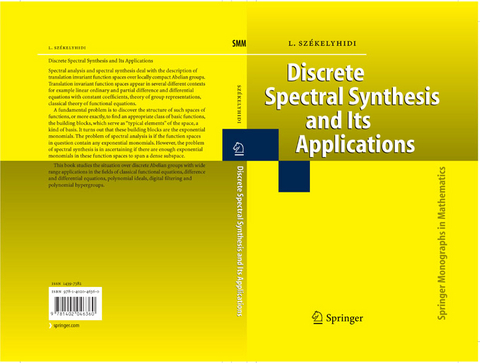
Discrete Spectral Synthesis and Its Applications (eBook)
119 Seiten
Springer-Verlag
978-1-4020-4637-7 (ISBN)
In order to study discrete Abelian groups with wide range applications, the use of classical functional equations, difference and differential equations, polynomial ideals, digital filtering and polynomial hypergroups is required. This book covers several different problems in this field and is unique in being the only comprehensive coverage of this topic. It should appeal to graduate students and researchers in harmonic analysis, spectral analysis, functional equations and hypergroups.
Contents 7
Preface 9
1 Introduction 16
2 Spectral synthesis and spectral analysis 22
2.1 The basic problems of spectral analysis and spectral synthesis 22
2.2 Spectral analysis and synthesis on L1(G) 23
2.2 Spectral analysis and synthesis on L (G) 26
2.4 Spectral analysis and synthesis on C(G) 32
3 Spectral analysis and spectral synthesis on discrete Abelian groups 40
3.1 Spectral analysis on discrete Abelian torsion groups 40
3.2 Spectral analysis on Abelian groups 42
3.3 Spectral analysis on commutative semigroups 42
3.4 Spectral synthesis and polynomial ideals 44
3.5 The failure of spectral synthesis on some types of discrete Abelian groups 49
3.6 Spectral synthesis on Abelian torsion groups 53
3.7 Polynomial functions and spectral synthesis 57
4 Spectral synthesis and functional equations 64
4.1 Convolution type functional equations 64
4.2 Mean value type functional equations 67
4.3 A functional equation in digital filtering 75
5 Mean periodic functions 84
5.1 The Fourier transform of mean periodic functions 84
5.2 The Fourier transform of exponential polynomials 92
5.3 Applications to differential equations 94
6 Difference equations in several variables 98
6.1 Spectral synthesis of difference equations 98
6.2 Applications 102
7 Spectral analysis and synthesis on polynomial hypergroups in a single variable 106
7.1 Polynomial hypergroups in one variable 106
7.2 Spectral analysis on polynomial hypergroups in one variable 111
7.3 Spectral synthesis on polynomial hypergroups in one variable 113
8 Spectral analysis and synthesis on multivariate polynomial hypergroups 118
8.1 Polynomial hypergroups in several variables 118
8.2 Exponential and additive functions on multivariate polynomial hypergroups 119
8.3 Spectral analysis and spectral synthesis on multivariate polynomial hypergroups 122
References 124
Index 128
1 Introduction (p. 1)
The basic tools for the investigation of different algebraic and analytical structures are representation and duality. "Representation" means that we establish a correspondence between our abstract structure and a similar, more particular one. Usually this more particular structure, the "representing" structure is formed by functions, de.ned on a set which is the so-called "dual" object.
In order to get a "faithful" representation, it seems to be reasonable that the correspondence in question is one-to-one. Another reasonable requirement is that if the same procedure is applied to the dual object, then its dual can be identified with the original structure. In order to do that, the dual object should have an "internal" characterization. Finally, a characterization of the "representing" structure is also desirable : which functions on the dual object belong to the "representing" structure?
The method of representation and duality appears in several different fields of algebra, analysis, etc. For instance, linear spaces can be represented as linear spaces of linear functionals, topological spaces can be represented as topological spaces of continuous functions, topological groups can be represented as topological groups of special homomorphisms, and so on. However, in all these cases one can assure the faithfulness via different assumptions only.
In the case of linear spaces the injectivity of the representing mapping holds only if the linear functionals of the original linear space form a separating family, which leads to Hahn– Banach type theorems. In the case of topological spaces the same requirement leads to conditions similar to those in Uryshon’s Lemma. In the theory of algebras the corresponding representation process can be described by the Gelfand transformation.
Let A be a complex algebra and let H denote a set of algebra homomorphisms of A onto C, the algebra of complex numbers. Such homomorphisms are called multiplicative linear functionals . We remark that the assumption on the surjectivity of a complex algebra homomorphism is obviously equivalent to it being nonidentically zero. Evidently, H is a subset of the algebraic dual of A, however, in general, H has no natural algebraic structure.
| Erscheint lt. Verlag | 25.1.2007 |
|---|---|
| Reihe/Serie | Springer Monographs in Mathematics | Springer Monographs in Mathematics |
| Zusatzinfo | XV, 119 p. |
| Verlagsort | Dordrecht |
| Sprache | englisch |
| Themenwelt | Mathematik / Informatik ► Mathematik ► Algebra |
| Mathematik / Informatik ► Mathematik ► Analysis | |
| Technik | |
| Schlagworte | abelian group • brandonwiskunde • Calculus • difference equation • differential equation • Equation • Function • functional equation • Harmonic Analysis • Variable |
| ISBN-10 | 1-4020-4637-5 / 1402046375 |
| ISBN-13 | 978-1-4020-4637-7 / 9781402046377 |
| Informationen gemäß Produktsicherheitsverordnung (GPSR) | |
| Haben Sie eine Frage zum Produkt? |
 PDF (Wasserzeichen)
Größe: 1,2 MB
DRM: Digitales Wasserzeichen
Dieses eBook enthält ein digitales Wasserzeichen und ist damit für Sie personalisiert. Bei einer missbräuchlichen Weitergabe des eBooks an Dritte ist eine Rückverfolgung an die Quelle möglich.
Dateiformat: PDF (Portable Document Format)
Mit einem festen Seitenlayout eignet sich die PDF besonders für Fachbücher mit Spalten, Tabellen und Abbildungen. Eine PDF kann auf fast allen Geräten angezeigt werden, ist aber für kleine Displays (Smartphone, eReader) nur eingeschränkt geeignet.
Systemvoraussetzungen:
PC/Mac: Mit einem PC oder Mac können Sie dieses eBook lesen. Sie benötigen dafür einen PDF-Viewer - z.B. den Adobe Reader oder Adobe Digital Editions.
eReader: Dieses eBook kann mit (fast) allen eBook-Readern gelesen werden. Mit dem amazon-Kindle ist es aber nicht kompatibel.
Smartphone/Tablet: Egal ob Apple oder Android, dieses eBook können Sie lesen. Sie benötigen dafür einen PDF-Viewer - z.B. die kostenlose Adobe Digital Editions-App.
Zusätzliches Feature: Online Lesen
Dieses eBook können Sie zusätzlich zum Download auch online im Webbrowser lesen.
Buying eBooks from abroad
For tax law reasons we can sell eBooks just within Germany and Switzerland. Regrettably we cannot fulfill eBook-orders from other countries.
aus dem Bereich