



Discovering Mathematics with Magma (eBook)
364 Seiten
Springer Berlin (Verlag)
978-3-540-37634-7 (ISBN)
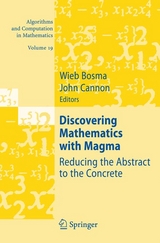
Cannon: 1) Principal designer of the Magma system 2) Extensive contributions to the field of group theory algorithms 3) Awards: 1993 CSIRO Medal (for Computer Algebra) 2001 ATSE Clunies Ross Award (for Cryptography and Computer Algebra) 2006 Richard D. Jenks Memorial Prize for Excellence in Software Engineering Applied to Computer Algebra. Bosma: co-designer of Magma, active in computational number theory and computer algebra
Preface 6
Magma: The project 8
Discovering mathematics: About this volume 14
How to read the Magma code 20
Contents 24
Some computational experiments in number theory 26
1 Introduction 26
2 Covering systems 27
3 Covering systems and explicit primality tests 32
4 The totient function 40
5 Class number relations 46
References 53
Applications of the class field theory of global fields 56
1 Introduction 56
2 Number fields 57
3 Global function fields 70
4 Applications 77
References 86
Some ternary Diophantine equations of signature (n, n, 2) 88
1 Introduction 88
2 Proof of Proposition 1.3 90
3 Construction of parametrising curves 91
4 The equation x5 + y5 = Dz2 93
5 Deciding local solvability 97
6 Mordell–Weil groups of elliptic curves 104
7 Chabauty methods using elliptic curves 109
8 The equations xn + yn = Dz2 for n = 6, 7, 9, 11, 13, 17 113
References 115
Studying the Birch and Swinnerton-Dyer conjecture for modular abelian varieties using Magma 118
1 Introduction 118
2 Modular abelian varieties 119
3 The Birch and Swinnerton-Dyer Conjecture 122
4 Some computational results 125
5 Modular symbols 126
6 Visibility theory 129
7 Computing special values of modular L-function 130
8 Computing Tamagawa numbers 131
9 Computing the torsion subgroup 132
10 A divisor and multiple of the order of the Shafarevich – Tate group 132
11 An element of the Shafarevich–Tate group that becomes visible at higher level 133
12 Complete Magma log 136
References 139
Computing with the analytic Jacobian of a genus 2 curve 142
1 Introduction 142
2 Finding genus 2 CM curves defined over the rationals 145
3 Isogenies 152
References 159
Graded rings and special K3 surfaces 162
1 Introduction 162
2 Elementary example 165
3 Graded rings of polarised varieties 168
4 Subcanonical curves 169
5 K3 database 171
6 Simple degenerations of the famous 95 173
7 Unprojection 178
8 Special K3 surfaces in Fletcher’s 84 180
References 183
Constructing the split octonions 186
1 Introduction 186
2 Structure constant algebras 188
3 Lie algebras of type D4 and E6 191
4 Triality 194
5 The Lie algebra of type G2 196
6 The split octonions 198
7 The quadratic form 202
8 The Chevalley groups of type G2 205
References 210
Support varieties for modules 212
1 Introduction 212
2 Notes on projectivity 214
3 Support varieties and rank varieties 215
4 Finding points on the variety 217
5 Computing the variety from a set of points 224
6 Varieties of truncated syzygy modules 226
References 228
When is projectivity detected on subalgebras? 230
1 Introduction 230
2 Criterion for projectivity 231
3 Basic algebras and homological algebra on the computer 233
4 Support varieties for modules over group algebras 234
5 Some notes on cohomology and computations 236
6 An algebra whose projective modules are detected on proper subalgebras 238
7 An example in which projectivity is not detected on subalgebras 241
References 244
Cohomology and group extensions in Magma 246
1 Introduction 246
2 Computing cohomology groups 247
3 Finding group extensions 261
References 266
Computing the primitive permutation groups of degree less than 1000 268
1 Some background 268
2 Mathematical preliminaries 269
3 Determining conjugacy 271
4 Maximal irreducible subgroups of GL(4, 5) 280
5 The main algorithm 282
6 Results 283
References 284
Computer aided discovery of a fast algorithm for testing conjugacy in braid groups 286
1 Introduction 286
2 Background: braid groups and testing conjugacy 287
3 Coming across another class invariant 293
4 On the way to a proof 299
5 Computing minimal simple elements 306
6 An application: key recovery 307
References 310
Searching for linear codes with large minimum distance 312
1 Introduction 312
2 Computing the minimum weight 314
3 Constructing new codes from old ones 326
4 Searching for good codes 328
5 Conclusion 337
6 Acknowledgements 337
References 338
Colouring planar graphs 340
1 Introduction 340
2 k-Flows in graphs 341
3 Planar graphs 342
4 k-Flows and k-colouring in planar graphs 347
5 Finding nowhere-zero k-Flows 348
6 Testing for nowhere-zero k-Flows 350
7 Conclusion 354
References 354
Appendix: The Magma language 356
Introduction 356
1 Basics 356
2 Sets and sequences 364
3 Tuples 372
4 Creating functions and procedures 373
5 Loops: for, while, and repeat 374
6 Maps 377
References 381
Index 382
| Erscheint lt. Verlag | 10.7.2007 |
|---|---|
| Reihe/Serie | Algorithms and Computation in Mathematics | Algorithms and Computation in Mathematics |
| Zusatzinfo | XXIV, 364 p. |
| Verlagsort | Berlin |
| Sprache | englisch |
| Themenwelt | Mathematik / Informatik ► Informatik ► Programmiersprachen / -werkzeuge |
| Mathematik / Informatik ► Mathematik ► Statistik | |
| Mathematik / Informatik ► Mathematik ► Wahrscheinlichkeit / Kombinatorik | |
| Technik | |
| Schlagworte | Algebra • algorithms • Code • Computer • Computer Algebra • computer algebra system • Geometry • Graphs • Magma • Number Theory • Permutation • programming • Programming language • SIGNATUR • Symbolic Computation |
| ISBN-10 | 3-540-37634-8 / 3540376348 |
| ISBN-13 | 978-3-540-37634-7 / 9783540376347 |
| Informationen gemäß Produktsicherheitsverordnung (GPSR) | |
| Haben Sie eine Frage zum Produkt? |
 PDF (Wasserzeichen)
DRM: Digitales Wasserzeichen
Dieses eBook enthält ein digitales Wasserzeichen und ist damit für Sie personalisiert. Bei einer missbräuchlichen Weitergabe des eBooks an Dritte ist eine Rückverfolgung an die Quelle möglich.
Dateiformat: PDF (Portable Document Format)
Mit einem festen Seitenlayout eignet sich die PDF besonders für Fachbücher mit Spalten, Tabellen und Abbildungen. Eine PDF kann auf fast allen Geräten angezeigt werden, ist aber für kleine Displays (Smartphone, eReader) nur eingeschränkt geeignet.
Systemvoraussetzungen:
PC/Mac: Mit einem PC oder Mac können Sie dieses eBook lesen. Sie benötigen dafür einen PDF-Viewer - z.B. den Adobe Reader oder Adobe Digital Editions.
eReader: Dieses eBook kann mit (fast) allen eBook-Readern gelesen werden. Mit dem amazon-Kindle ist es aber nicht kompatibel.
Smartphone/Tablet: Egal ob Apple oder Android, dieses eBook können Sie lesen. Sie benötigen dafür einen PDF-Viewer - z.B. die kostenlose Adobe Digital Editions-App.
Buying eBooks from abroad
For tax law reasons we can sell eBooks just within Germany and Switzerland. Regrettably we cannot fulfill eBook-orders from other countries.
aus dem Bereich


