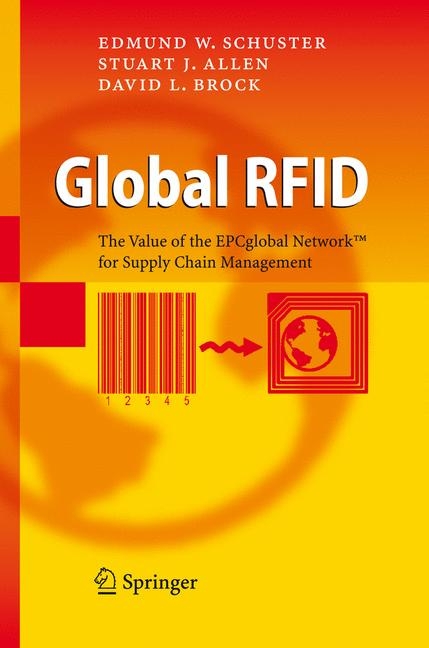
Global RFID (eBook)
XXVI, 310 Seiten
Springer Berlin (Verlag)
978-3-540-35655-4 (ISBN)
This book explores the essentials of RFID and the EPCglobal Network from the perspective of a practitioner that needs to make business decisions concerning the adoption of the technology. The perspective is from the supply chain management standpoint with emphasis on case studies and new thinking about the subject. The EPCglobal Network and RFID technology holds great promise for transforming business through the use of low-cost, radio frequency identification (RFID) tags to improve information flow and productivity.
Table of Contents 6
List of Figures and Tables 8
Who Invented the EPC? 12
A Large-Scale Effort 16
Preface 24
PART I: INTRODUCTION 28
The Emergence of a New Key Technology 30
The Bar Code and Beyond 30
The Basic Elements of Unique Identification 33
RFID versus the EPCglobal Network 34
Charting the Future 35
Initial Application Ideas 36
The History of Technological Advances 37
Parallels with Identification Technology 39
Productivity Through Information 40
Hardware: RFID Tags and Readers 42
Advantages of RFID Relative to Bar Codes 44
The Gradual Movement to Electronic Tags 45
Technical Aspects of Tags 48
The Electronic Product Code 50
Factors That Influence Read Reliability 51
The Way Forward 53
Infrastructure: EPCglobal Network 56
An Overview of Release 1.0 57
Developments Since 2003 60
Historical Reference 64
Data: What, When, and Where? 68
An Example from the Consumer Goods Industry 69
Why Location Is Important to Business 71
Existing Location Standards 71
An Approach to Location 72
PART II: LEVERAGING THE SUPPLY CHAIN: CASE STUDIES 74
Warehousing: Improving Customer Service 76
The Value of Customer Service 77
Automating Warehouse Operations 79
Efficient Handoffs in Order Fulfillment 80
Other Areas for Improvement 83
Maintenance: Service Parts Inventory Management 86
Overview 87
Business Operations for Service Parts 88
Suggested Solutions (Non-RFID) 93
RFID Enhancements 94
Pharmaceuticals: Preventing Counterfeits 98
An International Problem of Significant Magnitude 100
Current Solutions to the Pharmaceutical Counterfeit Problem 103
An RFID Based Solution 110
Steps Toward Practical Implementation 115
The Realities of Implementation 117
The Pharmaceutical Supply Chain 120
Basic Implementation Issues 124
Choosing an Industry-Wide Architecture 129
Alternatives to Using RFID Tags 131
Other Anti-counterfeit Applications 132
Appendix 133
Medical Devices: Smart Healthcare Infrastructure 136
An Intelligent Infrastructure for Healthcare 137
The Future 143
Agriculture: Animal Tracking 146
Disease Threat and Animal Tracking 148
Food: Dynamic Expiration Dates 154
Tracking Flavor Electronically 156
Retailing: Theft Prevention 162
The Indirect Impact of Theft 164
Analyzing Theft 166
Characteristics of RFID Technology 167
A Conceptual Model for the Analysis of Theft 168
RFID and Different Types of Theft 171
An Integrated Solution to Theft 177
Additional Benefits 178
Getting Ready for RFID as an Anti-theft Device 180
Conclusion 184
PART III: CREATING BUSINESS VALUE 202
Defense: Improving Security and Efficiency 186
Glossary 310
Information and Networking as a Future Strategy 189
DOD Supply Chain 191
System Improvement 195
How RFID and DOD Come Together 198
Conclusion 200
The Role of Data in Enterprise Resource Planning 204
Building a Business Case for the EPCglobal Network 214
RFID Infrastructure 215
The Dell Case 218
The RFID Scorecard 219
A Conservative Approach 222
Building the Business Case 222
Making the Decision 224
Conclusion 225
Enhancing Revenue Using the EPC 226
New Product Launches 232
Spatial Diffusion in Markets 234
The Data Issue 239
Visualizing Spatial Diffusion 243
Outlook: Navigating the Sea of Data 256
Analyzing Data Using Models 257
Building a Network Using Words 258
Establishing a Standard for Semantics 262
A Language for Interoperability 265
The Future 273
Notes 276
Preface 276
Chapter 1 – The Emergence of a New Key Technology 276
Chapter 2 – Hardware: RFID Tags and Readers 278
Chapter 3 – Infrastructure: EPCglobal Network 280
Chapter 4 – Data: What, When, and Where? 282
Chapter 5 – Warehousing: Improving Customer Service 282
Chapter 6 – Maintenance: Service Parts Inventory Management 284
Chapter 7 – Pharmaceuticals: Preventing Counterfeits 284
Chapter 8 – Medical Devices: Smart Healthcare Infrastructure 290
Chapter 9 – Agriculture: Animal Tracking 291
Chapter 10 – Food: Dynamic Expiration Dates 292
Chapter 11 – Retailing: Theft Prevention 294
Chapter 12 – Defense: Improving Security and Efficiency 296
Chapter 13 – The Role of Data in Enterprise Resource Planning 299
Chapter 14 – Building a Business Case for the EPCglobal Network 300
Chapter 15 – Enhancing Revenue Using the EPC 302
Chapter 16 – Outlook: Navigating the Sea of Data 306
Glossary 310
CHAPTER 3 Infrastructure: EPC global Network (p. 29-30)
Though tags and readers are important in achieving RFID on a large scale, there are other critical system elements needed for successful implementation in practice. The fundamental assumption of the EPCglobal Network is that low cost tags applied to objects will hold just enough data for identification using a serial number (the EPC). Additional information about a tagged object resides not on the object itself, but on a computer network. With this architecture, the serial number is the key for accessing information about the object.
For RFID Technology to become viable in practice, an infrastructure must exist for processing and communicating EPC data.1 In meeting the goal of creating a common infrastructure, MIT announced Auto-ID Release 1.0 in October 2003. At the same time, MIT entered into an exclusive licensing agreement with GS1.
In turn, GS1 established a new division called EPCglobal to implement Release 1.0 and to conduct further development based on industry input. This put forth an initial set of standards that formed the basis of an infrastructure for EPC data. Later, Auto-ID Release 1.0 became the starting-point for the EPCglobal Network.
Representing a mature set of standards,2 the original infrastructure design for linking physical objects to the Internet closely resembled that of the Internet itself. Distributed processing and open standards were the defining characteristics that combined to make the EPC and RFID technology operable across business and international boundaries. In the future, knowledge of this type of infrastructure will be as common as that of microcomputers, networks, and the Internet. All in business will need to understand at least the conceptual aspects of how the technology works in practice.
The EPCglobal Network and RFID technology have potential to combine the strengths of wireless broadcast networks such as television and radio, with the power of instant two-way communication.3 This accomplishes a task of great value to commerce through the merging of information with physical objects. In essence, the EPCglobal Network creates an object-centric system based on unique identification. This type of infrastructure serves as a base for creating new forms of automation and ubiquitous computing needed for "smart objects" that will populate the supply chains of the future.
The next section explores the essential aspects of Release 1.0. This serves as an important base for understanding the current development of the EPCglobal Network.
An Overview of Release 1.0
In conjunction with advances by tag and equipment manufacturers, the objective of Release 1.0 was to establish infrastructure and set open standards for wide-scale adoption of passive RFID technology across many different industries, thus creating a web of things.4 Encompassing a comprehensive information technology infrastructure along with open standards for data transmition, Release 1.0 marked a change in approach as compared to traditional RFID systems that depended upon proprietary standards. Though effective in specific applications, traditional RFID technology stopped short of completely fulfilling the need for open communication within business, government, and medical organizations.
As is the case with most information technology, the lack of open standards for RFID tended to inhibit widespread adoption within supply chains for consumer goods and other manufactured products because organizations were wary of implementing a system that might cause internal and external compatibility challenges. Interoperability between tags and readers situated at various stages of the supply chain was a major concern. This fact, combined with significant tag and reader costs that were dependent on volume of production, has limited widespread adoption of RFID in spite of advances in sophistication.
| Erscheint lt. Verlag | 25.1.2007 |
|---|---|
| Zusatzinfo | XXVI, 310 p. |
| Verlagsort | Berlin |
| Sprache | englisch |
| Themenwelt | Mathematik / Informatik ► Informatik |
| Wirtschaft ► Allgemeines / Lexika | |
| Wirtschaft ► Betriebswirtschaft / Management ► Logistik / Produktion | |
| Wirtschaft ► Betriebswirtschaft / Management ► Marketing / Vertrieb | |
| Wirtschaft ► Betriebswirtschaft / Management ► Unternehmensführung / Management | |
| Schlagworte | Auto-ID • Barcode • business • Communication • CompTIA RFID+ • Enterprise Resource Planning • Enterprise Resource Planning (ERP) • EPC • EPCglobal Network • Hardware • Internet • Management • MIT Auto-ID Center • MIT Auto-ID Labs • MIT Datacenter • Planning • Productivity • Radio-Frequency Identification (RFID) • Retail • RFID • Supply Chain • Supply Chain Management • ubiquitous computing • warehou • Web of Things |
| ISBN-10 | 3-540-35655-X / 354035655X |
| ISBN-13 | 978-3-540-35655-4 / 9783540356554 |
| Informationen gemäß Produktsicherheitsverordnung (GPSR) | |
| Haben Sie eine Frage zum Produkt? |
 PDF (Wasserzeichen)
DRM: Digitales Wasserzeichen
Dieses eBook enthält ein digitales Wasserzeichen und ist damit für Sie personalisiert. Bei einer missbräuchlichen Weitergabe des eBooks an Dritte ist eine Rückverfolgung an die Quelle möglich.
Dateiformat: PDF (Portable Document Format)
Mit einem festen Seitenlayout eignet sich die PDF besonders für Fachbücher mit Spalten, Tabellen und Abbildungen. Eine PDF kann auf fast allen Geräten angezeigt werden, ist aber für kleine Displays (Smartphone, eReader) nur eingeschränkt geeignet.
Systemvoraussetzungen:
PC/Mac: Mit einem PC oder Mac können Sie dieses eBook lesen. Sie benötigen dafür einen PDF-Viewer - z.B. den Adobe Reader oder Adobe Digital Editions.
eReader: Dieses eBook kann mit (fast) allen eBook-Readern gelesen werden. Mit dem amazon-Kindle ist es aber nicht kompatibel.
Smartphone/Tablet: Egal ob Apple oder Android, dieses eBook können Sie lesen. Sie benötigen dafür einen PDF-Viewer - z.B. die kostenlose Adobe Digital Editions-App.
Buying eBooks from abroad
For tax law reasons we can sell eBooks just within Germany and Switzerland. Regrettably we cannot fulfill eBook-orders from other countries.
aus dem Bereich