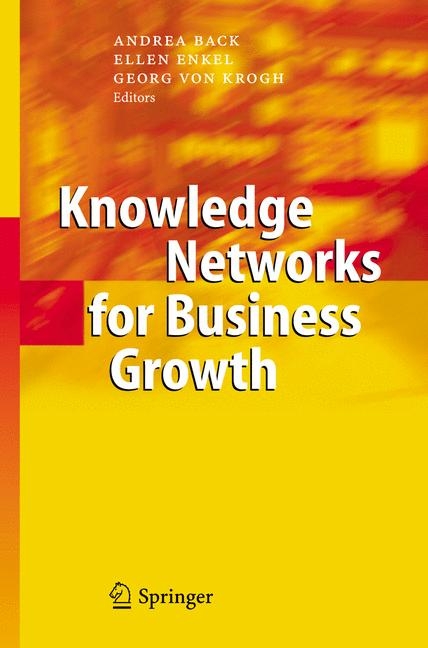
Knowledge Networks for Business Growth (eBook)
XII, 226 Seiten
Springer Berlin (Verlag)
978-3-540-33073-8 (ISBN)

The first part of this book contains three case studies which illustrate the idea of knowledge networks for growth. The step-by-step methodology of the second part shows the reader how to build up and maintain these networks. The templates in the last part of the book ease the adaptation of networks for the reader's own company or his or her specific business needs.
Preface 6
Table of Content 10
1 The Concept of Knowledge Networks for Growth 14
Abstract 14
Introduction 15
Knowledge Networking as a Strategy for Company Growth 16
Leveraging Companies’ Internal and External Growth Potentials 16
Forms of Governance for Knowledge Sharing and Integration 20
Clarifying the Concept of Intra-organizational Knowledge Networking 24
Framework for Knowledge Networks for Growth 29
Methodology 30
Knowledge Networks for Growth in Practice: Following an Internal Strategy through Innovation 31
Knowledge Networks for Growth in Practice: Following an External Strategy through M& A
General Factors to Be Adapted for Knowledge Networks for Growth 40
Discussion and Conclusion 42
2 Supporting Integration after M& A through Knowledge Networks within RWE Net
Abstract 46
Knowledge Integration after M& A in RWE Net
Conceptual Background 47
Approach Taken by the Research Project 50
Historical Background 51
The Demand for Knowledge Integration after M& A
The Development of an M& A Integration Network
Finding the Appropriate Structure for Knowledge Integration 54
Management Commitment 56
Selection of Knowledge Network Participants 58
Involvement of Knowledge Network Participants 60
Establishment of Social Ties 62
Further Development of the Knowledge Network 64
Supporting the Performance of a Knowledge Network 66
Lessons Learned 67
General Recommendations 68
3 The Customer – an Untapped Source of Innovation. Developing a Customer Integration Network in HP 72
Abstract 72
Customer Involvement in Internal Processes 73
Conceptual Background 73
The Company Background 76
HP’s Way to Customer Involvement 76
The Demand for a Customer Knowledge Network 78
Challenges Faced by the HP Support Center 78
The Approach of the Research Project 81
Addressing the Challenges of a Customer Knowledge Network 82
Overcoming Companies’ Internal Challenges 82
Delivering Facilitating Conditions 83
Initializing the Customer Knowledge Network 84
Further Development of the Customer Network 85
Supporting the Performance of the HP Customer Network 86
Lessons Learned 86
General Recommendations 87
4 Supporting Growth through Innovation Networks in Unilever 90
Abstract 90
The Launch of the Innovation Network 91
Conceptual Background 91
Company Background 93
The Need for an Innovation Network 95
Approach Taken by the Research Project 97
The Development of the Innovation Network 100
Alignment with the Company’s Vision and Corporate Strategy 101
Top Management Commitment 101
Selection and Motivation of the Network Members 102
Supportive Environmental Factors for Knowledge Processes 102
Distinct Success Factors and Barriers 103
Tasks of the Innovation Network 103
Integration of Performance Measurement 104
Organizational Tools 104
The Dynamics of Innovation Network Development 105
The Corporate Advantage of a Web of Innovation Networks – Taking a Future Perspective 106
Lessons Learned 106
General Recommendations 108
5 A Methodology for Adapting Knowledge Networks – Managerial Guidelines 112
Introduction 112
Vision and Strategy 115
Vision 115
Creating a Knowledge Vision 117
Identify Your Knowledge Strategy 119
Develop a Roadmap 121
Select a Process or Task that You Want to Support and Understand 121
Perform a Stakeholder Analysis 123
Understand the Different Types of Knowledge Needed 126
Decide on the Network Option 128
Select the Appropriate Network Reference Model 131
Identify Deliverables and Choose the Appropriate Knowledge Network 133
Set Up the Selected Network Type 136
Identify Your Specific Goals, Tasks and Activities 136
Composition of the Knowledge Board 139
Justification Process and Communication Plan 141
Facilitate Top Management Commitment and Find Sponsors 143
Facilitate the Relationships within the Network 147
Determine the Roles and Responsibilities 149
Organize the People and the Meetings 152
Organize the Specific Processes 157
Facilitate Relationships with the Outside World 169
Establish Internal Measurement 173
Choose and Organize Appropriate Rewards or Incentives 173
Methodology at a Glance: The Project Plan 175
6 Integrated Performance Measurement System for Knowledge Networks for Growth 178
Introduction 178
Discussing Selected Performance Measurement Approaches 179
Indirect Measurement Methods 180
Direct Measurement Methods 180
Balanced Scorecard (BSC) 183
Discussion of Approaches 185
The Integrated Performance Measurement System for Knowledge Networks for Growth 185
Introduction 185
External Performance Measurement 186
Internal Performance Measurement 196
Conclusion 201
7 Supporting the Adaptation – Templates 204
Interview Guidelines 204
Objective of the Interview Guidelines – General Recommendations 204
The Interview Process 205
Structure of the Interview Guidelines 205
Example of the Interview Guidelines 206
The Business Plan 207
Objective of the Business Plan 207
Preparation of the Business Plan 207
Structure of the Business Plan 208
Presentations to Convince Management 208
Objective of the Presentation to Management 208
Preparation of the Presentation to Management 209
Structure of the Presentation to Management 209
Example of the Presentation to Management 210
Kick-Off Workshop 213
Objective of the Kick-Off Workshop 213
Preparation of the Kick-Off Workshop 213
Structure of the Kick-Off Workshop 213
Outline of Communication 219
Objective of the Communication Outline 219
Structure of the Communication Outline 219
Internal Performance Measurement System 221
Objective of the Internal Performance Measurement System 221
Structure of the Internal Performance Measurement System 221
Project Plan 223
Objective of the Project Plan 223
8 References 224
9 List of Figures 232
10 List of Tables 234
11 Index 236
12 Authors 238
Prof. Dr. Andrea Back 238
Dr. Ellen Enkel 238
Dr. Grzegorz Gurgul 238
Carl-Heinrich Kruse 238
Kordula Schulte 238
Dr. Anita Pos 239
Dr. Maria Rumyantseva 239
Claudia Ulrich 239
Prof. Georg von Krogh 239
2 Supporting Integration after M&A through Knowledge Networks within RWE Net (p. 33-34)
Grzegorz Gurgul 1, Ellen Enkel1, Kordula Schulte2 and Carl-Heinrich Kruse2
1Research Center KnowledgeSource, University of St. Gallen, Switzerland
2RWE Net
Abstract
After a hundred years of market control in Germany, the electricity market is currently characterized by partial market deregulation and, consequently, the utilities have to cope with increased competition. To remain competitive, a major growth factor can be stimulated through mergers and acquisitions (M&A) that encourage synergies as well as providing access to new geographical areas. The companies RWE AG and VEW AG followed this path to growth and merged. After the merger both companies were reorganized and divided into several business units.
The challenge of a merged company is to overcome the barriers related to a merger and bring together the employees in order to formalize a knowledge transfer in the relevant strategic business fields. This process is called "Knowledge Integration after M&A". To implement the process, the company needs a comprehensive tool with which to integrate its employees’ knowledge. The goal of the project was to test the MERLIN methodology that had been established for intra-organizational knowledge networks in a new business field, adapt it for the new field of use, implement the knowledge network, and accompany it during the set-up phase.
The background to this case study describes RWE Net’s historical background and the urgency with which a formalized knowledge transfer was undertaken. Thereafter the approach – the various steps of a knowledge network setup – is described. This is followed by conclusions regarding a network’s developmental steps. The case is concluded with the lessons learned and the most important general recommendations.
Knowledge Integration after M&,A in RWE Net
Conceptual Background
Mergers and acquisitions (M&A) provide an opportunity to gain growth and are a means through which to extend a company’s workforce, internal abilities, and product range within a short time. M&A are not new phenomena, the first boom in mergers and acquisitions having occurred at the end of the 19th century. The rate at which M&A fail indicates that many problems pertaining to post-merger integration management are still unsolved, with some researchers even considering mergers and acquisitions a license to kill companies (Jansen, 2002). Acquiring and merging firms have indeed led to the discovery that the transfer and utilization of knowledge through these means can be a difficult task. This transfer and utilization of knowledge is contingent upon the successful integration of the acquired or merged unit – a process that very often fails outright. And although knowledge management has gained significance within the field of management and in academia since the nineties, it has almost no significance within the field of mergers and acquisitions.
| Erscheint lt. Verlag | 10.1.2007 |
|---|---|
| Zusatzinfo | XII, 226 p. |
| Verlagsort | Berlin |
| Sprache | englisch |
| Themenwelt | Mathematik / Informatik ► Informatik |
| Wirtschaft ► Allgemeines / Lexika | |
| Wirtschaft ► Betriebswirtschaft / Management ► Planung / Organisation | |
| Wirtschaft ► Betriebswirtschaft / Management ► Unternehmensführung / Management | |
| Schlagworte | business • Customer Integration • Innovation • knowledge management • Knowledge Networks • Management • Mergers and acquisitions • Methodology and Concept • Networks • Strategy |
| ISBN-10 | 3-540-33073-9 / 3540330739 |
| ISBN-13 | 978-3-540-33073-8 / 9783540330738 |
| Informationen gemäß Produktsicherheitsverordnung (GPSR) | |
| Haben Sie eine Frage zum Produkt? |
 PDF (Wasserzeichen)
DRM: Digitales Wasserzeichen
Dieses eBook enthält ein digitales Wasserzeichen und ist damit für Sie personalisiert. Bei einer missbräuchlichen Weitergabe des eBooks an Dritte ist eine Rückverfolgung an die Quelle möglich.
Dateiformat: PDF (Portable Document Format)
Mit einem festen Seitenlayout eignet sich die PDF besonders für Fachbücher mit Spalten, Tabellen und Abbildungen. Eine PDF kann auf fast allen Geräten angezeigt werden, ist aber für kleine Displays (Smartphone, eReader) nur eingeschränkt geeignet.
Systemvoraussetzungen:
PC/Mac: Mit einem PC oder Mac können Sie dieses eBook lesen. Sie benötigen dafür einen PDF-Viewer - z.B. den Adobe Reader oder Adobe Digital Editions.
eReader: Dieses eBook kann mit (fast) allen eBook-Readern gelesen werden. Mit dem amazon-Kindle ist es aber nicht kompatibel.
Smartphone/Tablet: Egal ob Apple oder Android, dieses eBook können Sie lesen. Sie benötigen dafür einen PDF-Viewer - z.B. die kostenlose Adobe Digital Editions-App.
Buying eBooks from abroad
For tax law reasons we can sell eBooks just within Germany and Switzerland. Regrettably we cannot fulfill eBook-orders from other countries.
aus dem Bereich